




How to Write SMART Goals: Step-by-Step Guide With Examples


Specificity is the key to effective results, whether you plan to launch a rocket to Mars or just bake a pie. In task or project management, when you set well-defined goals for your team — with clear statements, ownership, metrics, and deadlines — you create a smooth, successful workflow. The SMART concept is exactly about that.
SMART Goals — What Are They?
Have you ever been told to be smart in business, but didn’t quite understand what that really means? Many people don’t realize that SMART is actually an acronym. It brings together five important principles — one for each letter.
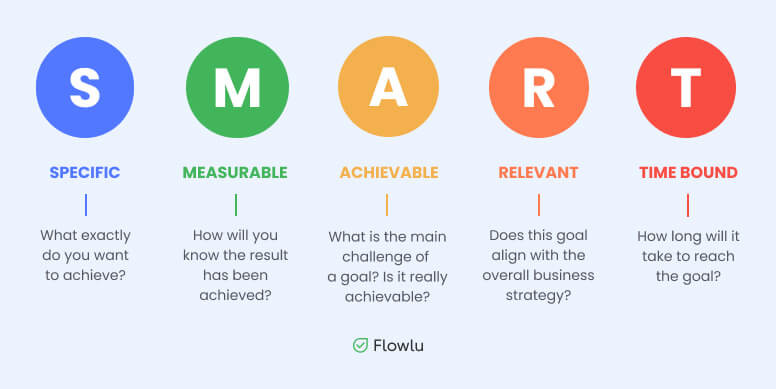
A SMART system helps define and set business or personal goals.
Clear short- and long-term smart goals enable managers to:
- forecast accurately,
- plan company activities,
- help employees understand better their responsibilities.
Sometimes people use the extended system with two more criteria which turn SMART into SMARTER. The last letters mean:
E - Ecological
R - Recorded
Companies include these criteria of smart goals to highlight that their business doesn’t cause harm to others — employees or customers. The last letter ensures that the objective is documented in writing, rather than communicated only verbally.
Why Do People Use SMART Goals for Work and Learning?
SMART goals became popular because the concept goes beyond a business framework — it shapes a way of thinking. Its universality is helpful for managing large companies, running a one-person business, personal development, coaching, or training.
The concept provides:
- Information exchange and consistency. When a team or individual knows the exact goal they are working toward, motivation improves efficiency by 20%.
- A clear understanding of success. SMART goals help establish clear criteria, eliminating vague objectives and revealing ideas that are truly worth starting.
- A plan with clear structure and terms. People better understand what they want to achieve and by when.
- Trackable indicators. SMART goals also help managers evaluate projects after completion using real numbers and determine whether the outcome was successful or not.
What Each SMART Criterion Means
Let's explain what each letter in SMART means for your business goals.
S — Specific
The main SMART concept says your goal must be specific, not general. It’s a wrong idea to state: “I want my business to be successful".
Such wording fits any business, not specifically yours. To make it more personal, add a unique vision that reflects the real challenges or perspectives of your undertakings. Tie your goal to your actual work. That’s the only way to increase chances of achieving success.
SMART goal example: “I want my business to become 25% profitable by the end of this year” — this already sounds more specific.
M — Measurable
This means you can evaluate the success or failure of a project. Goals must include an objective way to measure progress. This could be a deadline, a quantity, a percentage change, and so on.
SMART goal example: “I can consider my business successful when I achieve a stable 25% profit each year.”
A — Achievable
This doesn’t mean the goal has to be easy to achieve, but it must be realistic. In other words, you should know what resources you really can allocate to complete that goal.
How do you know if you can achieve the goals?
If you come up with a commercial idea, ask yourself if the objective corresponds to the project’s scope. In case of personal goals planning, use time-management techniques such as resource, time, and skill analysis.
Sometimes you may feel you set an unrealistic goal. But if you’ll see it from a different perspective, it might simply be ambitious. How to know what category your goal belongs to?

Imagine you’ve been learning a foreign language for about six months. You decided to set a goal to speak it fluently within a year. Is it ambitious or unrealistic? To decide, first analyze your actual progress.
Your goal is unrealistic: After a half of a year studying, you only know a few topics, mix up grammar rules, and can’t form complete sentences.
Your goal is ambitious: Finishing this short period of learning, you can use grammar rules correctly and easily combine both memorized and new words into phrases and sentences.
Another example: As a manager you need to create an action plan for your team. To decide what result you want to see, first, review recent performance statistics or KPI. Then compare data with previous periods. Think, is there a point in raising the bar if past results show the team is barely meeting its targets?
R — Relevant
This criterion is closely connected to the previous one. Relevant means the goals align with the real — not ideal — state of affairs. Some people sacrifice relevance in pursuit of ambition.
Returning to management as an example: You want your sales reps to double the number of cold calls they make per day. It sounds ambitious, but in practice, it would require them to work at least two extra hours daily.
Achievable? Yes.
Relevant? No.
Although the goal is technically achievable, it conflicts with existing workloads and working hours, making it impractical in the current context.
T — Time-Bound
The final letter emphasizes how important it’s to set clear timeframes. Without defined deadlines or milestone checkpoints, any project’s completion can stretch indefinitely. It also becomes difficult to track progress or plan the next steps. So, pay attention your SMART goals have a strict durability in hours, days, weeks or months.
Optional SMARTER criteria
E — Ecological
Environmental friendliness means you maintain good relationships with people, companies, and the world. SMARTER goals include respect for nature, but honesty, integrity, and avoiding harm are equally important.
R — Recorded
Every plan, decision, or task should be documented. Written goals and instructions are always more effective and reliable than verbal ones.
How to Write SMART Goals
You’re inspired by the potential of SMART goals and want to apply them in practice. How do you get started? Imagine you already have a draft of your goal. To make it SMART, prepare a checklist and follow these steps using clarifying questions:
Step 1. What Do You Need to Improve?
What kind of result do you want to achieve? What are the initial data, why don't they suit you? How much bigger or better should the result be?
Step 2. What Do You Need It For?
Who is interested in this improvement? Maybe it’s your personal goal, or the company’s one? What benefits will it bring immediately after the achievement, in a month, in a year? What will be the next step?
Step 3. Where Are the Limits?
How can you measure the result? How will you know when goals are completed? What calculations or metrics should be used to evaluate? Who will check the result of your SMART goals?
Step 4. What Do I Have?
Are there enough resources for improvement? Which resources need to be increased to achieve the desired result? Are there examples of similar successes among competitors? What conditions could create obstacles, and how can they be prevented?
Step 5. By When Do You Need It?
To answer this question, take into account all initial data, resources, and efforts. How long will it take to achieve the goals in this context? Does this task fit into the company’s long-term planning? How much time can you allocate to achieving the goals?
Visualize all the steps of progress with automation tools like a Gantt Chart or a Kanban Board. You can use them as standalone applications or find it in comprehensive work management solutions, such as Flowlu.

Example of SMART Goals for Work
Let’s imagine a textile manufacturing organization. It sells products in the U.S. market, with delivery handled by mail. The chief set a long-term SMART goal for the team — to expand the business internationally. The reality is that the company has production facilities and established contacts, but there isn’t a suitable transportation network.
S: What needs to be improved?
— The logistics system. The company wants to send products through an international delivery network.
M: How will goal achievement be measured?
— By terms of completion. The goal will be considered achieved if a test batch completes the entire logistics chain within two weeks.
A: How does the company achieve this goal?
— With a partnership. A contract is under discussion with the shipping company, and a test batch of goods is ready for shipment.
R: Why is the goal important?
— To launch exports. The company aims to increase trade turnover and enter new markets.
T: What are the terms?
— Four weeks. The logistics system must be fully set up this month, as obligations with the international customer begin on the 1st of next month.
Why is This Goal SMART?
- it’s concrete and clearly defined;
- achievement can be measured;
- the company has a realistic chance of success;
- the goal is relevant to the company’s strategy;
- it has a strict deadline.
How to Write SMART Goals for Different Situations
Use the templates to write goals in smart format for any situation.
For Teams
SMART goals setting is an effective solution to manage team productivity. It provides clarity, motivation, and transparency, and helps the staff focus on real, measurable results.
When you set SMART goals for a large group of employees, remember that responsibility is usually shared. Success of completion depends on clear communication and cross-team collaboration. Also, focus on collective metrics rather than personal KPIs, for example, on project completion or client satisfaction. Motivation comes from collective success.

Example of SMART goals for a development team:
- S: Reduce the download time of the main catalog page by 50%.
- M: Track the download speed to ensure it reaches 2 seconds, down from 4 seconds.
- A: Conduct audits, implement optimizations, and involve testers to verify the work.
- R: The goal aligns with the overall retention strategy.
- T: Complete the task within one month.
For Individuals
These SMART goals focus on one person’s tasks, performance, or development. Therefore, the responsibility also lies with that individual. Goals for one person usually take less time to complete, require fewer resources, and are directly tied to the person’s role and KPIs. The most effective motivation here is recognition or career advancement.
Example of SMART goals for sales rep:
- S: Increase my monthly sales by 10%.
- M: Sell at least 5 products per day.
- A: My current client base and sales capacity are growing.
- R: This improvement is part of the audience expansion strategy.
- T: Achieve this by the 25th of next month.
For Managers
Managerial SMART goals fall between team and individual ones. On one hand, a manager has personal responsibility for achieving the objective. But on the other hand, the goals must consider overall team productivity and available resources.
Motivation should address both the manager’s personal interests and the team’s performance, taking into account the company’s overall development KPIs as well as the manager’s individual achievements.
Example of SMART goals for a project manager:
- S: Ensure the on-time delivery of the new software release.
- M: Track the progress of all project milestones and maintain team task completion at no less than 80%.
- A: Allocate resources, coordinate team members, resolve difficulties.
- R: This goal aligns with the company’s product launch strategy.
- T: Achieve project delivery within the next 3 months.
Common Mistakes and How to Avoid Them
When you write out smart goals at first, it’s easy to make common pitfalls.
You Don’t Adapt the Goals to Unexpected Changes
It’s great when you clearly understand how to tackle a specific challenge and carefully track your progress. However, situations sometimes change faster than the goal can be completed.
Solution: From the beginning, allow flexibility in your SMART goals and plan actions in advance in case metrics, results, or assignees change.
You Don’t Have a Clear Idea of How Success Will be Measured
Sometimes it’s difficult to define outcomes in numbers. But without clear measurements, it’s impossible to track progress. This issue is especially common in creative fields.
Solution: If you can’t express results of goals in percentages or numbers, use visual benchmarks or detailed written descriptions.
You Don’t Want to Give up Ambitious Plans
As mentioned earlier, overly ambitious goals often lead to burnout and demotivation instead of strong results.
Solution: Analyze real data and review past metrics to adjust the “achievable” part of the goal. If you don’t want to reduce ambition, consider adding more resources.
You Set Too Many SMART Goals
Focusing on quantity rather than quality blurs priorities and distracts from the most important problems. This can negatively affect overall business development.
Solution: Use SMART goals to improve a few high-impact processes. Even if they require more time, they will lead to stronger and more meaningful results.
You Don’t Track the Progress
Even if you know how to write good SMART goals, you won’t achieve the desired results without monitoring every step of execution.
Solution: Use digital tools to track employee activity and progress across specific workflows. For example, Flowlu offers users task and project management tools with the flexibility of Agile methodology.
Bottom Line
SMART goals are a powerful way to boost individual or team productivity. Clear tasks with measurable results and defined deadlines help create a well-organized workflow.
Companies and solo workers implement SMART goals in their processes because the method is:
- universal;
- easy to remember and simple to implement;
- proven effective;
- free from the need for advanced skills or complex tools.
To achieve better results, combine the advantages of the SMART goals conception with modern digital solutions. Visualize workflows, track projects, monitor milestones, control opportunities, communicate with staff and customers in one place, and automate routine tasks. Try these and more in Flowlu to create a well-organized, easy-to-manage workflow.

Although SMART is valuable for its universality, it works poorly for creative or research-based work — for example, for writers, artists, advertisers, and journalists. Creative results of goals are often subjective and cannot be evaluated unambiguously using strict metrics.
SMART works better for long-term development strategies. However, it should not be applied to processes that require a very long time to complete as a single goal. A more effective approach is to break a large, global challenge into several smaller goals.
- Set up daily, weekly, or monthly checklists to track interim results.
- Use specialized software, such as a CRM, that provides tools for task and project management.
- Ask employees to create short reports after completing each milestone.