


Best Sales Funnel Examples in 2026: Real-World Cases
- What Is a Sales Funnel and Why Do You Need One?
- Sales Funnel Stages Examples
- B2B Sales Funnel Examples
- Ecommerce Sales Funnel Examples
- Sales Funnel Landing Page Examples
- Sales Funnel Dashboard Examples
- Sales Funnel Website Examples
- How to Build and Optimize Your Sales Funnel with Flowlu
- Take the Best Practice to Boost Conversion

Sometimes we think our sales strategy is perfect, but in reality, the data paints a different picture. In our race to success, we often forget a simple truth—It is not we who dictate; clients follow the journey that is most convenient for them. What purpose does the conversion system serve here?
In our guide, we show you why it’s important to create clear stages of the customer process. Also, we share real-world practices to deliver insights for each step. These help you learn how to build a simple system that actually works.
What Is a Sales Funnel and Why Do You Need One?
This is simply the path a person takes from first discovering your product to becoming a customer.
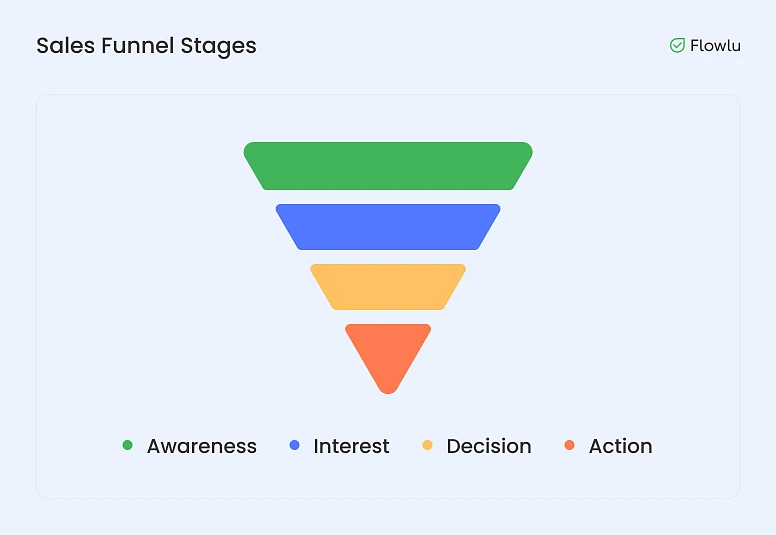
This framework has a beginning, middle, and end. More specifically, it includes Awareness, Interest, Decision, and Action—though the stages can vary or be defined differently. Some models also include Consideration, Purchase, and Retention.
This is usually depicted as a progression from wide interest to a smaller group of buyers.
How a Well-Defined Funnel Boosts Conversion
When you work properly on each stage, you start to see the results:
- The client experience becomes more predictable
- You know the right moment to deliver your message
- Analytics reveal the exact places where prospects drop off
- It becomes easier to create personalized offers
This way, strong conversion comes from a smooth interaction through each step, lower loss of prospects, and increased engagement.
Sales Funnel Stages Examples
The classical division of this tool includes four stages:
Top of Funnel, or TOFU
The upper and widest part is responsible for attracting prospects.
At this stage, marketers aim to make more people aware of your company. To achieve this, they use:
-
Posts across online channels
Look how this organic products company created such posts to reach a wider audience and introduce the products they offer.
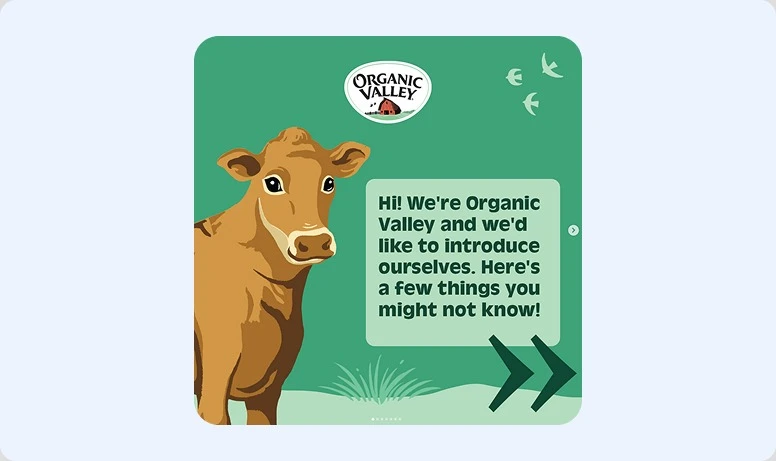
This approach works well because the content acts as a “welcome message,” making it especially effective for people who are not yet familiar with your product or service.
-
Collaboration with influencers
Today, it’s a trend to collaborate not only with well-known bloggers but also with virtual influencers, who are represented in areas like fashion, IT, sports, human rights, and ecology projects. Look at Lu do Magalu for Magazine Luiza.
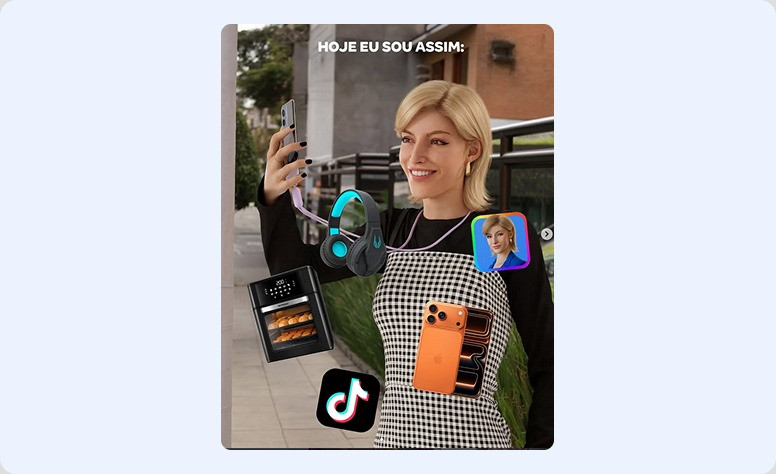
Although she is a virtual character, she is placed in realistic, everyday settings. This makes her visually unique while still relatable to real customers.
-
Ads on social media
You see them in your feed every day.
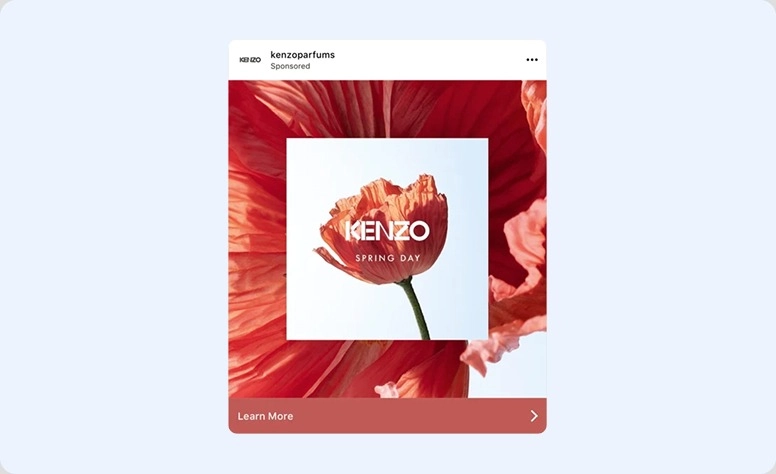
The image is simple, with bright yet pleasant colors associated with spring and floral freshness. This creates a positive emotional response and encourages users to learn more about the seasonal offers.
-
Google (or any other search engine) ads
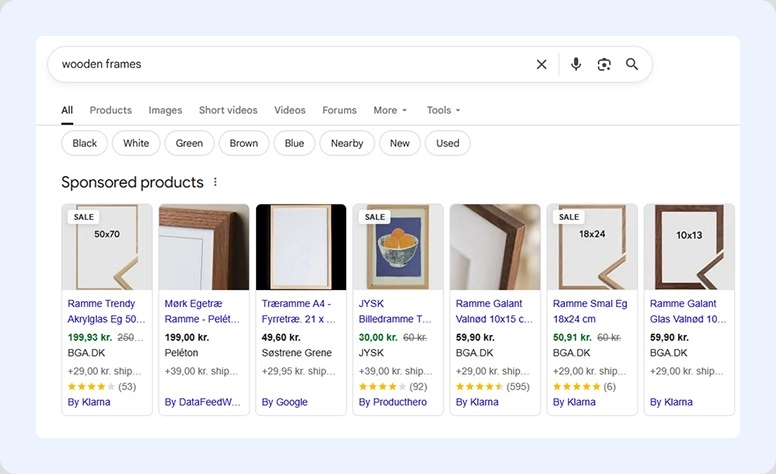
You see them when you search for products or services on your search system.
-
SEO content marketing through blogs
You can write articles with useful cases, tell the people your expert advice, and offer your help like Super Bright LEDs in their article “How to Adjust Your Headlights.”
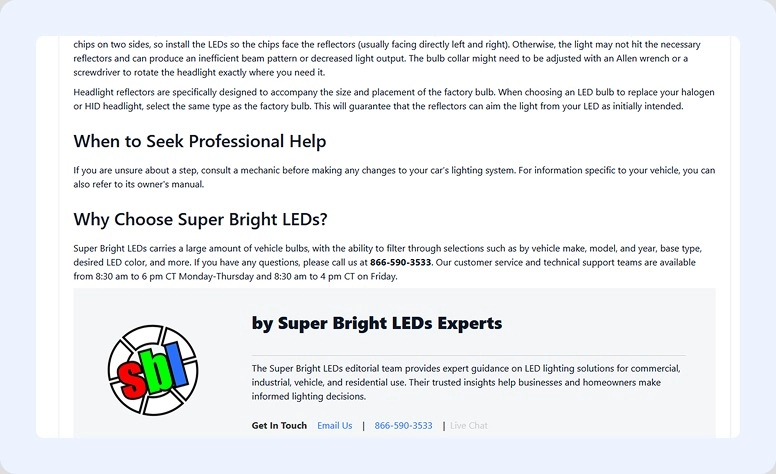
The product is integrated naturally at the end of the guide. After reading the article, users receive actionable advice, which demonstrates the brand’s expertise and encourages them to try the service.
Middle of Funnel, or MOFU
On this stage, your main goal is to nurture potential customers. People already realize they’re interested in how your solution can solve their problem.
Ideally, here you aim to capture visitors' contact data: phone number, profile link, or other contact information.
To do this, you may use:
-
Quick tests to clarify users’ needs.
Explore how Colgate offers a quiz to learn more about people’s oral care routines. When you finish it, they ask you to enter your email to receive the result.
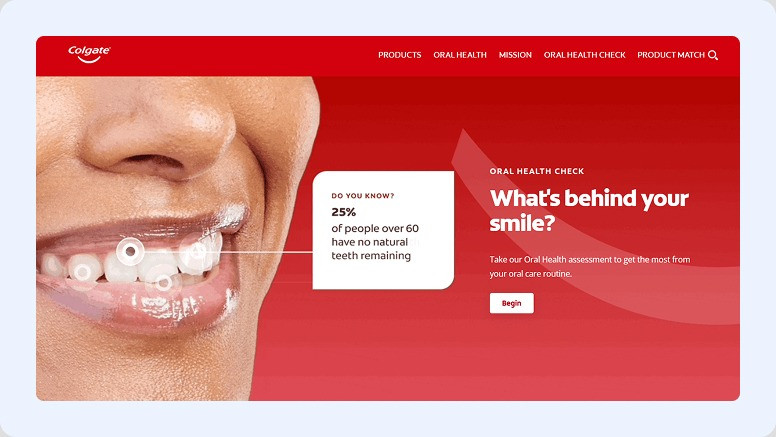
This approach allows the company to grow its database with new users who can later be nurtured into potential buyers.
-
Comparison with similar services or products
See how Flowlu adds a price comparison on its main page, so people can choose what budget they need depending on their team size.
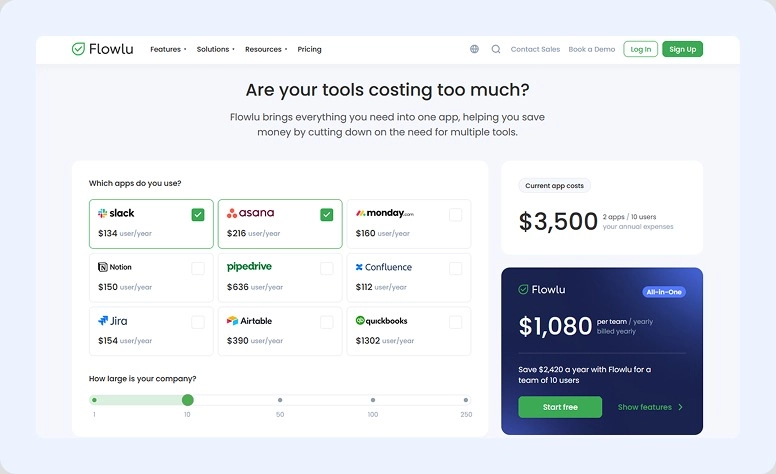
This type of table offers a quick and convenient way to compare options at a glance. It also builds trust by presenting pricing transparently, showing that the company prioritizes user comfort.
-
Sale coupons
Offer your visitors a discount in exchange for their contact details.
The beauty industry frequently uses this method to encourage new clients to start using their services or products immediately after visiting the site.
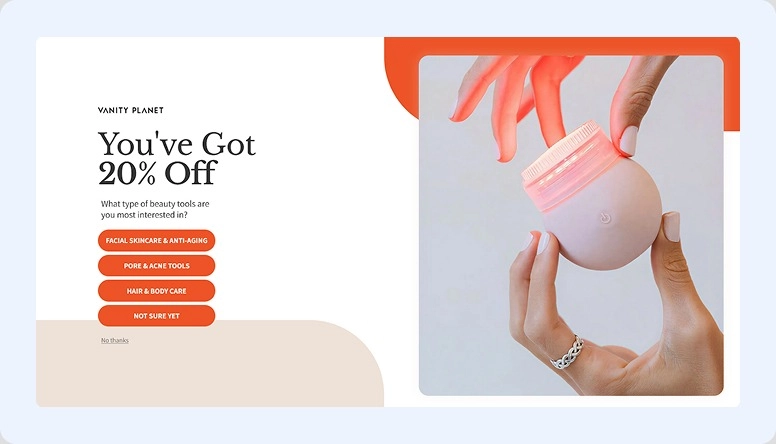
This approach works because it provides an immediate incentive. In addition, it offers multiple options allowing users to choose the most suitable one.
Bottom of Funnel, or BOFU
The place for closing deals. At this stage, customers are about to complete the target action, so they need something to give them more determination.
Such a final conviction is presented in the form of a CTA—Call to Action. Usually, it’s a button with different text.
It may include “Buy now,” “Add to cart,” “Start free trial,” “Shop now,” “Get a demo,” and more.
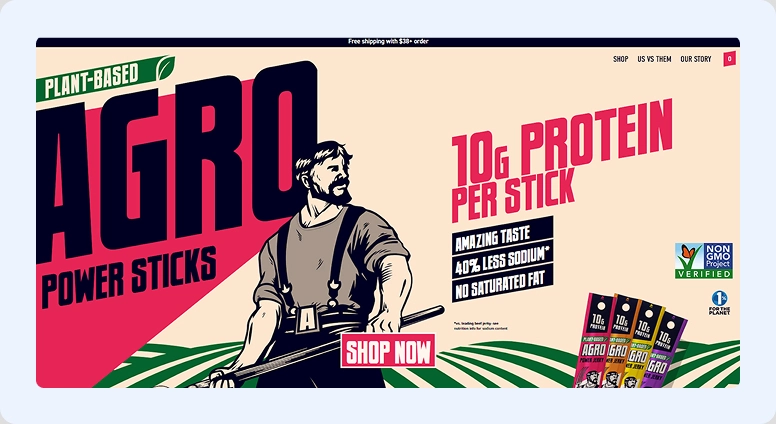
Look at the powerful and stylish CTA of this food website. It is simple and clear, yet stands out from other elements on the page, naturally drawing users’ attention.
Post-Purchase: Retention and Loyalty
The interaction with clients doesn’t end with the purchase. To turn first-time buyers into close friends of your brand, you have to prepare a full strategy.
And although retention is a separate topic for an article, or even a book, let’s see what actions help you make your audience return to you again:
- Follow-up messages
- Newsletters about new items and discounts
- Exclusive sales options, like loyalty programs or personalized offers
- Rewards for achievements—for first purchase, a certain number of orders, positive feedback, etc.
Consider all the steps separately. Ideally, hire a specialist who will be in charge of marketing campaigns at each stage. But if you’re ready to do it on your own or with a small team, use special tools for help.
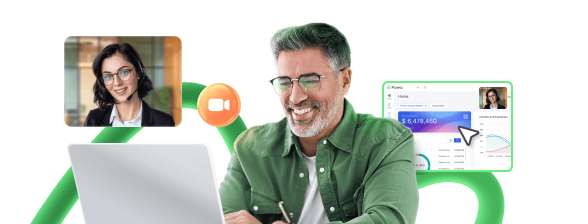
With Flowlu, you can visualize and track your sales operations to see what needs to be improved.
B2B Sales Funnel Examples
Now, let’s get more specific and look at practical ways to work with potential customers in B2B.
Content
When you want to attract potential customers in this area, you should start with content.
Companies use different formats:
- Posts on community platforms
- Articles in blogs
- Guides in knowledge bases
- Videos on YouTube.
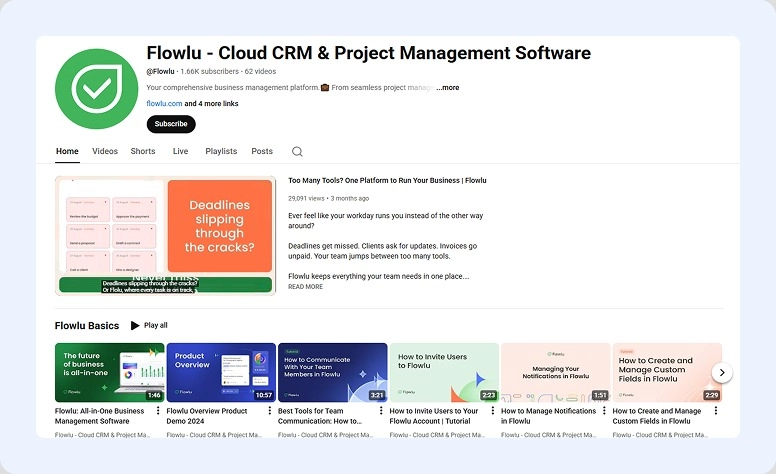
See how Flowlu did it. They created YouTube videos to help users better understand the system and solve issues without contacting technical support.
Creating all this content follows a general aim—to provide users with useful materials that address pain points and offer real advice. Ideally, all the information should gently lead to the idea that your product or service is the perfect solution to a user's specific challenges.
Webinars
In general, video content now is much more popular than imagery in the media space.
Use it in your strategy and try proven methods to engage people—start a webinar.
This format not only showcases your expertise, it also provides you with new contacts that can be nurtured in the future as loyal customers or even partners.
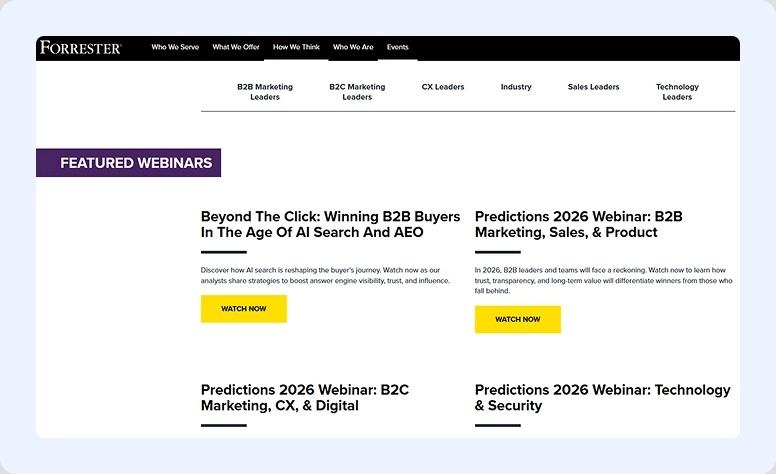
Forrester runs webinars covering effective marketing strategies in the context of AI and emerging technologies. You can watch this material whenever you want or also learn about upcoming releases.
Email Nurturing
Managers get down to this method after interested prospects are captured. This strategy involves sending messages to build a relationship with prospects, educate them, and eventually guide them toward conversion.
Let’s see the possible sequence of nurturing for B2B prospects:
1. Welcome
“Welcome to [Company] - Here’s how we can help solve your [specific pain point].”
2. Education
“Here’s our guide on improving [specific task] with [product/solution].”
3. Product Insight
“See how [Product] reduces [pain point] in 3 simple steps.”
4. Case study
“How [Company X] increased productivity by 50% using [Product Name].”
5. Sales-Driven
“Ready to see [Product Name] in action? Schedule your free demo today!”
Ecommerce Sales Funnel Examples
The ecommerce industry has the same goal—walk potential buyers to purchase. But they do it a little differently. Let’s see how they reach high conversion in practice.
From Website Visit to Purchase
Most online clothing stores use the following tactics—they first attract visitors through Instagram ads.
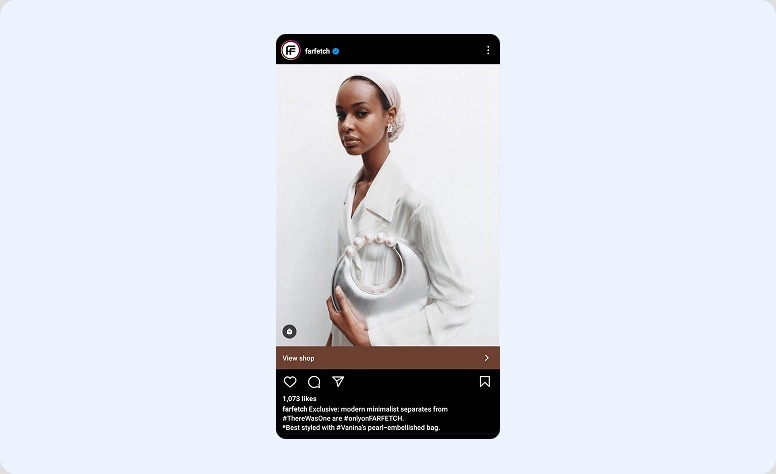
Drawn in by attractive outlooks, people land on a product page. Here they browse items, and also may receive a limited-time discount popup.
Abandoned Cart Recovery Strategies
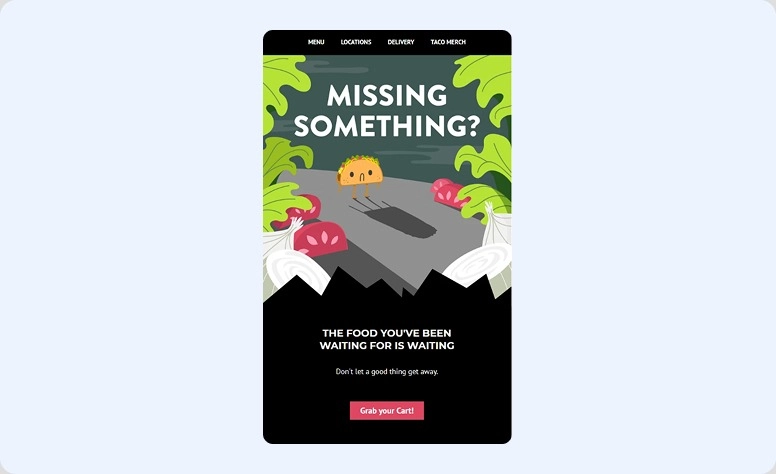
This method comes into play when a customer leaves items in their cart and doesn’t take any action for a while.
The system works as follows: the store sends a follow-up message with a reminder and a small discount. This encourages users to return and complete their purchase.
See how creative Taco Bell was. Their approach appeals to the emotions associated with abandoning a cart. By showing “sad” products, they create a sense of guilt and remind users about their unfinished purchase. This encourages them to return and complete it.
Upselling and Cross-Selling Techniques
We are sure you have encountered this tactic before.
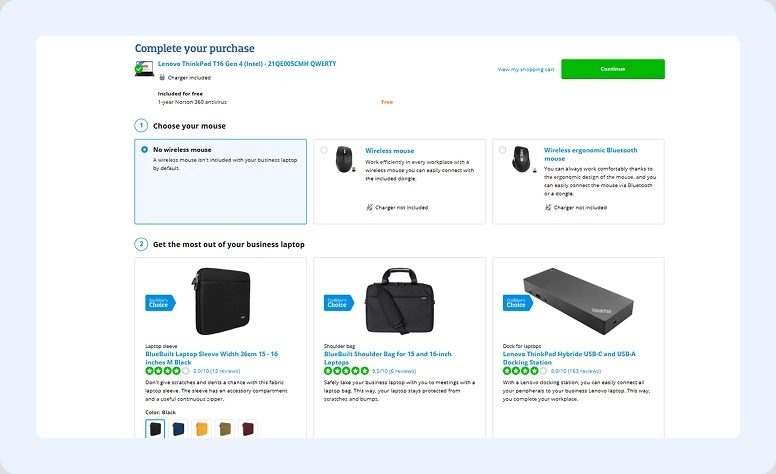
Let’s imagine that you visit an electronics website looking for a laptop. Eventually, you choose one and add it to your cart. The algorithm anticipates your needs and suggests additional items, such as a laptop bag or a mouse.
If your choice is based on specific characteristics, such as hard drive capacity or the absence of a camera, websites provide relevant recommendations.
Look how Coolblue uses this approach in their online store.
Sales Funnel Landing Page Examples
Let’s see what companies design their sites with a clear understanding of their visitors' actions.
Key Elements of High-Converting Landing Pages
From a design perspective, the perfect page should take into account the behavioral psychology of visitors: where they look in the first seconds, what they are likely to click on, and which information attracts their attention first.
All these peculiarities make specialist select following obligatory elements:
- Clear headline
- Strong core offer
- Engaging visuals
- Prominent CTA (primary and secondary)
See how Webflow keeps it simple yet effective. Visitors find this resource convenient and easy to use for sure. Moreover, in this way, the creators clearly demonstrate their expertise as website builders.
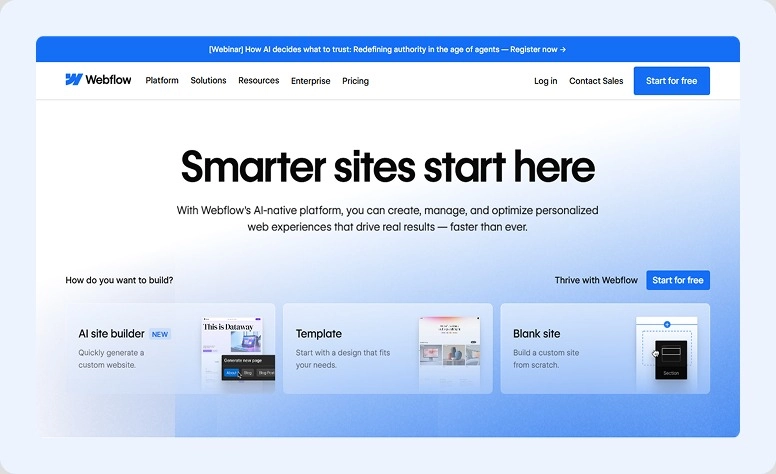
Also note how they announce a webinar.
Lead Magnets and Opt-In Forms
These are the “hooks” of your website—forms specifically designed to collect visitor information.
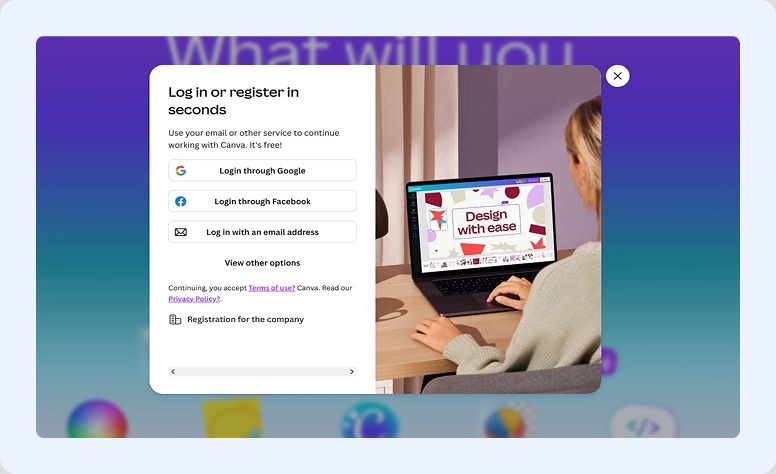
Canva demonstrates this perfectly. To access their high-quality free templates, the system uses an opt-in form that asks visitors to create an account.
A/B Testing for Better Performance
This method is also known as split testing.
It helps specialists compare two versions of a digital asset—site, or ad campaign—and see what works best.
Let’s see the algorithm:
Imagine you create a luxury watch shop landing page. You want people to click the button “Buy now” more.
- Create the variants. Designers offer the original page (Version A) and also create a modified one (Version B).
- Isolate one variable. You change only one specific element. Imagine that in A, you color the button black and gold, but in B, it's a high-contrast bright red.
- Split the traffic. Show A to 50% of your visitors and B to the other 50% at the same time.
- Analyze the reaction. Track which button color provoked more clicks or completed purchases.
Why it matters:
Instead of "feeling" like a red button is better, you have data proving that it actually increased your conversions.
Sales Funnel Dashboard Examples
Dashboards are visual instruments that allow people to estimate progress at first sight. Almost every project management platform incorporates this tool in their functionality as a basic feature.
Visualizing Your Funnel with Flowlu
In Flowlu, the sales dashboard allows managers to track the key stages of an opportunity’s lifecycle: New, Qualification, Proposal, Negotiation, Final Review, and Won. You may add more or stay only 4 essential—all depending on your specific business deals.
Whatever stages you create, the dashboard displays:
- The number of active opportunities
- Potential revenue
- Stage duration (how long deals stay in that phase)
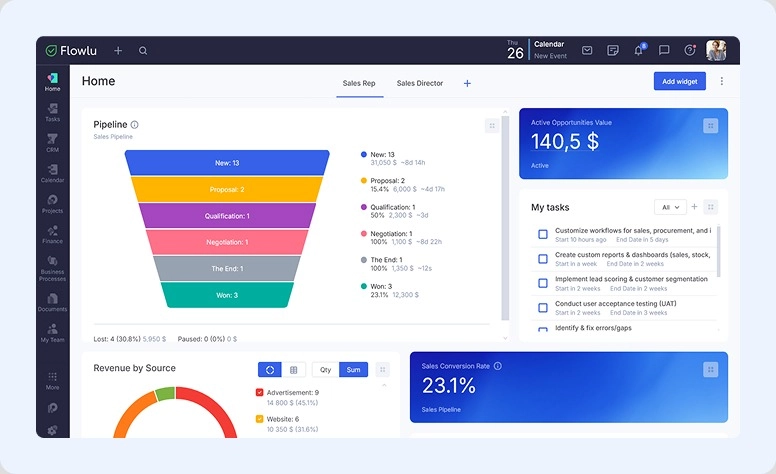
Flowlu can also analyze your sales and finances as soon as you plug it in. As a result, you’ll get reports on the efficiency of each stage of lead-to-customer processes to refine your team’s process and stop losing potential customers.
Key Metrics to Track at Each Stage
The effectiveness of each step should be measured by concrete data.
Awareness
Here you want to know how successfully people are discovering your product.
Study the numbers of:
- Website traffic: how many visitors open your resource.
- Reach: how often your content was seen.
- Social media growth: how many new followers you got, or mentions you had across different platforms.
- Brand search value: what number of people typing the name of your company into search engines.
Interest
You need to explore what percentage of visitors want to study your product further.
Look at data:
- CTR, or click-through rate: this shows the amount of those who click on your ad.
- LGR, or lead generation rate: how many visitors traded their digital address for a "Lead Magnet" (like in our Canva example).
- Content Engagement: this is the time people spend watching your videos or reading text.
- Email Open Rates: are people actually opening the newsletters they signed up for?
Decision
Find out who is considering buying your product.
Explore stats:
- MQL to SQL Conversion: how many marketing leads go to sales qualified.
- Demo or Trial Sign-ups: who request to learn and test products personally.
- Visit of Page with Pricing: if people see this, that means they are close to choosing.
- Shopping Cart Abandonment: for e-commerce, it’s important to find out if people often add products but don’t check out.
Action
Here, you need to estimate final conversation and revenue.
Metrics to explore:
- Conversion Rate: the amount of prospects that turn into paying customers.
- CAC, or Customer Acquisition Cost: how much money you spent to get each new client.
- Average Deal Value: amount of money earned per transaction.
- Sales Cycle Length: days your team spent to make a person go from "Awareness" to "Action".
Don’t stop on these 4 stages. Continue tracking data at the next step—Retention. Here you may calculate CLV (Customer Lifetime Value). To work with this stat easily, use our free CLV Calculator.
Sales Funnel Website Examples
A high-converting web resource is not just a beautiful picture. It’s a well-designed digital assistant that, through its elements, walks visitors toward a goal. But what makes them the best?
How Leading Companies Structure Their Sites
Top companies don’t ask for a sale right on their homepage. They walk you toward the action very carefully, without a pushy tone.
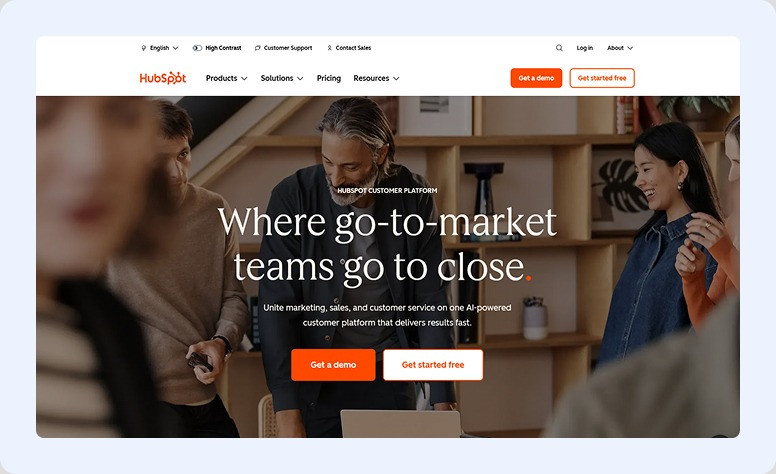
Look at how HubSpot does it:
- Above the Fold: You see a clear headline with a primary CTA.
- Social Proof: A list of partners and user statistics.
- Feature Deep-Dive: As you scroll, you learn about the main features.
- Trust Signals: The next block shows case studies and awards.
- The “Safety Net”: At the bottom, there is one more low-friction CTA.
Integrating Funnels with CRM and Email Marketing
The real power of this tool lies in what happens after the click. By integrating your website with a CRM or a comprehensive platform like Flowlu, you create a seamless data loop.
How it works in most CRMs:
-
Lead Capture: The platform collects interested visitors directly from your site.
-
Automated Entry: The system automatically creates new opportunities using the contact information the client shared.
-
Instant Nurturing: The person receives a “welcome” message customized for that specific magnet.
Mobile Optimization for Funnel Success
Did you know that over 50% of B2B queries now come from mobile devices rather than desktops? This means you must ensure your resource provides a convenient user experience.
What to check:
- CTAs: They should be easy to tap so people don’t need to zoom in.
- Loading Speed: No one likes waiting more than 2–3 seconds for a site to open.
- Forms: Typing is difficult on a smartphone, so make registration forms work with “one-tap” sign-ins or ready-made templates.
How to Build and Optimize Your Sales Funnel with Flowlu
To manage all these stages, you need a tool. We’ve already said you can create your own representation of the customer experience with Flowlu. Let’s see it in detail.
CRM Integration for Lead Tracking
In Flowlu you can bring in interested people and create opportunities through 4 channels:
- Calls in Flowly (with the help of the IP telephony module)
- From emails
- Your site webforms
- From other software through AP
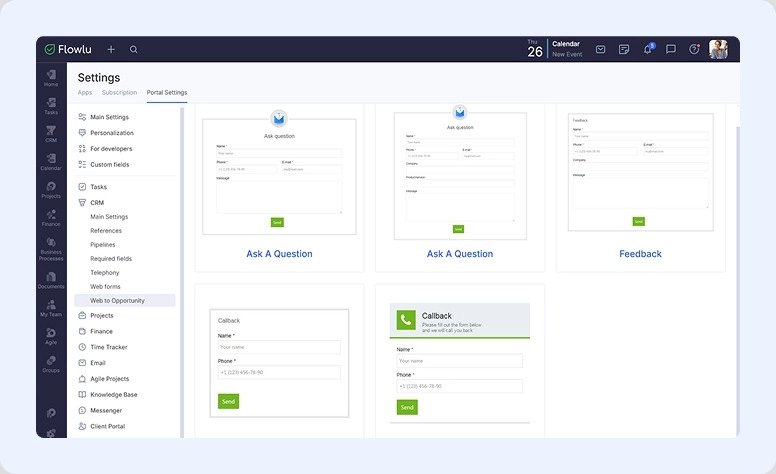
To install Web Forms on your website and make the system create opportunity from leads’ requests, just open Portal Settings → CRM → Web to Opportunity. Choose one you like most and fill it with necessary information.
Automating Follow-Ups and Email Sequences
In Flowlu, you can set up automations that trigger whenever an opportunity moves to a specific stage on the clients journey. To do that, you need to have the installed email module and at least one connected inbox to set up automations.
From here you can create templates and manage them.
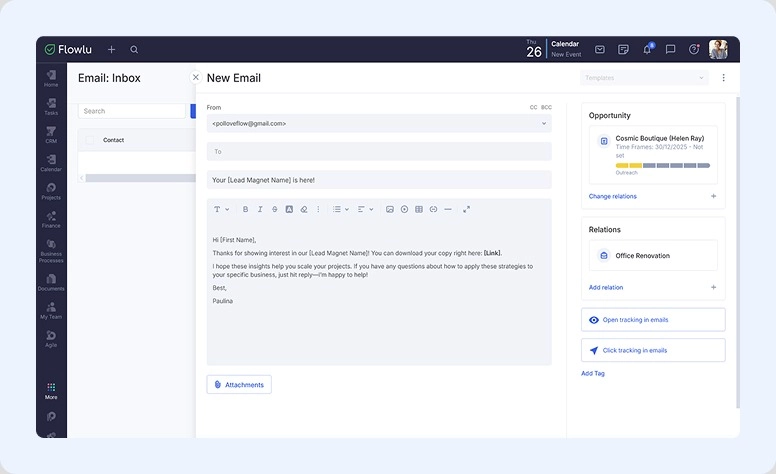
Set up smart follow-ups for "stuck" deals. If the "Proposal" stage lasts more than 4 days without any activity, Flowlu can automatically send a "Still Interested?" email.
Take the Best Practice to Boost Conversion
Within our comprehensive review, we have gathered the best ideas and b2b sales funnel examples to inspire your next move.
Keep in mind that behind every high-converting element—whether it's a video, a post, or a polished landing page—lies a strategic effort. Every step should be organized logically and designed to solve a specific problem for your audience. Only with a clear strategy can you generate high-quality leads that convert into loyal buyers and drive sustainable revenue.
To move away from guesswork and toward an approach based on firm data and honest statistics, always leverage digital tools. Flowlu is a reliable partner for your marketing and sales strategy. From capturing prospects to converting them into long-term customers, Flowlu ensures the interaction is convenient and transparent for both your team and your brand advocates.
The main difference lies in the primary driver: e-commerce emphasis on emotion and desire, and b2b on logic and ROI.
Most buying journeys are categorized into three primary stages:
- TOFU — Awareness
- MOFU — Interest & Consideration
- BOFU — Decision & Action
Many modern strategies also include a 4th stage: Post-Purchase (Retention & Loyalty).
A dashboard tracks all changes in real time, providing clear visibility into the statistics of each stage. This allows managers to make data-driven decisions quickly and optimize marketing strategies in the short term to prevent potential customer loss and maximize revenue.
- No clear CTA
- Trying to sell too early
- No lead capture in MOFU
- No follow-up
Specialist select following obligatory elements:
- Clear headline
- Strong core offer
- Engaging visuals
- Prominent CTA (primary and secondary)