




Branding for Freelancers: Step‑by‑Step Strategies to Stand Out

- What Is Personal Branding for Freelancers?
- Why Personal Branding Is Important for Freelancers
- Key Elements of Effective Branding for Freelancers
- How to Build a Personal Brand as a Freelancer — Step‑by‑Step
- Strategies to Promote Freelance Brands and Attract More Clients
- 6 Personal Branding Tips for Freelancers
- Common Personal Branding Mistakes Freelancers Make
- Your Brand Is Your Mission

Personal branding for freelancers in today's world isn't just a modern trend but a competitive advantage. But for many solopreneurs, building their own brand is associated with a huge amount of work in areas they’re not experts in. Creating a design, maintaining social media profiles, or writing content sounds nearly impossible for one person—especially someone who crafts furniture, for example.
In this article, we explain why building a strong personal brand is profitable and how to do it without trying to be a jack of all trades, master of none.
What Is Personal Branding for Freelancers?
To build a personal brand is, in essence, to create your own company. One small difference—the only workforce here is you. But that’s also a major advantage. All the accolades will be yours alone.

Personal branding is a purposeful practice of promoting your skills, unique vision, and the value of what you do for others.
Your freelance brand determines how people see you. That’s why it’s critical to offer an honest experience and put a piece of your soul into your work. Only in this way will people appreciate what you do and want to buy the service or product you produce.
Why Personal Branding Is Important for Freelancers
We’ll give you three reasons that will persuade you to start considering building your own brand right now. Branding helps you to:
#1. Stand Out From Competitors and Be Easy to Find
Customers remember things that create a strong, vivid image. The next time people realize they need a dog training course, handmade clothing, or a consulting service, your personal brand will come to mind first.
Let’s look at real examples for inspiration.
When people search for a freelance graphic designer, they often come across Scott Luscombe’s bold profile. Companies looking for experienced marketing copywriters are very likely to choose Kathy Edens. Require a software consultant or developer? Paul Hunking knows his craft best. All of these professionals are great examples of freelancers who built personal brands from scratch and became well-known figures in their industries. You can explore their LinkedIn profiles for inspiration.
There are countless examples like this. Just imagine that by building a well-developed personal brand, you can make people associate a specific service or product with you.
#2. Boost Reputation and Build Long-Term Relationships with Clients
A professional approach to work, a clear communication style, proven experience, and even your problem-solving strategy create a strong image of your business. Reflect all of this in your brand. When people recognize these unique qualities, you become visible in your industry and irreplaceable to clients over time.
#3. Charge Higher Prices for Your Services
Let’s be honest—business is about revenue. A strong brand showcases your expertise and experience, which justifies higher rates. And trust us, people won’t hesitate to pay more.
Key Elements of Effective Branding for Freelancers
Personal brand building includes five fundamental “bricks.”
Niche and Positioning
Your niche is connected to the services you’re ready to offer to your audience. These are based on your skills. Analyze what you can and can’t do, and take your real interests into account. Thereafter, check whether the proposed products or services are in demand in the market.
Clear steps to formulate your position:
- Explore the market — this helps you understand where your skills are useful.
- Identify your target audience — this allows you to create a general profile of your customer and understand better their needs.
- Study your competitors — their experience gives you more insights and ideas.
- Find your uniqueness — think about what makes you different from others in the same niche.
Brand Name vs. Personal Name
A popular saying, “As you name the boat, so shall it float,” applies to business, too. Let your “boat” name be:
- Easy to read and remember
- Reflective of your work
- Unique and creative
- Evoking positive associations
- Legally available
- Malleable for future business changes
In a naming strategy, people often ask if it’s better to name a company after a creator’s name or think of something different.
Some startup experts recommend using a personal name if your business focuses on coaching or workshops because it builds trust and associations with your future courses.
But in general, the best advantage of starting a business with your name is that it’s more likely to be unique. So it’ll be easier for you to register a domain for a future website, for example.
Most users say there is no difference, and you can name your brand whatever you want. The main thing is that it meets the list of requirements above.
Visual Identity: Logo, Colors, Style
Your visual identity + your brand’s name creates a powerful image that sticks in people’s minds.
Start with a color palette. If you’re not sure what to choose, explore your competitors' design elements.
Certain colors are often associated with specific industries.
For example: red and yellow for food, grey and orange for technologies, green for finance and insurance, and blue for medicine or IT solutions.

Of course, there aren’t strict rules, but using familiar patterns in personal branding helps freelancers to tie their business to the right associations and make it easy to recognize.
Brand Voice and Bio
Brand voice means how you’re going to communicate with your audience. To choose the right one, you need to know your buyers very well—their average age, profession, hobbies, and buying power.
Use an informal style if you want your clients to see you as a friend. This allows for jokes, slang, or even sarcasm. An informal tone of voice works best for younger audiences and smaller communities in creative fields, sports organizations, or pet-related niches.
A formal style leaves little room for casual liberties. Use it if you want people to see you as a serious expert or a wise coach. No jokes, slang, or other displays of familiarity. This tone of voice works well for larger communities in the educational system, medicine, consulting, and IT brands.
Online Presence: Website, Portfolio, Social Profiles
It’s difficult to imagine personal branding for freelancers without social media. It’s where you'll find plenty of potential clients for sure.
Social media is a powerful tool for promoting and supporting your brand. The first step is to choose the platforms that best fit your type of business.
For example: if you’re a creative freelancer, these can be visually oriented sites such as Instagram or Pinterest, and for an IT specialist, Twitter or LinkedIn fit more.
How to Build a Personal Brand as a Freelancer — Step‑by‑Step
Once we are aware of the key elements of a brand's key element, it’s now easier to break the process into stages.
Step 1: Define Your Ideal Clients and Services
Create a profile of your buyer persona—a semi-fiction representation of your ideal customer based on real data and some select educated speculation about customer demographics, behavior, motivation, and goals.
Then think, what service is more appropriate for these types of clients, and how to make your offer more useful and convenient for them.
For example: you’re a wedding decorator. The image of your ideal customer will look like these: young people about 28-35 years, mostly women, with average or above-average incomes.
If you want to start with a broader audience, make artificial and patterned decorations your priority offering. Their price is lower and helps cover standard orders from more people. Want to attract a higher-paying customer? Offer your decoration service using real flowers or premium material and create highly personalized elements of decor.
Step 2: Clarify Your Unique Value Proposition
When starting a business, many people think they need to offer the world something super original and unusual. The truth is, unless you’re an inventor launching a startup, your service probably won’t be unique.
The reality is that most successful businesses are quite similar.
So what’s the point of being unique then? Even if your service isn’t original, the approach of service delivery—it’s what should stand out. Think of unusual details in your approach to work or a list of special services you can offer.
For example: you’re a technician who repairs computers. By studying competitors, you learn that most offers focus on “fast work, honest pricing, and 100% satisfaction guarantee.” These are good qualities, but if you position yourself the same way, no one will remember you. To stand out, add to your portfolio things like “remote software repair” or “50% discounts for seniors.
Step 3: Craft Your Personal Brand Story
People love to listen to stories. A fascinating and compelling origin story makes any business memorable.

What your story should include:
- Original details. Answer the question, “Why did you start your brand?”. Share life moments that led you to this decision. They can be funny, inspiring, or tied to your childhood or career.
- Value. Describe the ideas you believe in and want to translate through your brand. For example, use quotes or refer to people who inspire and motivate you.
- Goal and journey. Tell the audience what you want to achieve and how. Make your customers feel like important participants in your mission, not just “wallets with money.”
Add emotions. This is “a glue” that ties all components together and makes your story strong and engaging.
For example: you’re an English teacher launching your personal courses to prepare people for IELTS. Your story can sound like this:
“I never dreamed of being a teacher as a child. Shocking revelation, right? But I also never imagined it could be so fascinating!
I visited England for the first time as a young engineer specialist when I was 25. And after a month there, I completely fell in love with the culture and language of Shakespeare and Byron.
I returned to France and started preparing for the IELTS myself.
How was it? I’m sure you know that. I was in your shoes once. And I managed to score 9!
It’s been six years now since I’ve helped students achieve what I once did myself.
My goal is simple: not just to teach English, but to make students love it. I believe that only through love can you achieve the score that opens doors to universities, careers, and new countries.
And once I was on your side, I knew exactly how to get you to the other one.”
Step 4: Design Your Visual Identity and Assets for Portfolio
The key element of your brand’s style is visual consistency. Choose and use the same logo, color palette, fonts, and images across all your profiles.
Branding for creative freelancers in this question is easier. But, anyway, regardless of your field of activity, you can always create designs yourself with apps like Canva or delegate it to professionals.
We recommend hiring a professional photographer to take studio photos of yourself. High-quality materials make your profile look respectable, and visitors will immediately recognize your professionalism.
Furthermore, use the same photo avatar across different social media profiles (or maintain the same clothing style for all avatar photos) so people don’t get lost in thought if that person is really you.
Step 5: Show Up Consistently With Content and Communication
Regular posting and consistent communication are key activities for promoting your brand.
Share new ideas or behind-the-scenes insights 2–3 times a week—or even daily. This lets people know you’re actively developing your brand.
Your content should be not only informative but also valuable to your audience. To understand what interests your followers most, stay engaged and maintain consistent communication.
For example: create quiz posts, ask for feedback, run polls, and actively participate in comments and discussions around your topics.
Collect feedback after completing projects and share real case studies. This kind of content acts as valuable social proof.
Strategies to Promote Freelance Brands and Attract More Clients
Thought Leadership
This is a strategy for positioning your brand as an expert in a certain industry. Prove your leadership by creating valuable or innovative content, showing unusual ways to solve usual problems, and giving tips backed by personal experience and statistics.
To become a leader, you need to develop not only your hard skills but also strengthen your personal skills of communicating, persuasion, and learning.
Networking, Communities, and Referrals
Making yourself known in your industry means more people can recommend your brand to others.
Find communities with similar interests and become an active participant. Share your experience, provide links to helpful articles or past work, and create the image of a trusted expert your audience can rely on.
This will help you establish valuable connections and build recognition among peers and users. Referrals are a great source of new clients, so don’t miss this opportunity to expand your brand’s reach.
Platforms, Niches, and Global Clients
To reach as many people as possible, freelancers should create and maintain profiles on different platforms. Business platforms are digital spaces that allow interaction between two or more user groups. They don’t produce products themselves but allow people to create and share them.
For example, YouTube lets one group (creators) share ideas through video content, while another group (the audience) consumes it.
There are many platforms for different industries and e-commerce niches.
Examples include: Shopify for building attractive online stores, fintech platforms for finance, Etsy for crafts, Upwork for freelancers — the list goes on.
Choose the platform that best fits your niche. Actively using and promoting your brand on these platforms helps you find new clients and expand your brand recognition on a global scale.
6 Personal Branding Tips for Freelancers
The importance of personal branding for freelancers lies in building trust, visibility, and long-term client relationships. Whether you’re a creative specialist or a technician, every endeavor requires a plan to make sure you stay on track. Let experts’ advice be your checklist on a way of successful personal branding building.
#1. Define Your Unique Value Proposition (UVP)
Answering the question, “What makes my offer unique?” gives you and your audience a clearer vision of your UVP. Include this information in your portfolio as your brand story. Use AI text generators to help you create or check a story, as well as generate ideas for future posts or articles.
#2. Develop Visual Identity
Keep your brand’s visual representation consistent. You don’t need to be a professional designer for that. Nowadays, you can ask for generative AI to help you choose color sets and even generate logos.
For example: free AI logo generators are available from Canva, Diffusion, or Adobe.
To select color schemes, use free tools like Coolors or Khroma. Branding for creative freelancers turns creativity into credibility.
#3. Build a Portfolio
Gather your best work, not everything you have ever done. Occasionally it’s not only for customers to understand your skill level. Your ready samples help people explain what they want to get. Furthermore, don't forget to update your portfolio with fresh samples regularly.
#4. Share Your Working Process
Add case studies with explanations about what your process consists of, what tools you use, and how many hours are spent on a certain kind of work. When customers better understand the details of your labor, they treat your work with great respect and patience.
#5. Collaborate and Cross-Promote
Work with other creatives, brands, or influencers. Cross-promotions expand your visibility and help you reach new audiences.
#6. Use Special Tool to Manage Workflow
Modern digital solutions can help you automate administrative tasks and cut down time spent on routine processes, giving you more hours to focus on your core work.
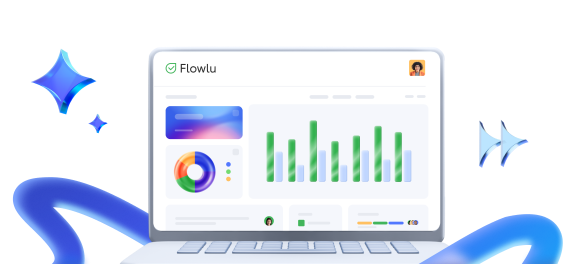
Flowlu is a great example. This all-in-one software offers tools for content planning and client communication. Flowlu users can create highly personalized invoices and emails, automate follow-ups, and collect detailed data for case studies.
Common Personal Branding Mistakes Freelancers Make
Branding requires a lot of time and effort. It’s a colossal job that is not immune to mistakes. But awareness is our power. So let’s learn the pitfalls from the start.
Mistake #1: Expert in Everything
Many freelancers believe that a long track record proves expertise and makes clients prefer them.
Why that’s wrong: In reality, people often see a “jack of all trades” as a master of none. A web designer, SEO specialist, business coach, and bachata dancer all rolled into one can leave clients confused about what problem your brand actually solves.
Solution: Even if you’re truly multi-talented, pick one main focus and master it.
Mistake #2: Focus on Selling
Everyone understands your brand is your bread and butter. But don’t build your strategy on constant “hire me” messages.
Why it’s wrong: People won’t put up with self-promotion for long, even if you are truly an expert in your field.
Solution: Attract people not through loud wording but through real demonstrations of your skills. Add more content about your successfully completed work and customers’ positive feedback. Let real clients’ words, not your own, advertise you.
Mistake #3: No Social Proof
Imagine a customer visits your profile, but there’s no information about your interactions with past clients—no feedback, client stories, or testimonials.
Why it’s wrong: potential clients feel uncertain about whether your work has been valuable for anyone at all.
Solution: Start collecting your users’ opinions and create a dedicated section on your website or social media profiles so people can see that your work is valuable.
Mistake #4: Ignoring Personal Story
Many freelancers think storytelling is secondary and has little to do with branding.
Why it’s wrong: Stories make your business relatable and value-driven, not just an impersonal buy-sell transaction.
Solution: You don’t have to share deep personal feelings or life-changing events. Create a creative, funny, or even serious story that tells people about your brand. Even if you’re introverted, let people get to know a little more about your business.
Mistake #5: Copying Competitors
We know how hard it's to start something from scratch, and borrowing ideas is okay — but copying is a bad move.
Why it’s wrong: Thinking no one will notice similarities is risky. Copying others not only turns off your audience but can also lead to legal trouble.
Solution: Draw inspiration from good ideas, but adapt them to fit your brand and add your own unique vision.
Your Brand Is Your Mission
Freelance branding goes beyond commercial goals. While big companies look for a human touch in their services, solopreneurs have even more opportunities to reach clients’ hearts and minds. A strong desire to provide real value almost always leads to success.
By following personal branding tips for freelancers and avoiding common mistakes, you can create a strong and engaging personal brand. With modern tools and technology, these processes become much easier to manage.
Let yourself focus on your core work while specialized apps handle routine organizational tasks. For example, Flowlu saves significant time on administrative operations. With this system, you can clearly organize your work through task planning and communicate with your team or clients all in one place. Automating invoices, emails, and financial reports gives you a clear view of your business performance and allows you to spend more time on the work you truly love.

A personal brand isn’t mandatory for your freelance career, but we believe every business idea has its unique mission. If your work delivers real value to your audience, it deserves public recognition. Starting your brand will bring benefits for sure.
Many factors—experience, niche, and strategy—influence the timeline for building a personal brand. In general, creating a personal brand can take anywhere from several months to a few years.
Yes, it can. But it’s usually slower and requires other channels to build recognition. For example: word of mouth, referrals, networking, events, portfolio, and a website—just to name a few.