




What Are the Most In-Demand Skills for Your Career

- What Are the Most In-Demand Skills in 2026?
- Why Skill Demand Is Changing in the AI Era
- 5 Most In Demand Tech Skills
- 4 Human Skills That Stay Popular
- Business, Marketing, and Sales Skills Employers Value
- How to Choose Which Skills to Learn
- A 12-Month Plan to Build In-Demand Skills
- Components of Success
- Stay Employable Beyond 2026

It goes without saying that last year's progress lies in specific technologies such as data science, cloud computing, and artificial intelligence, to name just a few. And this global picture transforms not only what employers expect from their workforce but also how companies actually operate.
Although the present reality reveals that not all the operations can be replaced by machines.
As a result, now companies are looking for people who can combine IT knowledge with strong human abilities such as analytical thinking, communication, and adaptability.
Understanding which competencies are becoming more sought after and how to develop them can help professionals stay competitive in a rapidly changing job market.
In our guide, we analyze the most in demand skills in 2026. From here you’ll know why human abilities still matter in the age of automation and generative AI and which of them you should build to strengthen your career opportunities.
What Are the Most In-Demand Skills in 2026?
It’s not a secret that the large part of the 2026 job market is occupied with the huge advancements in digital transformation, automation, and artificial intelligence.
From this, you can easily understand that people who combine analytical thinking, technology, and human creativity are becoming more valuable across industries.
The fastest-growing job positions are also linked to these areas. Data science, cybersecurity, artificial intelligence, and cloud computing—offer big perspectives to applicants.

But what about universal professional qualities like adaptability, problem-solving, and communication? These are also in high demand.
As a result, the biggest trend of 2026 is hybrid competences. This means that the best employee is one who can mix both practical and technical business understanding.
So, if you incorporate these traits—congratulate yourself—you'll be especially valuable.

Why Skill Demand Is Changing in the AI Era
The increase of both automation and AI is changing how things work right now.
If you think about it, software systems are already handling many routine tasks so that employees can focus on more important tasks that include strategy, innovation, and decision-making.
There are mainly 3 reasons why this is happening:
#1. Automation of Routine Tasks
Technologies that are easily powered by machine learning can easily automate repetitive processes in many industries. For example, in customer service, manufacturing, and even finance.
Result: This way, employees will build expertise in areas that are harder to automate, such as complex analysis or creative problem solving.
#2. Growth of Data-Driven Decision Making
More businesses rely on information. So, it’s not surprising that fields like analytics and statistics are becoming more valuable.
Result: Again, companies require employees who can not only analyze data but also interpret it and turn it into actionable insights.
#3. Fast Digital Transformation
It’s normal for companies to have their services and systems online connected to cloud computing.
Result: As you can see, these companies require employees who know how to work with security, systems, and scalable technology.
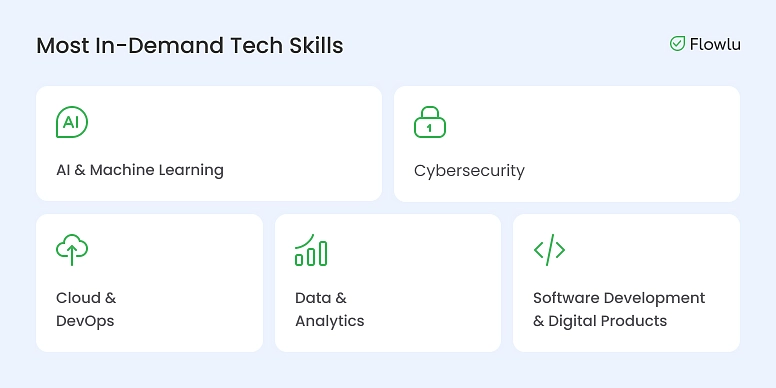
5 Most In Demand Tech Skills
As you can imagine, hiring trends are being dominated by technical knowledge, especially in areas that support software engineering, and AI.
1. AI & Machine Learning
These abilities are, without any question, highly sought after in 2026. The common knowledge related to AI:
- Automation design
- Model evaluation
- Prompt engineering
- AI-assisted software creation.
#2. Data & Analytics
As we’ve already mentioned above, knowledge related to information is highly valued. The main areas of data are:
- Visualization
- Analytics
- Statistical modeling
- Science
#3. Cloud & DevOps
More and more software systems are run on cloud platforms that are built around cloud computing. Some important competencies related to it are:
- Infrastructure automation
- Cloud architecture
- Containerization
- DevOps practices
#4. Cybersecurity
With the growth of cyber threats and attacks, companies are looking for professionals with the following kinds of expertise:
- Risk management
- Security compliance
- Threat detection
- Network security.
#5. Software Development & Digital Products
Unlike the areas mentioned above, which are relatively recent, software engineering isn’t new but remains a highly sought-after field across many tech roles. Some important areas include:
- Product design
- Mobile software creation
- UX (user experience)
- Website creation.
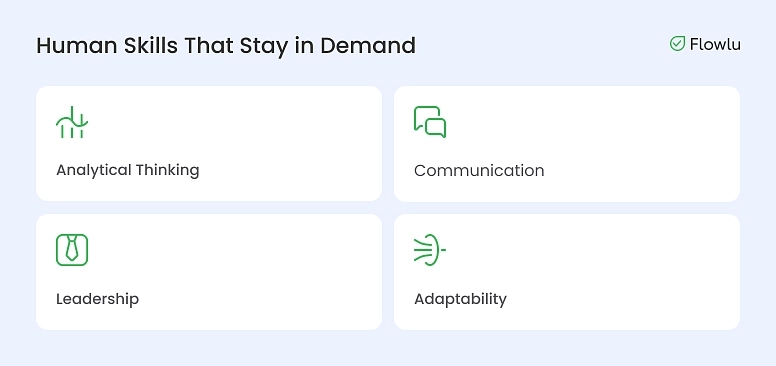
4 Human Skills That Stay Popular
While technology is advancing in different areas and fields, the truth is that certain human abilities continue to be vital for almost every job role.
1. Analytical Thinking
It’s crucial for companies to hire professionals who can both evaluate complex problems and develop strategic solutions.
Analytical thinking is a combination of structured decision-making, critical evaluation, and logic.
2. Communication
Communication continues to be critical so teams can collaborate effectively. It’s important that employees know not only how to express their ideas clearly but also that they can present statistics and write well.
3. Leadership
While many people continue to think that leadership is only meant for managers, this is far from the truth.
Companies keep looking for professionals who can support group success and take initiative. This includes being able to motivate teams, resolve conflicts, and guide projects.
4. Adaptability
Not so many decades ago, workers had the same job role with the same tasks for 30 or 40 years without any change. But this has already reached its end.
Nowadays, with the fast technological change, workers should keep constantly improving new approaches and tools. This means being able to quickly adapt to new job requirements and systems.
Business, Marketing, and Sales Skills Employers Value
Up until now, we have been discussing only the role-specific knowledge employees sholud have or develop in 2026. But there are also kinds of capabilities that remain important.
Digital Marketing
More and more businesses consider online platforms for their promotion strategies. Some important areas include:
- SEO (search engine optimization)
- Social media strategy
- Content creation and distribution
- Promotion analysis.
Product Management
Product managers are the ones responsible for the coordination of the business, engineering, and customer acquisition teams. They should focus on the following areas:
- Product strategy
- Customer expectations
- Feature prioritization.
Sales & Business Development
It’s crucial for companies to hire professionals who can turn ideas into revenue. Some of the abilities you need to have include:
- Strategic partnerships
- Client relationship management
- Negotiation.
How to Choose Which Skills to Learn
Now that we’ve already taken a look at the most in-demand skills 2026, you need to choose ones you will learn.
Keep a balance between market expectations and your personal strengths and interests.
Here’s how you can choose which to learn:
Step #1: Research Market Requirements
Take the time to look at both industry reports and job listings to discover what employers are requesting more often.
Step #2: Identify Your Strengths
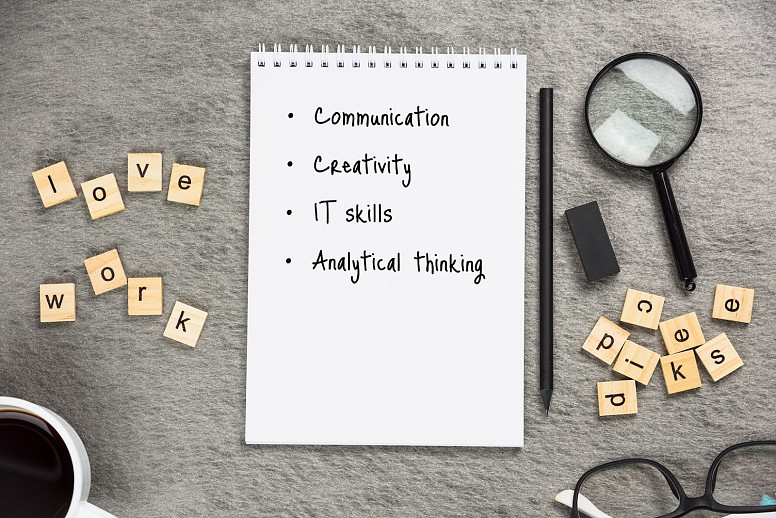
It’s always better to choose what to learn based on your natural preferences:
- Communication
- Creativity
- Problem-solving
- Analytical thinking.
Step #3: Combine Skills Strategically
It’s important to keep in mind that the valuable careers usually combine two or more most in-demand skills 2026. Here are some examples:
- Software development + product design
- Data analysis + business strategy
- AI + audience engagement
A 12-Month Plan to Build In-Demand Skills
It takes both consistent effort and practice to develop valuable competencies. To help you, we established a 12-month plan that you can follow:
Months 1–3: The Basis
You should start by exploring the basic concepts. Try out trusted resources:
- book
- tutorials
- online courses.
Make sure that during this time you focus on understanding the main ideas instead of getting a deep knowledge about some of them.
Months 4–6: Practical Experience
This is the time to apply the knowledge that you acquired through projects. Here are some things you can do:
- Create promotion campaigns
- Analyze datasets
- Build simple software tools.
Months 7–9: Portfolio Development
At this point, you're ready to create a portfolio that shows your abilities. You can include:
- Marketing case studies
- Data analysis reports
- Coding projects.
Months 10–12: Real-World Experience
This is when you should try to gain experience through:
- Open-source contributions
- Internships
- Freelance projects.
By doing this, you will be not only refining your competencies but also building professional credibility.
Components of Success
The successful professionals in the coming decade will focus on continuous mastering and development.
Important strategies include:
- Combining IT knowledge and human strengths
- Adapting to new technologies
- Building real-world experience
- Maintaining a strong professional network
Rather than relying on a single ability, developing a diverse ones that can help ensure long-term career stability.
Stay Employable Beyond 2026
The ideal applicant in 2026 is a professional who is ready to continuously learn and adapt.
And even with the growth in digital areas, human abilities also remain in important.
So, boost communication, creativity, and leadership. Such traits help you solve complex problems and guide yourself and your teams through changes.
What is more important—try to not focus on one strength. You’ll build the successful career path only if you develop your IT expertise, strategic thinking, and strong personal abilities.
If you’re ready for long-term career growth, first identify important competencies, then start exploring, and finally go to practical experience. Start your own projects and find real-world applications.
During your mastering or optimizing working processes, you will find great ideas, insights, or effective solutions for sure. Not to miss them or share with colleagues, don’t forget to write them down. It would be better if all your drafts were part of your workflow.
To achieve this level of consistency, use dedicated business platforms like Flowlu.
Flowlu offers a built-in task manager integrated with calendars, so you never miss an important event. Its CRM module allows you to track internship application pipelines, while Lists help you manage and monitor completed courses.
Whether you work independently or as part of a team, Flowlu makes it easy to capture and organize your ideas—helping you build a structured and valuable knowledge base.
Many of these features are available for free for personal use.

While there are various, we believe working with AI is the valuable one.
While it depends on the knowledge and on the time you have available, it should take you between 6 to 12 months.
The truth is that they’re both important for modern companies.
Focus on:
- Data literacy (learn Excel and Google Sheets)
- AI usage and prompting (start with ChatGPT, or Claude)
- Web development fundamentals (learn HTML and CSS)
- No-code or low-code tools (Webflow, Bubble)
- Basic programming (for example, JavaScript)
You can explore job listings and write down the frequently mentioned requirements. After creating a list, review which ones you already have. Then focus on learning the ones you’re not familiar with.