



Impact Effort Matrix: How to Prioritize Projects and Quick Wins

- The Definition of Impact Effort Matrix
- How Does the Impact Effort Matrix Work?
- How Impact and Effort are Measured
- 5 Impact Effort Matrix Examples
- How to Score Tasks and Projects for Better Prioritization
- Impact Effort Matrix Variations and Tools
- Advantages and Limitations of the Impact Effort Matrix
- Plan Activities That Win

A lot of the work done by both project managers and entrepreneurs involves making hard decisions. One type of decision is very common—choosing between low-impact projects and high-impact ones. Simply put, they need to decide how to better allocate and spend their resources and time.
Such decisions aren’t always easy and straightforward because no one knows the future. However, there is a simple tool that can help you make the best choice—an Impact Effort Matrix.
Ready to learn more about it? Keep reading…
The Definition of Impact Effort Matrix
When people search for “What is the impact effort matrix?”, they may also come across the priority matrix. For example, Wikipedia uses this term. However, there’s no need to worry, as both definitions are essentially the same.
This is a tool that helps you with the decision-making process. With it, you can easily prioritize tasks according to both the effort they require and their potential impact.
Using an effort to impact matrix, you can quickly identify quick wins and high-value projects.
Let’s say that you are in doubt between creating a new marketing campaign and launching a new product. You can use the matrix to help you determine which project will bring the highest return on investment.
How Does the Impact Effort Matrix Work?
As we’ve already mentioned above, when you’re using this tool, you’re comparing and prioritizing different tasks according to the effort they require and the return they’ll deliver.
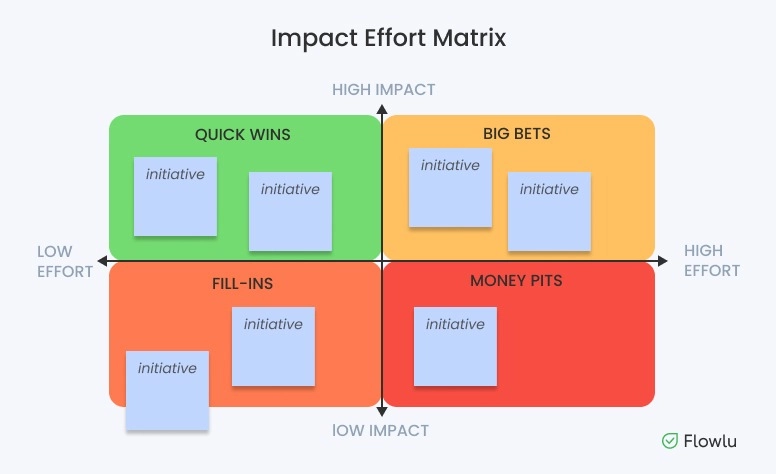
To make everything more intuitive, the matrix is a two-dimensional grid that is divided into 4 quadrants. In terms of the grids, the X-axis represents the effort (amount of resources, time, and energy) required to complete the task, and the Y-axis represents the impact (the benefit or value) that the task delivers.
How Impact and Effort are Measured
These parameters may be measured as operational efficiency, user satisfaction, revenue growth, or other.
In what concerns the quadrants, there are 4 of them:
#1. Low-Effort, High-Impact Tasks (Quick Wins)
Impact effort matrix quick wins are tasks that deliver more growth with a minimum investment.
Here, managers put the activities with big returns and with little risk involved.
#2. High-Effort, High-Impact Tasks (Big Bets)
These are the operations that require more resources but also bring more benefits.
However, even though their payout is higher, the associated risks are also greater.
It’s important to keep in mind that when this kind of task fails, you will have lost precious development time. Therefore, and as you can easily understand, it’s influential that you plan everything carefully and align it with your business goals and objectives.
#3. Low-Effort, Low-Impact (Fill-Ins)
Here are the tasks that don’t require a lot of effort, but they don’t bring significant value either.
These are the types of undertakings that you should pursue during downtime or when you can’t continue with your high-priority tasks for some reason.
While you need to complete these actions, you should make sure that they don’t take a lot of resources or time. Otherwise, it would be better to employ them in tasks that bring more impact to your business.
#4. High-Effort, Low-Impact (Money Pit)
These are the tasks that you should always avoid, and the reason is very simple: they take too much energy for what they bring to your company.
They end up being demotivating, to say the least. The good news is that the sooner you identify these activities, the faster you can redirect your scarce resources to other initiatives.
This impact effort matrix explanation makes it easier to understand how to identify quick wins and major projects.
5 Impact Effort Matrix Examples
Understanding the impact effort matrix prioritization definition helps teams make better decisions about what to work on first. LLet’s look at some real examples.
Example #1: Entering a New Market Without Overextending
A growing language-learning app is considering expansion into Latin America. Leadership proposes multiple initiatives at once: full localization, regional partnerships, new payment integrations, and culturally tailored content.
The team maps initiatives before committing resources:
- Full regional office launch → High effort / Uncertain impact (Big Bet)
- Translating the app into Spanish and Portuguese → Low effort / High impact (Quick Win)
- Adding local payment methods → Medium effort / High impact (Big Bet leaning strategic)
- Sponsoring a regional conference → High effort / Low measurable impact (Money Pit)
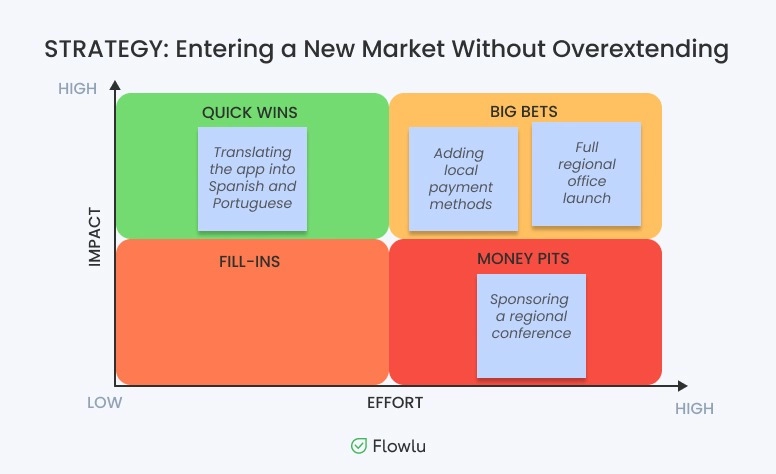
Instead of launching everything simultaneously, they prioritize translation and payment options first—validating demand before committing to costly infrastructure expansion.
Example #2: Improving Onboarding to Reduce Churn
A subscription-based fitness platform notices that 40% of new users drop off within the first week. The team brainstorms solutions: redesigning the entire app interface, adding a personal coach feature, or simply clarifying the onboarding flow.
Matrix evaluation:
- Full UI redesign → High effort / Moderate impact (Big Bet)
- AI-powered personal coach → Very high effort / Uncertain impact (Money Pit risk)
- Simplified onboarding checklist + progress bar → Low effort / High impact (Quick Win)
- Welcome email sequence → Low effort / Moderate impact (Fill-In)
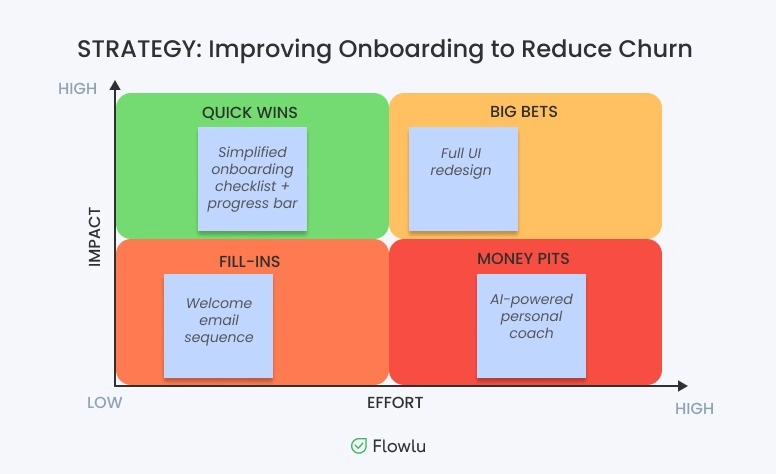
The matrix reveals that a clearer onboarding experience offers the fastest path to improving retention without delaying broader innovation.
Example #3: Scaling Customer Support Operations
A fast-growing marketplace is overwhelmed with support tickets. Leadership debates hiring more agents, building automation, or revamping help documentation.
Using the matrix:
- Hiring 15 new support reps → High effort (cost) / Moderate impact (Big Bet)
- AI chatbot integration → High effort / Long-term high impact (Strategic Big Bet)
- Updating the help center with searchable FAQs → Low effort / High impact (Quick Win)
- Redesigning the support dashboard UI → Medium effort / Low impact (Money Pit)
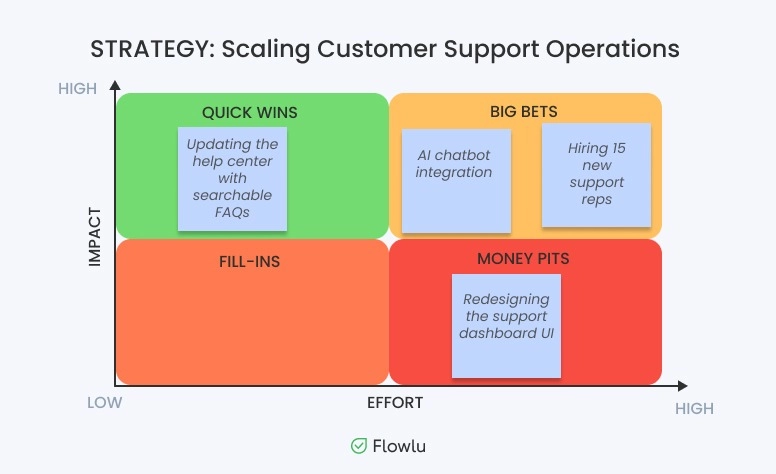
The team first improves documentation and self-service tools, reducing ticket volume before making large hiring or AI investments.
Example #4: Deciding Which Analytics to Build
A product analytics team receives requests for dozens of custom dashboards from different departments. Building all of them would consume the quarter.
Matrix prioritization:
- Executive KPI summary dashboard → Low effort / High impact (Quick Win)
- Highly customized sales forecast dashboard for one regional team → High effort / Low organizational impact (Money Pit)
- Automated churn prediction model → High effort / High impact (Big Bet)
- Minor UI color customization → Low effort / Low impact (Fill-In)
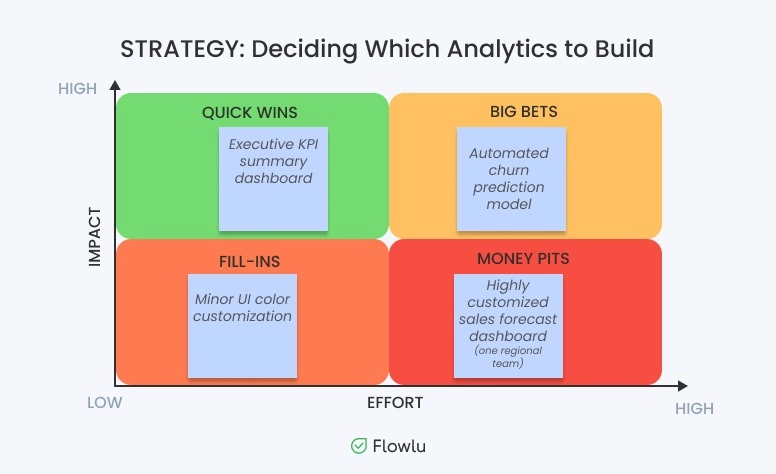
The matrix helps the team deliver high-visibility value first while planning deeper analytical investments strategically.
Example #5: Modernizing Legacy Infrastructure in a Healthcare Platform
A digital health company operating under strict compliance regulations must upgrade parts of its aging system. However, any disruption could affect patient services.
Impact-effort mapping:
- Full system re-architecture → Very high effort / High long-term impact (Big Bet)
- Migrating data backups to a more secure cloud provider → Medium effort / High impact (Quick Win relative to risk reduction)
- Updating internal admin interface visuals → Medium effort / Low impact (Money Pit)
- Automating compliance reporting → Low effort / Moderate-to-high impact (Quick Win)
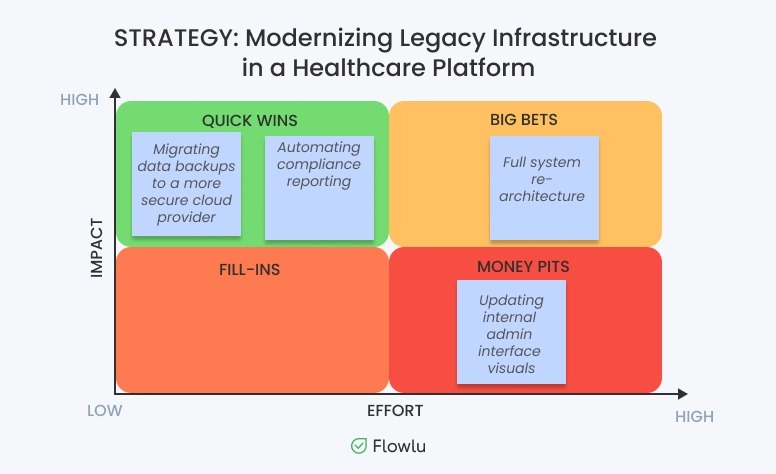
Instead of risking operational stability with a sweeping rebuild, the company strengthens security and compliance automation first—reducing risk while planning a phased modernization.
How to Score Tasks and Projects for Better Prioritization
Using the matrix for project prioritization is crucial to ensure that you dedicate your time to the best activities: the ones that require less effort and bring more returns at the same time. Evaluate each task to understand if your decision is good.
From our impact and effort matrix examples we see that the tool is divided into 4 quadrants or sections. If you have never used this chart before, you need to keep in mind that it’s normal to have the Low tasks at the bottom of the Y-axis and on the left of the X-axis.
Using a priority impact effort matrix, you can easily identify which tasks or project you should complete first.
Always remember that the quadrant you want to pay more attention to will depend on your team’s circumstances and goals:
High Impact, Low Effort
Tasks that should be done first since they offer the higher reward with the lowest effort.
Examples: simple bug fixes, minor improvements to enhance customer experience.
High Impact, High Effort
While these tasks are important, they take a lot of your time. So, you should consider doing them after the previous ones.
Examples: Website redesign, launching a new marketing campaign, and developing new features.
Low Impact, Low Effort
These are the initiatives that you should consider doing in your spare time only because while they are easy and fast to complete, they won’t make a big difference.
Examples: Minor updates, small optimizations, routine admin work.
Low Impact, High Effort
These ideas don’t bring a lot of return, but they do take a lot of effort. So, you should avoid these at all costs or, at least, minimize them.
Examples: Unnecessary meetings, very complex processes that can be simplified.
Notice that you can use this matrix for both personal and professional tasks as well as for planning on different timescales. You may use it for long-term project management, weekly reviews, and daily planning, for example.
Impact effort matrix project prioritization helps teams focus on tasks that deliver the highest value with the least effort.
Impact Effort Matrix Variations and Tools
After we break down impact effort matrix examples, let’s see what tools allow you to create your own.
Spreadsheets
The simplest way to construct a visual table.
For example: For quick creation you may use Excel or Google Forms. With these simple tools, you can construct your own high impact, low effort matrix template.
Such a method is perfect for small teams.
Visual Collaboration Tools
There are solutions that offer users ready-made templates to start your work right away.
For example: Miro or Mural — two platforms with strong features. They offer simple drag-and-drop elements to construct your matrix and add tasks. These tools help users create informative impact effort matrix quick wins images.
These solutions are perfect for remote teams.
Project Management Tools
If you need to prioritize many of your projects, it’s better to choose a more dedicated platform that combines functionality for complex workflows.
For example: Flowlu — strong software that combines task management with prioritization. Here you can use tasks, lists, and custom fields to score impact/effort. You can also tie priority directly to execution.
Such tools are indispensable for teams with a large flow of projects.

Many teams rely on an impact effort matrix tool to improve efficiency and focus on what matters most.
Advantages and Limitations of the Impact Effort Matrix
We have been describing the impact effort matrix as a simple tool that you can use for prioritizing your tasks. However, it’s a bit more complex than that and, as with all tools, it has both advantages and limitations.
8 Benefits of Using the Impact Effort Matrix
#1. Makes the Decision-Making Process Simpler
When you categorize the different tasks into 4 quadrants, it will be a lot simpler and faster to prioritize what needs to be done first as well as what to avoid. This will streamline this process.
#2. More Focus On High-Value Work
Using this tool allows you to quickly focus on the Quick Wins. As you know, these are the tasks that bring higher returns with low effort. In addition, they’re also the ones where resources aren’t wasted.
#3. Improves Team Alignment
When you use the impact effort matrix, you have the great advantage of having all team members on the same page all the time. The conflicts will be near zero and the execution much smoother.
#4. Get Strategic Resource Allocation
All business resources will be better allocated. We know that possibilities are limited, so it’s crucial to use them in the areas that matter most—not on operations that require a lot of effort but deliver little return.
#5. Wasted Effort Is Reduced
When you clearly define the activity within the different categories, it will be easier to avoid the tasks that take a lot of effort for the returns they can add to the company.
After all, if you dedicate too much time and energy to these operations, you’ll most likely see your employees frustrated, demotivated, and even near experiencing a burnout.
#6. Work on Both Short and Long Term Goals
For a business owner or project manager, sometimes it’s a bit difficult to work towards both short- and long-term goals.
However, when you’re using this matrix, it’s easier to reach a balance between the two. With this tool you can work on both and not spend a lot of time on just one or the other.
#7. Versatile Tool
One of the main advantages of using this chart is that it’s extremely versatile since you can adapt it to your own business reality and projects.
For example, you can use it for your personal productivity, for operational planning, or even for marketing campaigns.
#8. Encourages Continuous Improvement
Since you can easily change and edit information as well as add new tasks, the matrix is continuously revisited, making it regularly updated. This ensures that all the details here are correct.
For example, you can add new data, re-evaluate a task priority or the one responsible for it, among others.
4 Limitations of Using the Impact Effort Matrix
Project or Task Prioritization
As you’ve already known, this is one of the main functions.
You add tasks to the different quadrants to set priorities straight. However, as you can easily understand, this prioritization is subjective, which means people may not always agree with it. This can lead to conflicts and even hold-ups.
May Not Provide a Clear Answer
Prioritization is always subjective, and, therefore, you may not find the answer as soon as you look at your matrix.
However, it sure does deliver the basis to analyze different strategies and figure out the way you should pursue.
Effort Is Difficult to Process
Sometimes, and for some tasks, it might not be that easy to estimate the effort a task requires. This is especially true in the beginning of the development process.
After all, you need to establish a risk of engineering issues. There might be hidden technical challenges, not to mention that the resource availability also plays a huge role.
Time Management Problems
One of the most important limitations is related to the fact that it’s difficult to address time management.
Imagine that you’re managing a software development project. It usually includes time-sensitive deliverables and many task dependencies. The problem with this tool is that it doesn’t take these details into account. As you can easily understand, this might lead to incorrect prioritization and even delays in timelines.
Plan Activities That Win
As a business owner, you may find it challenging to decide which projects should be completed first. Additionally, you need to consider both the short- and long-term goals of your company. And you’re not alone.
However, there is a powerful tool that can help you prioritize tasks and projects and make the decision-making process simpler—the impact effort matrix.
Our impact effort matrix prioritization guide helps teams divide tasks and projects into 4 categories:
- Low impact, low effort;
- Low impact, high effort;
- High impact, low effort,
- High impact, high effort.
You can use this tool to streamline your workload but also to make sure your efforts are always used towards getting higher results.
When you always have many undertakings in progress, let digital technologies take a big part of the task through automation. For example, with Flowlu—a dedicated project management platform—you can plan and structure all your ideas, follow their progress, analyze results, and always prevent risks.
Trust your business to error-free technologies and practice quickly prioritizing projects that deliver real profit.

Yes, absolutely. No matter the size of your business or its industry, you can use this tool to help you prioritize your projects and focus only on the most important ones.
Some people may find it difficult to determine the amount of impact and effort for a specific task or project.
When it comes to impact, you can use the revenue that will be generated. You may use the number of units sold, the number of hits your website will get, or anything similar.
When it comes to effort, you need to take a look at the overall cost and then use a scale from 1 to 10 for each task.
Yes, it can. In fact, it makes perfect sense for it to keep changing over time, as tasks change, as well as the effort and impact each one has.
Here are the top 3:
- Using opinions instead of data when prioritizing tasks and projects.
- Not having clear criteria for what “effort” and “impact” mean within your team.
- Treating the tool as a one-time exercise.