


How to Build a Useful Nonprofit Dashboard For Fundraisers


We’ve all been there: staring at a dense, 10-tab spreadsheet at 6 p.m. when you’d much rather be out grabbing coffee with a potential major donor. Statista research found that the top two challenges nonprofits reported last year were rising operating costs and limited staff capacity. Your nonprofit’s fundraising team may already be stretched thin, and they don’t want to spend their limited time parsing through confusing spreadsheets or documents for the fundraising insights they need.
The more time your team spends digging through complex reports, the less energy they have to focus on the essential work that powers your mission, like planning campaigns and directly engaging with supporters and beneficiaries.
With that in mind, we’ve compiled five tips to help your team build a nonprofit dashboard that provides real value to your fundraising team. We’ll start by helping you define your goals in the dashboard creation process.
1. Define the purpose of your fundraising dashboard.
Before you start building a nonprofit dashboard, you need to understand the value your team is seeking. Audit your current system for tracking fundraising progress. What are the major gaps and pain points for your team?
Typically, the primary data tracking needs that nonprofit teams have are:
- Evaluating and measuring current fundraising campaign progress
- Conducting urgent tasks, like following up with a planned giving inquiry
- Assessing the health of donor relationships and being aware of any potential lapses or upgrade opportunities
Consider whether upgrading your fundraising technology can better track progress in these areas and achieve your goals. For example, you may need to migrate to a more robust nonprofit CRM to store and assess donor data. Or you may need to implement an integration between your donation form and your nonprofit dashboard to ensure your tools are speaking the same language.
With a clear accounting of your current needs and software stack, you can start building a custom-fit dashboard that effectively serves your fundraising team.
2. Place your constituents front and center.
At the end of the day, your nonprofit’s constituents—your donors, volunteers, beneficiaries, advocates, and peer-to-peer fundraisers—are the heart and soul of your nonprofit’s mission. Since your fundraising team prioritizes these individuals in their work, they should also play a significant role in your fundraising dashboard.
Your dashboard should prominently display the following supporter-related metrics:
- Recent new donors: These donors should receive greater engagement, such as phone calls and emails, at the start of their involvement in your organization. This level of interaction increases the likelihood that new donors will stay involved with your nonprofit long-term.
- Recent donor interactions: With a record of past interactions, fundraisers can easily pick up where they left off, such as by following up via phone call with a donor they spoke with at an in-person event.
- Donor retention: Knowing your donor retention rate is hugely important, since it can cost up to $1.50 to raise $1 from a new donor, but just $0.20 or less to raise $1 from an existing donor. Displaying your donor retention rate in your fundraising dashboard keeps this metric top of mind and enables you to quickly take action as needed to increase retention.
- Donor lifetime value (LTV): Donor LTV is the total amount of money that the average donor contributes to your nonprofit over the course of their involvement. This metric provides critical insight into your nonprofit's sustainability and long-term financial viability.
With these key performance indicators (KPIs) at their fingertips, your fundraising team can connect with donors at the right time to maintain high engagement. This ensures that your team doesn’t overlook the importance of people in the fundraising process. You need the dedicated support and passion of donors to fuel every aspect of your fundraising success, from campaigns to major giving.
Many nonprofits track these supporter insights inside their CRM. In Flowlu, donor profiles can store interaction history, notes from meetings or calls, and donation records. When these records feed into a dashboard, fundraisers can quickly see which donors recently gave, which relationships need follow-up, and where engagement opportunities exist.
3. Make it easier to visualize progress with timeframes and charts.
Realistically, how you display your fundraising KPIs is almost as important as the metrics you choose to track. If your data is hard to visualize or understand, your fundraising team won’t be able to maximize it to its fullest potential.
With that in mind, we recommend adopting clear data visualization and organization strategies, such as:
- Using visual trackers for fundraising campaign goals to show progress toward specific milestones. These give the visual learners on your fundraising team a clear overview of your fundraising progress. For example, you could use a fundraising thermometer to show progress made toward your fundraising goal for your current crowdfunding campaign. Or, you could use a timeline to display the goals your fundraising team achieves at each milestone of your campaign, such as reaching $10,000 or receiving donations from 250 donors.
- Implementing customizable date ranges so fundraising leaders can compare current performance against historical trends. For instance, let’s say you want to compare your year-end giving performance over three years. Use your fundraising dashboard to set date ranges for December 2023, 2024, and 2025 to compare results side by side. This data can help you pinpoint the specific strategies that led to success or underachievement in each year.
- Breaking down your fundraising performance by specific time intervals to identify seasonal or weekly trends. By viewing the amount raised by week, month, and fiscal year simultaneously, your team can understand the overall flow and rhythm of your supporters’ giving habits. For example, if you notice a consistent fundraising dip in the summer months, you can proactively schedule a matching-gift drive or social media challenge to maintain momentum.
This level of transparency into your fundraising data ensures that everyone is on the same page regarding your organization's financial health. It makes it easier for your team to acknowledge and celebrate wins, or to adjust its fundraising strategies earlier in a campaign or year, to maximize success.
4. Actively update and assign tasks to keep your team on track.
Your nonprofit dashboard should include a dedicated section for tracking active tasks assigned to individuals and the broader team. These tasks might include:
- Calling first-time donors to say thank you
- Identifying donors at risk of lapsing to reach out to them before they disengage
- Planning your messaging strategy for an upcoming peer-to-peer fundraising campaign
- Scheduling follow-up emails with donors after an event to introduce them to fundraising and volunteering opportunities
Use a clean, uncluttered layout that highlights task owners, deadlines, and budget information for each activity. A couple of helpful ways to display tasks are through a Gantt chart or Kanban board.
A Gantt chart is a visual project management tool that uses a waterfall format to depict a workflow. In the waterfall format, you must complete a phase (a task or activity) before unlocking and completing the next phase. The tool depicts tasks along a chronological timeline. These charts are useful for breaking down larger projects into more easily manageable activities.
A Kanban board also helps visualize workflows, but is slightly more flexible because tasks don’t necessarily have as many dependencies. When building a Kanban board, you’ll use columns that represent the phase that each task is in the larger process, such as “not started,” “in progress,” and “completed.” Kanban boards are helpful for completing more immediate, daily tasks.
Consider using a combination of these visual project management tools to help complete different tasks within a larger fundraising initiative. For example, you might use a Gantt chart to visualize the complete timeline of a GivingTuesday campaign, and a Kanban board to assign daily tasks to fundraising team members.
Tools like Flowlu combine fundraising data with project management features, which makes it easier to turn insights into action. For example, teams can create tasks to follow up with new donors, assign outreach responsibilities, or plan campaign milestones. These activities can be visualized using Gantt charts or Kanban boards so everyone understands what needs to happen next.
5. Conduct user testing to optimize your dashboard.
Building your nonprofit dashboard doesn’t have to be a one-and-done task. You may find your dashboard helpful for a few months or even a few years, but start to see gaps as time goes on. You can always update your dashboard to adapt to your changing priorities and needs.
Conduct a dashboard audit every few months to get feedback from your fundraising team. Take the following steps:
- Ask a fundraising team member to complete a common task, such as updating a donor profile with recent interaction information. Can they complete the activity in a timely manner (one minute or less)? Do they run into any barriers when completing the task?
- Evaluate any integrations that keep your dashboard running smoothly. Do you have any data siloes or instances where your data could flow more smoothly between platforms?
- Consider the usability and accessibility of your dashboard. Are labels descriptive and accurate? Are text and buttons readable, with high color contrast? Is navigation streamlined, requiring just a few clicks to complete target actions?
Take team member input into account when updating your dashboard to improve the user experience. Use a continuous improvement approach by making small iterations to your dashboard instead of major, time-consuming overhauls.
With a clear and helpful nonprofit dashboard, you maintain high fundraising performance and drive greater support for your mission. By creating a tool that is reliable, intuitive, and focused on relationship-building, you’ll empower your fundraisers to do their best work without being slowed down by technical complexities.
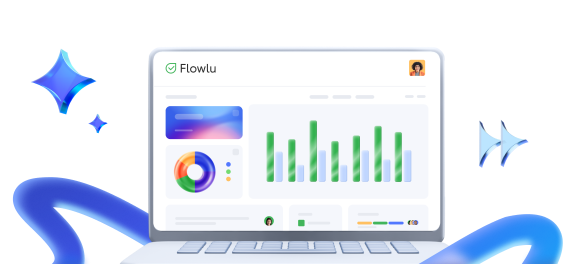
Many nonprofits start with spreadsheets but eventually reach a point where managing fundraising data becomes difficult. Platforms like Flowlu simplify this process by combining CRM, dashboards, project management, and automation in one place. With the right system and a well-designed dashboard, fundraising teams can spend less time managing data and more time building relationships with supporters.
For the best results, fundraisers should check their task-oriented dashboards daily to manage follow-ups and donor interactions. Leadership teams should conduct a deeper dive into trend-based metrics, like retention rates and LTV, on a weekly or monthly basis. This cadence keeps short-term tasks on track while aligning long-term strategies with data trends.
To avoid dashboard fatigue, limit your main view to only the most critical KPIs that require immediate action. Use tabs or separate dashboard views for different purposes, such as one for daily tasks and another for quarterly board reporting. Regularly audit the dashboard to remove any metrics that the team no longer uses to make strategic decisions.
Ideally, a director of development or a database manager should oversee the initial setup to ensure the KPIs align with your organizational goals. Once the dashboard is built, automated integrations should handle the bulk of the data maintenance. If you lack internal expertise, hiring a consultant for a one-time setup can prevent your current staff from feeling overwhelmed by the technical process.