


B2B SaaS Customer Success: Best Practices Guide


Quick answer
A big share of subscription services is changing the way your company does business. After all, in traditional software, the sales process ended as soon as the customer paid the fee. In SaaS, though, this is where everything starts. And that affects what you provide to users to keep them around as long as you can.
To make sure you're moving in the right direction, learn how to define and measure B2B SaaS customer success. And it's not only about metrics. It's a strategy that makes sense for your business. Don't stop at knowing people are using your software. Make sure they're also achieving their goals.
What customer success means in B2B SaaS
SaaS customer success can be defined as a strategy that helps users achieve their goals by using your software.

Unlike traditional B2B models, the sale happens more than once, since we're talking about recurring subscription revenue. Whenever users can't achieve their goals, they can cancel their subscription — churn.
To avoid this, three pillars should support your product:
#1: Customer support
Their primary goal is to fix tactical or technical issues, but always in a reactive way.
How it works:
A support team waits for someone to reach out — whether they forgot a password, ran into a broken integration or link, found a bug, or hit some other issue. Success is measured by how quickly the support team resolves the problem.
#2: Account management
The main goal is to secure both contracts and upsells, which means handling the commercial relationship with each account.
How it works:
As you'd expect, success here is determined by revenue growth — not just retaining the account on board, but also offering add-ons to grow the account.
#3: Customer success management
The ultimate goal is to maximize ROI (Return on Investment) and product value for every account, and this is always done proactively by anticipating the customer's needs.
How it works:
The Customer Success Manager (CSM) regularly analyzes product usage data. If someone isn't using a top feature, the CSM reaches out ahead of time to offer help or solutions. In this case, success is measured by whether they're meeting their business goals using your software.
Whether you use a dedicated customer success platform or an all-in-one solution like Flowlu, having a centralized system makes it much easier for these teams to work together.

Core customer success best practices
To make sure that you have a good CSM, you want to follow these SaaS customer success best practices:
Onboarding
The main goal in this phase is to clearly demonstrate the value of your product; otherwise, you’ll see churn increase.
One of the things that usually helps is to focus solely on the 2 or 3 main features of your product (the ones that ensure most customers’ problems are solved).
Product adoption
As soon as someone is done with the onboarding process, it is your job to ensure that they are using the tool correctly and consistently. This means that you need to know not only whether the product is being used, but also how often people use it and which features they like the most.
As a rule of thumb, it’s a reason to be alert every time usage drops by more than 20% each week. There should be enough time for you to get in touch with your audience, understand what’s wrong, and offer help.
Success plans
A success plan is the map that covers everything between the time you make the sale and the moment the account reaches its goal.
One of the things that many people don’t know is that success plans should be shared with everyone involved. They should include the company’s clear goal, the metrics that will be used to measure it, and specific milestones that include who is doing what and by when.
Health scores
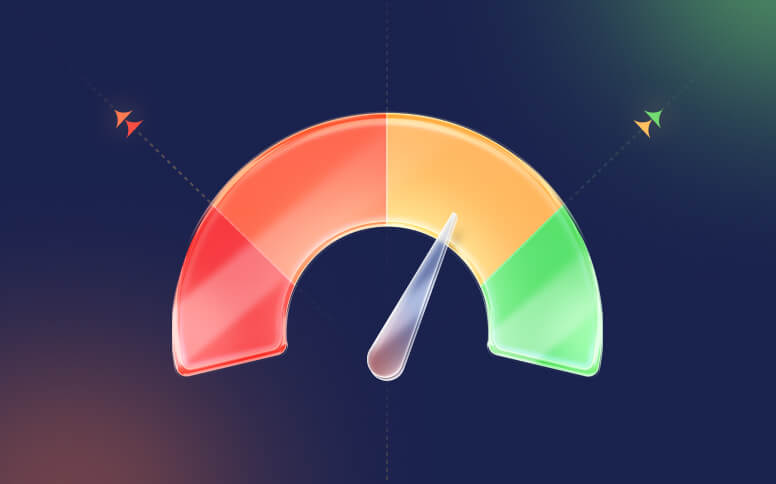
It’s an indicator that may be red, yellow, or green, and it estimates the likelihood of a customer churning or renewing.
You can determine this health score based on different metrics, such as seat utilization, feature adoption, login frequency, response time to emails, billing delays, the number of open high-severity support tickets.
While you may use all these metrics, it’s important that you start with a simple formula at first.
QBRs (Quarterly Business Reviews)
A QBR, also known as an EBR (Executive Business Review), is a presentation of different business metrics that needs to include the client's executive decision-maker.
Keep in mind that this meeting is focused much more on looking ahead at your company’s priorities than on what has been done up until now.
Renewals
The renewal time can be seen as a part of your success or failure. If you have done everything up until now, the renewal is just the natural next step, and there’s no reason to feel pressured.
No matter the case, you need to look at renewals long before they expire. Generally speaking, you need to start looking at them when you have 90 days left until the contract expires. This is the time to do a quick health score check to uncover any risks.
When 60 days are remaining until the renewal → send a new proposal to the client.
When 30 days are remaining → take care of all the procurement and legal paperwork.
7 customer success metrics and signals every CS team should track
1. Churn
When talking about this metric, it’s important to divide it into logo churn and revenue churn.
While the first refers to the percentage of accounts that actually cancel their subscriptions, the second shows the percentage of recurring revenue lost.
2. Retention
GRR (Gross Revenue Retention) is one of the most important metrics for measuring customer retention that SaaS companies aim to improve over time.
The maximum is 100%. Considering that 84% is the 2026 median for private B2B SaaS companies, you should aim for at least 80%. The closer to 100%, the better.
3. Expansion
This includes three different components: seat expansion, tier upgrades, and cross-selling.
4. NRR (Net Revenue Retention)
NRR measures the total value of your existing audience, including price increases, tier upgrades, cross-sells, upsells, and the expansion revenue they generate.
NRR can be greater than 100%. When this happens, it means that your existing accounts generate enough additional revenue to offset all churn. In other words, your revenue can continue growing even without acquiring new customers.
The most common values in 2026 are around 116% or higher for enterprise SaaS and around 97% for SMB-focused SaaS companies.
5. Activation
The activation rate refers to the time between signing the contract and actually using the software.
When someone never activates or takes too long to do it, they will probably churn.
6. Usage
In many cases, to account for usage, you'll need to monitor the product stickiness ratio. This means that you’ll need to calculate the ratio of daily active users (DAU) to monthly active users (MAU). This metric allows you to determine whether a customer is already comfortable using your software or not.
If you get a 50% ratio, for example, this means that your average user logs into your software about 15 out of every 30 days. In case you're selling a tool that should be used daily, such as a CRM, you should start worrying if this ratio drops below 20%.
7. Customer health
This is a very complex metric since it needs to take into account behavioral, relationship, and financial aspects. Use a percentage of these three aspects to determine overall customer health.
Consider using a weight of 50% of product usage, 30% weight of relationship, and 20% weight of commercial/support.
Many people believe that users who frequently contact customer support are likely to churn. The reality is that they couldn't be more mistaken. In many cases, this actually shows they’re engaged with the product and really trying to get the most out of it.
A much stronger warning sign is when seat utilization keeps decreasing, support tickets disappear altogether, and the account goes almost completely silent.
What to use to build a scalable customer success process
#1: Playbooks
A playbook is simply a detailed plan that tells your CSM exactly what needs to be done when a specific event occurs. As you can easily understand, this eliminates uncertainty and guesswork.
You should have at least three playbooks defined:
- For onboarding: This should be triggered the moment the contract is marked as closed. It defines when the welcome email is sent, when the kickoff call should take place, and the key milestones.
- For risk mitigation: This is activated when one of the most important health indicators drops. For example, when product usage falls below 50% or 40%.
- For expansion: This comes into play when a user reaches a high level of seat utilization (such as 90%). This shows they may be ready for an upgrade or cross-sell.
#2: Automation
While human interaction is very important, sometimes automation can do the trick. Therefore, divide your audience into high-touch and low-touch segments.
High-touch. These are accounts that generate around 10% to 20% of your revenue. Dedicate time to live quarterly business reviews (QBRs), customized success plans, and strategy calls for these accounts.
Low-touch. This segment should rely on as much automation as possible. You may add in-app walkthroughs, self-service help centers, and automated email triggers.
#3: Solid CRM
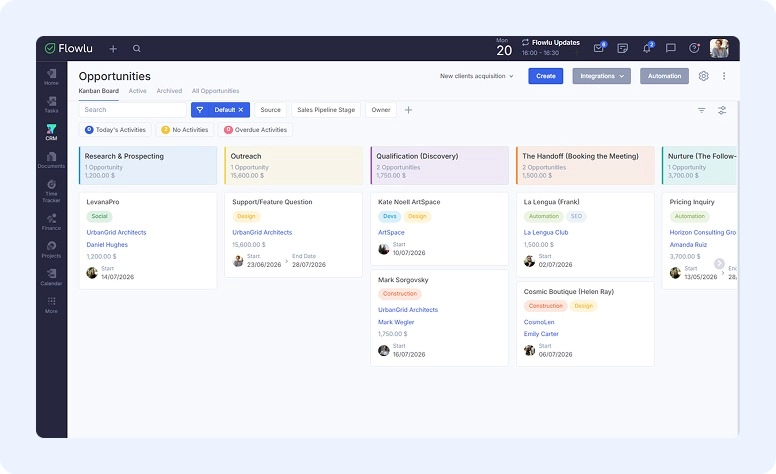
When you're looking to be more efficient, consider using a CRM to execute playbooks, automate repetitive tasks, and keep all contact information in one place.
Most CRMs on the market are generic and primarily built around sales.
However, a CRM like Flowlu can make a huge difference. This cloud-based platform lets you manage projects, capture leads, automate deal creation, and track opportunities in a single workspace. It also offers extensive customization and detailed reporting, including lead sources, revenue by pipeline stage, loss reasons, and much more.
#4: Feedback loops
A good customer success strategy SaaS companies implement isn't just designed to manage customers — it should also help improve the product.
After all, it’s closely tied to what your company builds and what your experience is. Therefore, it's important to formalize feedback loops such as these:
- The product loop. Create a list of feature requests, pain points, and UI blockers. Each month, hold a meeting with the Product team to review this list.
- The sales loop. When an account churns because it wasn't a good fit, document the reasons and share them with the Sales team.
Customer success is company success
Building a strong customer success strategy SaaS that business can rely on won't happen overnight. You’ll need to stop being reactive and start being proactive. Come up with a strategy to improve your SaaS customer retention based on what we’ve covered above, especially the SaaS onboarding best practices, since onboarding is a crucial step in the entire process.
With preventing or reducing churn as one of your main goals, use repeatable playbooks, smart automation across different tiers, and a reliable CRM system like Flowlu to manage all this information.
FAQ
It’s a strategy that you can define to ensure your customers can reach their goals by using your product. In B2B SaaS, this means focusing on helping people get value from your solution so they continue renewing their subscriptions and generating recurring revenue.
We can say that there are 5 main pillars here. This includes the shortest time between signing the contract, onboarding, and starting to use the product; proactive success plans, strategic QBRs, data-driven health scoring, and early renewal window.
To reduce it, SaaS companies may easily add triggers when risk signals are seen. For example, if you see someone stop using your product by more than 20% in just one week, you may want to take a closer look to see what’s happening and take proactive actions.
Specialists can and should use multiple metrics to help them determine customer health. These may include the activation rate, gross revenue retention, net revenue retention, and product usage, among others.