



Small Business Accounting Basics: What to Track and How to Manage It


Quick answer
If you're wondering how to do accounting for a small business, start here: your goal is to make sure you collect the right data, get the right numbers, and use that data to make decisions. That's why even small businesses shouldn't treat accounting and bookkeeping as something you only think about once a year, at tax time.
Before we go further, it's worth drawing a clear line between bookkeeping and accounting. The first is about the data you collect every day; the second is about looking at those numbers and turning them into a growth strategy.
Why both matter and what the basics are — that's what you'll learn today.
Small business accounting vs. bookkeeping
We've already given you a short description of each, but let's cover the bookkeeping basics and take a more detailed look at what makes them different concepts.
Bookkeeping
These bookkeeping basics are all about building the foundation for your business. The main goal is to record all your financial transactions daily, so your numbers stay accurate and organized. That means simple, recurring tasks like running payroll, invoicing, data entry, and bank reconciliations.
Keep in mind that accurate bookkeeping matters a lot — if it's off, your accounting won't be much use either. After all, if you collect the wrong data, your financial statements will be wrong too.
Accounting
Accounting is more focused on using the data you've collected to build a strategy for growing your business. That means analyzing, interpreting, and reporting on your financial data. Common tasks here include budgeting, tax planning, forecasting, and putting together financial reports — done monthly, quarterly, and annually.
If you're just launching your small business, pay extra attention to bookkeeping. Keeping your records straight isn't hard — you can use dedicated software for it (Flowlu, for example, tracks all the finances tied to your deals or projects), or hire a freelancer to handle it part-time.
That said, don't neglect accounting. Certain moments call for a specialist to make sure you're making the right call — like deciding on your business structure, handling a major financial investment, or getting ready for tax season.

What small businesses need to track
Accurate financial data is crucial for all small businesses. But which data is most important to keep an eye on?
#1. Income
Or revenue. It refers to the amount of money entering your business from selling your services and products. You need to know your income to determine your profitability, as well as to file your taxes.
To determine your income, keep track of cash register tapes, sales receipts, bank deposits, and e-commerce platform reports.
#2. Expenses
These are all the costs your business needs to cover to run day to day. It's important to track them because most expenses are tax-deductible, which means they lower your taxable income.
To determine expenses, keep track of inventory, software subscriptions, utilities, rent, office supplies, and marketing costs. Make sure you keep all receipts.
#3. Invoices
These are the bills you send to customers when you deliver products or services. They're your Accounts Receivable, and it's important to track them closely — unpaid invoices are one of the main causes of cash flow problems. You need to know how much each customer owes you and when it's due.
To keep track of your invoices, look at their numbers, payment terms, issue dates, and payment status.
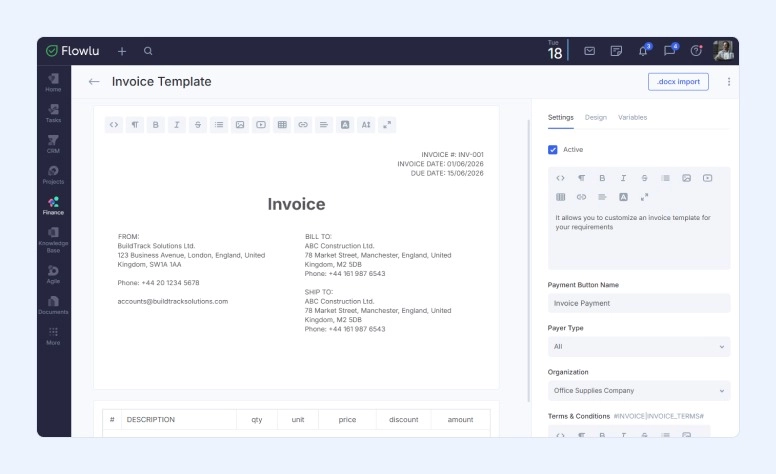
Try our Free Invoice Generator to quickly and easily create a professional, unique invoice with your logo for services, products, consulting, or more. No registration needed.
#4. Bills
These are the invoices you get from your contractors, suppliers, and vendors, and they're your Accounts Payable. Pay your bills on time and maintain a good relationship with your suppliers.
Look at due dates, amounts owed, and payment methods to keep track of your bills.
#5. Payroll
If your small business already employs people, you need to take care of their wages, benefits, and withholding taxes. Pay extra attention here — even a small mistake can lead to a big penalty or an audit from tax authorities.
To keep track of your payroll, look at gross wages, hours worked, independent contractor payments, bonuses, and tax withholdings.
#6. Taxes
It's important to know you're responsible for more than just annual income tax. Since these can add up, you may want to consider setting aside a percentage of your revenue throughout the year.
To keep track of your taxes, look at these types:
- payroll taxes
- local business property taxes
- estimated quarterly income taxes paid
- sales tax collected from customers
#7. Assets
This category includes everything of value that your business owns. It's important to track your assets, especially if you're applying for a loan.
You can track them by looking at your inventory on hand, vehicles, equipment, real estate, cash in the bank, and intellectual property.
#8. Liabilities
These are everything your business owes to third parties. To determine how much your business is worth, you need to calculate its equity, which means knowing both your liabilities and assets.
Liabilities can be tracked by looking at credit card balances, long-term leases, business loans, and outstanding lines of credit.
Basic accounting reports and processes
Good financial management depends on solid structure and organized data. Reports and processes are the two pieces that help businesses get a clear picture of their finances, keep the budget healthy, and take reasonable next steps.
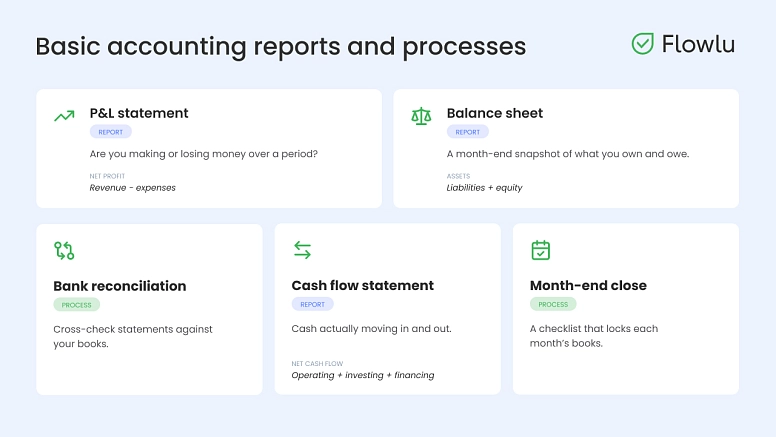
As a starting point, here are the 5 basic accounting pillars:
1: P&L (Profit and Loss) statement
Also known as the Income Statement. It measures how your business is performing financially over a specific period — a year, a quarter, or just a month.
Simply put, this statement tells you whether your business is making or losing money after accounting for your costs.
How to determine your net profit:
Subtract your expenses from your revenue.
2: The balance sheet
Think of the Balance Sheet as a snapshot taken on the last day of each month — it shows how much your business owns and how much it owes. Ultimately, when you look at the balance sheet, you can tell what would be left over if you closed the doors today and paid off all your debt.
How to determine your assets:
Add your liabilities and equity together.
3: The cash flow statement
This shows the actual movement of cash in and out of your bank accounts during a specific period. Here's the catch: even with a positive profit and loss statement, your business can still go under if it runs out of cash.
This statement splits all cash movements into 3 categories:
- Financing activities — owner investments and loans
- Operating activities — daily sales and costs
- Investing activities — buying assets such as equipment
How to determine your net cash flow:
Add up your cash from operating, investing, and financing activities.
4: Bank reconciliation
This is the act of cross-checking your credit card and bank statements against your accounting software. It's an important task to make sure there are no fraudulent charges or bank errors, and to catch any receipts you might be missing.
How to do it:
Compare your bank statement balance to your book balance, then adjust for outstanding checks, pending deposits, and any bank fees until the two match.
5: Month-end close
This is a simple checklist of tasks to complete at the end of every month. Once the month is closed, the data won't be altered. This list keeps transactions from getting lost between months.
How to do it:
Reconcile all accounts, review outstanding invoices and bills, record any missing transactions, then lock the books for that month.
Tools, mistakes, and best practices
Keeping track of your business finances can save you a lot of headaches. Doing it regularly prevents wasted time and money — that's accounting for small business in a nutshell.
But accounting for small business doesn't look the same for every type of organization or industry. Some businesses get by with spreadsheets, while others need dedicated software. So, which is your case?
When can you use spreadsheets?
Using spreadsheets like Google Sheets or Microsoft Excel may be enough for some businesses. Check whether any of these describe yours:
- You're a freelancer or solopreneur with few transactions each month.
- You use cash-basis accounting, tracking transactions only when money actually enters or leaves your account.
- You have simple expenses and deal with no more than 5 clients each month.
Even if spreadsheets work for your case, keep in mind they're prone to mistakes since they rely on manual input.
When should you use software?
Opt for accounting software when you need to:
- Log employee expenses and process payroll.
- Manage inventory that needs to be tracked and updated in real time.
- Spend more than a couple of hours each week manually entering data from bank statements.
Some popular options to consider include QuickBooks, Xero, FreshBooks, and Flowlu. Each covers the essentials like invoicing, expense tracking, and reporting, though they differ in pricing, ease of use, and extra features like project or CRM integration.
Why using special tools may be best option
More and more tools now let you handle your finances and daily operations together in one place.
Here's why you should give Flowlu a try:
1. It fits both enterprises and solopreneurs
Even if you're running a larger company, Flowlu can be an easier, more convenient alternative to spreadsheets. And if you're managing smaller projects, it helps you track your budget in a clear, simple way.
2. It offers a financial document builder — from custom creation to full automation
Create your own invoice (or estimate) and save it as a template, or use one of the ready-made ones.
3. It keeps your finances in context
Tie all financial documents to a specific opportunity or project, so you're not searching for data across the platform.
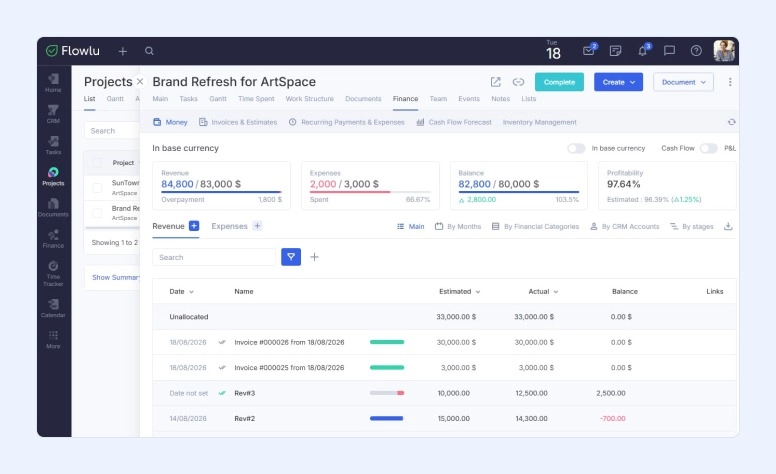
4. It gathers and prepares your results for you
Flowlu gives you detailed reports. You can see the big picture or drill into specific project data: cash flow, invoices and estimates, recurring payments and expenses, inventory management, and even cash flow forecasts.
Instead of using a separate tool for every task, Flowlu lets you do it all in one place: monitor your finances in project context, create financial documents, integrate useful payment systems, automate sending, and get detailed reports.
5 Small business accounting mistakes
#1: Mixing personal and business funds
This is a mistake many freelancers and solopreneurs make. It's easier and faster to keep using the same bank account for both personal and business expenses. But when tax season rolls around, or if you face a tax audit, this can turn into a nightmare — you won't have the same liability protection you'd have as a corporation or LLC (Limited Liability Company).
#2: Not keeping receipts under $75
Make sure you keep all your receipts, no matter the amount. Don't rely on your bank statement descriptions alone — they're often too vague.
#3: Misclassifying workers
Every worker should be classified correctly. Don't call someone an independent contractor instead of a regular employee just to save on payroll taxes.
#4: Ignoring financial reports
You should look at your numbers regularly, not just once a year at tax time. Check your P&L monthly and your cash flow weekly.
#5: Postponing reconciliations
Do reconciliations regularly — putting them off makes it easier to miss receipts and harder to catch duplicate subscriptions.
Make every number count
You shouldn't look at small business accounting basics as just one more task or obligation — see it as a competitive advantage. Knowing your small business accounting basics is crucial to avoid sudden bottlenecks and pitfalls.
No matter if you use spreadsheets, accounting software, or an all-in-one tool like Flowlu, remember that consistency is key — it should be the first item on your accounting checklist.
FAQ
It's the process of tracking, recording, analyzing, and reporting all the financial transactions of a business.
While some people use the two terms interchangeably, they're different.
Accounting is about developing a strategy based on the data gathered through bookkeeping.
Bookkeeping is the daily recording of a business's transactions.
The most important records are income, expenses, employment tax records, and bank statements.
Yes — depending on the business, spreadsheets may be enough to handle accounting. That said, keep in mind these systems rely entirely on manual entry, which is prone to errors. In fact, a single mistake can put your entire financial data at risk.
Income and expenses → weekly
P&L and cash flow → monthly
Full reconciliation and month-end close → every month without exception.