


How to Use CRM Analytics to Predict Customer Behavior and Improve Retention


Customers rarely churn without warning.
The signs are usually there … declining engagement, stalled deals, fewer logins …
But they’re easy to miss in the noise of daily work. By the time the problem is obvious, the customer has often already decided to leave.
Luckily, customer relationship management (CRM) analytics help you spot these signals earlier and act sooner. Let’s take a closer look at how to use CRM analytics to predict behavior and improve retention.
Highlights
- CRM analytics reveals early customer churn signals so teams can act sooner.
- Clean, structured data makes predictions reliable.
- Behavior-based customer segmentation shows who is at risk or ready to expand.
- Tracking intent signals helps teams intervene at the right moment.
- Reviewing predictions regularly keeps insights accurate and useful.
How are CRM analytics helpful for understanding customer behavior and retention?
Many teams already have the signals they need to improve customer experiences and foster loyalty. But they can’t see them clearly or quickly enough to act.
CRM analytics make these patterns visible as they happen.
And the impact is real. A 2024 Freshworks survey found that businesses using CRM systems are 86% more likely to exceed their sales targets than those that don’t. When you look at it from this angle, visibility changes everything.
Let’s look into how that visibility works in practice.
Bring all customer signals into one view
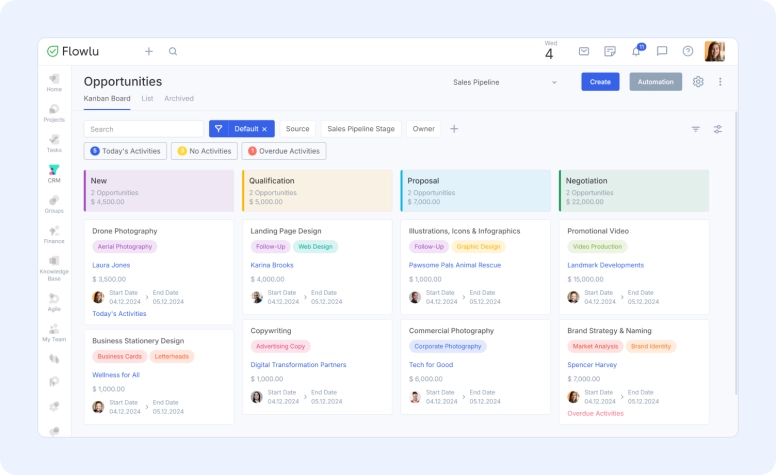
CRM software pulls customer interactions from marketing, sales, and support into a single view. When customer interactions are all in one place, behavior stops looking random and starts forming patterns. Connecting those interactions to deal stages makes it easier to see stalled deals or slowing engagement.
CRM dashboards show you these signals immediately.
Engagement dips? Response times stretch? Usage drops? These early actionable insights show up straight away, so you have time to intervene before frustration turns into churn.
In Flowlu, you can connect deals, projects, invoices, emails, and support activity in one workspace, giving your team a complete behavioral timeline for every account.
Spot patterns that indicate churn or expansion
CRM analytical tools help you track engagement levels, purchase history, and support activity over time. They show you when patterns begin to repeat, so you can use these signals to predict churn.
Plenty of companies already use CRMs to do this. As Tealium’s 2025 Future of Customer Data report found, 43% of organizations using customer data platforms say retention is a main goal.

CRMs let you compare high-retention customers with accounts that churned, making it easier to see differences in customer behavior and sales approach. From there, you can work out what you did differently and what each customer segment needs.
Turn insights into faster customer experience decisions
Insights alone don’t increase sales. Actions do.
This is where CRM analytics start to pay off. CRM behavioral signals help you craft clear next steps for account managers and sales teams.
For example, you might notice …
- Short-term customers disengage after the first contract period, so the sales team introduces structured check-ins earlier in the lifecycle.
- Accounts that expand usually show a spike in usage or support questions first, so account managers start watching for those signals.
- Deals that stall at a certain stage need technical validation, so pre-sales support gets involved sooner.
Identifying patterns early changes how your teams sell, support, and retain customers going forward.
And that shift adds up. According to Tealium’s 2025 report, 90% of organizations using unified customer data say it helps them deliver more relevant experiences.

That relevance, in turn, drives performance. As the 2024 Freshworks survey shows, most companies reported sales revenue increases of 21–30% after implementing a CRM system.
In other words, the value of a CRM comes from how you put it into action.
Speaking of which …
How to use CRM analytics to predict behavior and improve retention
To predict customer behavior, you need three things in place first: Clean data, clear segments, and consistent observation. Without this foundation, patterns stay hidden, and retention efforts become reactive.
Get them right, though, and you can act proactively.
1. Start with clean, structured CRM data
Begin by looking at your CRM data quality. If your inputs are messy, the conclusions are too.
Clean, structured data matters because predictions rely on tracking behavior over time. If people use pipeline stages differently, the data stops reflecting what’s really happening, and predictions become unreliable.
Start by auditing your database.
Review duplicate contacts, check incomplete records, and standardize fields like deal stages, industry tags, and lifecycle status. Then, agree on clear definitions so everyone records data the same way going forward.
(Make sure to maintain that discipline over time. Run regular checks. And make data ownership part of team routines.)
Over time, clean data creates a reliable view of customer behavior, and that reliability is what makes prediction possible.
In Flowlu CRM, you can use built-in Duplicate Management tool to quickly find and merge duplicate contacts or organizations, either in bulk or manually, so your reports and forecasts stay accurate. Follow the step-by-step guide in our knowledge base.
2. Segment customers based on behavior, not assumptions
Segment customers to understand how similar groups act before they buy or churn.
For example, segment your customers based on:
- Customer lifetime value.
- Purchase frequency.
- Deal velocity.
- Engagement.
These behaviors reveal patterns that broader categories hide.
For example, some accounts buy quickly but churn fast. Others move slowly but stay for years. Without segmentation, those signals blur together.
To segment your customers:
- Start by grouping customers using the behavioral signals already in your CRM systems.
- Look at activity levels, renewal cycles, feature usage, or support history.
- Compare segments over time to see which groups renew, expand, or churn most often.
- Refine those segments regularly as real-time data arrives.
Remember, customer expectations shift, and market trends change. If your segments stay static, you’ll lose value as these things evolve. But if you revisit them regularly, you’ll see where risks and opportunities are forming.
Segment customers in Flowlu using tags, custom fields, and built-in fields like Industry and Category to group accounts by real behavior (not assumptions) and uncover patterns in retention, expansion, and churn. Learn how to classify and organize your contacts in our help center.
3. Identify and track the signals that predict customer behavior
Next, look for the signals that predict change.
Segments tell you who behaves similarly. Signals tell you when behavior is about to shift.
Start by identifying intent signals already visible in your CRM data.
This might show up as …
- New stakeholders joining conversations.
- Sudden interest in different features.
- Increased research activity.
- Visits to pricing pages.
These moments rarely appear at random. They usually reflect a decision forming in the background.
For example, if you were selling New York car insurance, you might notice a sequence of behaviors before someone buys.
Prospects might:
- Visit the pricing page multiple times within a week.
- Read your comparison guides.
- Use your quote calculator.
- Check your policy details.
Each of these actions looks small on its own. But together, they tell a clear story. Someone’s gearing up to buy.
You can track these signals directly in your CRM.
- Create fields to capture key behaviors.
- Set alerts when activity spikes or drops.
- Review patterns during pipeline or account reviews.
Over time, these signals become inputs for segmentation, churn scoring, and retention planning.
4. Build simple predictive models to identify churn risk and intent
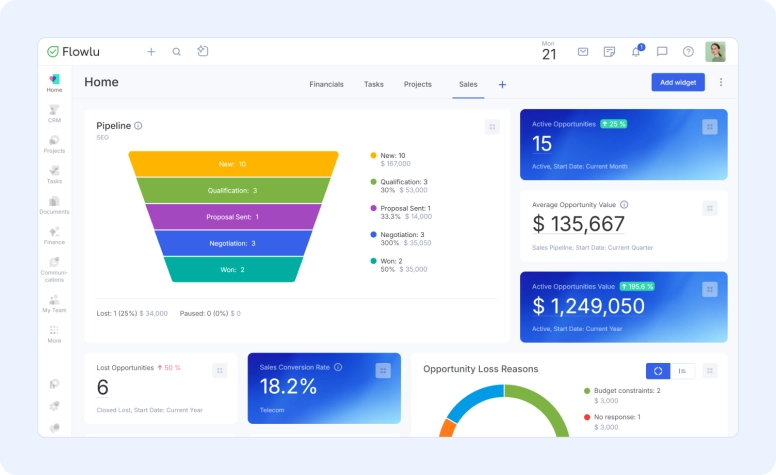
At this stage, you’re identifying the behaviors that come before churn, renewal, or expansion.
Start by analyzing historical CRM data. Look for signals in the months before customers leave or renew.
Are you seeing engagement drop? Does deal velocity slow? Do support requests increase?
These patterns are often consistent once you start looking. Recognizing early signals gives your teams time to act.
To create predictive models, try simple approaches first. Here are a few examples:
- Regression models. Estimate how likely an outcome is by analyzing relationships between variables.
- Classification models. Sort customers into categories, such as “high risk,” “medium risk,” or “likely to renew."
- Decision trees. Map a sequence of conditions that lead to an outcome, to see churn and conversion behaviors.
Many CRM systems already support these models through built-in reporting or integrations.
Make sure to explore your CRM’s functionality to understand how it can help you make these predictions.
5. Trigger customer retention actions the moment behavior changes
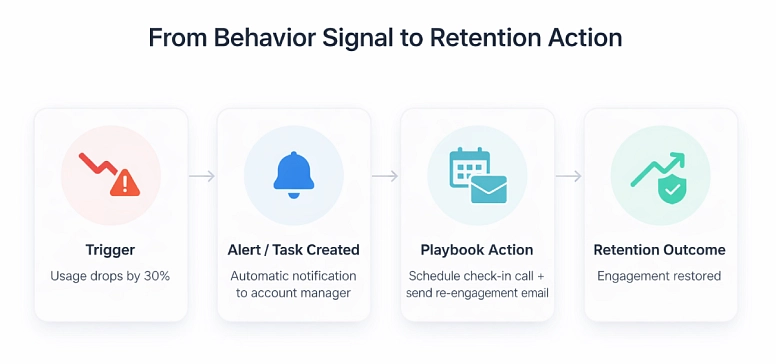
Now, turn your insights into actions.
Start by defining clear thresholds that signal risk, such as these …
- Declining usage: Product usage or feature adoption drops by a defined percentage over a set period.
- Renewal risk timing: No activity or meetings scheduled within a defined window before renewal dates.
- Engagement drop: Email opens or logins fall below a normal level for two or three weeks.
- Stalled deals: Opportunities sit in the same deal stage longer than the average sales cycle.
Next, you need to automate the responses to these triggers. (Improving retention depends on anticipating needs before customers ask for help.)
In Flowlu, you can set up automation rules to trigger tasks, reminders, or email sequences when usage drops or deals stall, helping your team act before churn happens.
Also, you might use an AI marketing tool to send a tailored re-engagement email sequence when product usage drops. Or move an opportunity back into a nurture workflow when a deal sits in the same stage for too long.
You could also:
- Alert customer success to schedule a review call when support tickets increase.
- Prompt a check-in call when a key contact hasn’t logged in or replied to emails.
Finally, coordinate messaging across marketing, sales, and customer service. That way, customers experience one consistent relationship, not three departments.
6. Protect customer data while scaling predictive analytics
Protect customer data to ensure trust and compliance.
Start by mapping where data moves. Customer records often pass between CRM platforms, analytics tools, and marketing systems. Understanding those flows helps you prevent security gaps and data privacy risks.
This step is pivotal from a compliance standpoint. Predictive analytics relies on lots of customer data. A single leak or misuse can damage customer trust and lead to non-compliance fines.
To manage this properly, monitor who can access sensitive information and how they use it. You should also limit access where possible and regularly review permissions.
Many organizations now adopt practices aligned with Data Security Posture Management (DSPM). This approach helps you automatically identify and secure sensitive data across cloud environments.
7. Validate predictions and refine your model continuously
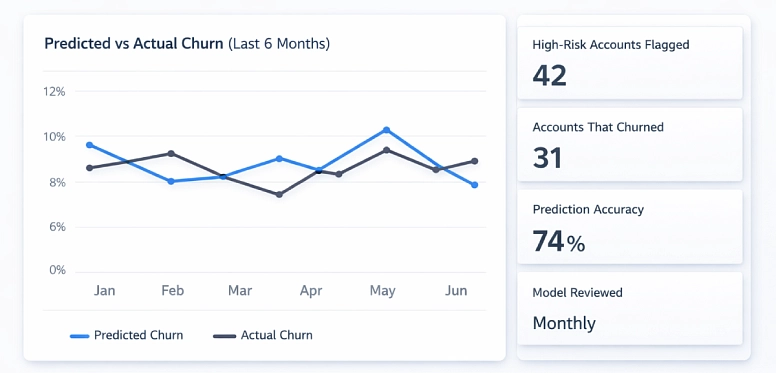
Keep reviewing and updating your predictions regularly. This is how they stay accurate over time.
Start by comparing predicted outcomes with real results.
Here are a few ways to do this …
- Look for consistent blind spots by identifying segments where predictions are often wrong. These gaps often point to missing data or signals that you need to include.
- Review timelines, not just outcomes, by checking whether predictions were made early enough to act. Accurate predictions that arrive too late still fail to help customer retention.
- Compare which accounts the analytics flagged as high risk with the ones that actually churned. Look for patterns in the incorrect predictions as well as the correct ones.
Small gaps between prediction and reality add up quickly. When you review results regularly, you ground your models in real behavior instead of assumptions.
Once you’ve reviewed your predictions, update your models and segments to reflect what customers are actually doing now.
Finally, track sales forecasting accuracy in a way that leadership can quickly understand. Show how predictions compare with renewals, churn, and deal progression over time. When leadership can relate analytics to real value, they can make better, faster decisions.
Wrap up
Predicting customer behavior starts with clean data, clear signals, and consistent follow-through. When you track patterns, act early, and refine your models, it’s far easier to build effective retention strategies.
Ready to manage customer relationships, workflows, and reporting in one place?
Explore how Flowlu can help you turn insights into practical action.
The strongest signals for predicting customer behavior are:
- Customer engagement activity.
- Support interactions.
- Deal progression.
- Purchase history.
The goal is to track behaviors that change before customers renew, expand, or leave.
Review predictions regularly, ideally monthly or at the end of each sales cycle. This helps you maintain accuracy and adjust for changes in customer behavior or market conditions.
The biggest CRM mistake is relying on incomplete or messy data. Predictions are only useful when the underlying CRM data is accurate and consistently maintained.