




Company OKRs: Meaning, Examples, and How to Set Objectives and Key Results


Quick answer
Even with a clear company direction, employees can lose focus in the daily work rush. This may lead staff to unconsciously chase their own objectives instead of the business's.
To prevent this, many large companies — like Google and Intel — use a framework called OKRs, or Objectives and Key Results. More than just a mindset, this framework sets rules that connect ambitious ideas with measurable key results across the company, teams, and individuals.
See how it can help your company stay true to its overall goals and culture while keeping daily execution sharp.
What OKRs mean for a company
Sometimes it can feel like your business is running in several directions at once. The truth is, you're not alone — and like many large companies, you can solve this using OKRs.
At its core, the meaning comes down to a goal-setting framework created to help businesses stay focused, align teams, and measure what matters. It tries to answer two questions: where does the company want to go, and how will it know it's getting there?
Naturally, answering the first question gives you the objective. Answering the second shows you how you'll achieve that goal.
OKR vs KPI
Many business owners still confuse OKRs with KPIs — Key Performance Indicators. Let's clarify the difference in the table below:
|
Criteria |
OKRs |
KPIs |
|
Purpose |
Lead the company toward growth and change |
Measure business as usual, such as ongoing performance |
|
Focus |
On where the company should be in the near future |
On what's currently happening within the business |
|
Nature |
More dynamic and aggressive |
Static and continuous. The metrics are usually calculated quarterly, for example |
|
Outcome of failure |
Expected to happen occasionally |
Shows a process is broken and needs to be fixed immediately |
Both are important for a successful business: KPIs tell you how things are currently running, while OKRs push you toward where you want to be. Used together, they give you a complete performance picture.
Special tools can make monitoring both much easier. In Flowlu, for example, you'll find real-time updating dashboards with more than 70 widgets, and can create tasks with detailed settings (like descriptions, priority levels, checklists, subtasks, and project relations) that keep every assignee completely clear on what's expected.

OKR Cadence
One thing to keep in mind: OKRs aren't a system you set up and forget about. Instead, you need to review them throughout the year.
As a rule of thumb, define 3 to 5 high-level strategic objectives each year to keep the bigger picture in view. Then set different ones each quarter to drive execution. And always remember to share the OKRs with your team.
How to write good company OKRs
Don't think that defining OKRs will be easy. The main challenge here is to reach a balance between making a goal difficult but at the same time keep it possible to achieve. And as you already know, if you can reach 100% of your OKRs, this means that you set the limits too low.
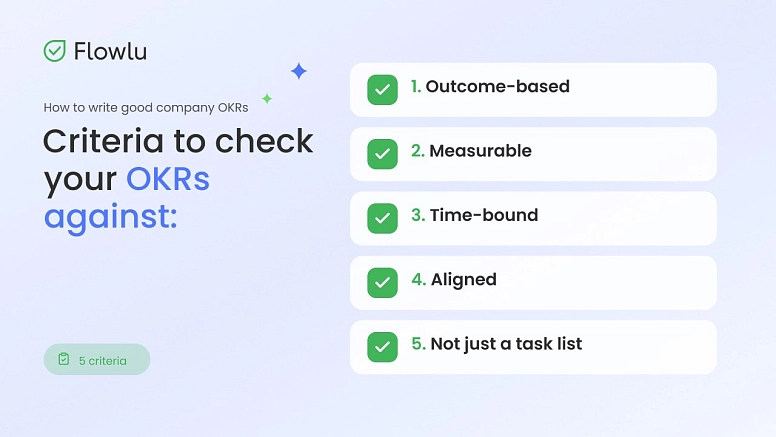
Below are some criteria to check your OKRs against:
1. Outcome-based
When you define objectives and key results, think about what you get, not how you get it. Forget about the activities and focus on the outcomes only.
2. Measurable
This is a tricky one for many business owners. The thing is, an objective is mainly qualitative, while a key result needs to be quantitative.
3. Time-bound
To be an OKR, you need a number and a deadline. Make sure you have milestones, especially when writing these for each quarter.
4. Aligned
When you define OKRs, don't treat them as rules you impose on your team. Instead, build alignment through a two-way conversation.
There's no question it's management's job to set the strategy behind company OKRs. But take the time to connect those objectives with your team's own team goals, and ask how they believe those objectives can be reached.
5. Not just a task lists
Whenever you see a key result that starts with a word like "test," "launch," "build," "implement," or "consult" — you don't have a key result. You have a task.
To fix that, look at each one and ask yourself: what happens once this task is completed?
The answer to that question is your real key result.
Company OKR examples by department
As a company, you need general OKRs for the entire business. But it's important not to forget to set them for each department as well. Here are some OKR examples:
Sales
The sales department's main focus relates to deal size, revenue velocity, and market expansion. Based on this, your objective is to accelerate the mid-market engine for growth.
You may define 3 key results:
- Increase annual revenue from recurring customers to $1.0M.
- Decrease the sales cycle to 20 days.
- Increase the win rate to 30%.
Marketing
The marketing department is oriented toward brand authority, pipeline generation, and acquisition efficiency. Therefore, your objective is to become the leader in your industry.
To achieve it, you may define 3 key results:
- Grow organic traffic to 60k monthly visitors.
- Generate $2.0M in Marketing Qualified Pipeline for the sales team.
- Decrease customer acquisition cost by 10%.
Product
This team is in charge of time-to-value, system reliability, user adoption, and customer delight. Set the bar like this: turn the mobile app into the most reliable one in your industry.
Break it down into 3 key results:
- Increase user retention rate to 40%.
- Decrease errors reported by users to less than 2 per month.
- Improve the app's load time to under 1.5 seconds.
Customer success
Customer success is responsible for customer health, expansion, retention, and advocacy. That means you should build a solid foundation of loyal customers.
Set 3 practical key results:
- Increase net revenue retention rate to 80%.
- Decrease churn to under 3%.
- Move 10 enterprise accounts with a health score below 5 to a healthy status — a health score above 75.
Operations
Specialists in this department focus on cost management, talent density, internal efficiency, and scalability. So here, you should adapt your internal structure to support rapid expansion.
Stick to 3 key results:
- Time to hire for technical roles should be under 25 days.
- Get an Employee Net Promoter Score above 50.
- Decrease cloud infrastructure costs by 10%.
How to track OKRs without creating extra bureaucracy
Whether you're doing annual or quarterly planning, the last thing you need is to spend too much of your team's time just defining OKRs.
And that's only the first step. The next one is monitoring — which means your team also has a role to play here.
These 4 aspects can help:
1. Determine ownership
When you define an OKR, you need to assign an owner to it. Otherwise, it won't work.
Since we divide the OKR framework into objectives and results, you'll need an owner for each part. Objectives are usually owned by the team leader or department head. Key results are owned by individuals.
2. Improve the review cadence
This framework may be something new to your team. That's why you should integrate it into the meetings you're already having.
Let's say you usually have a brief with the team at the beginning of each week — just use 10 minutes to check how the key results are going. Also use monthly meetings to review the key results, but focus your energy on the ones that are blocked or at risk. This will let you reallocate resources or make necessary changes.
3. Scoring should be simple
OKR scores aren't meant to evaluate individual performance. Let your team know this in advance.
As a rule of thumb, scoring should be as simple as possible. For example, you may use:
- Green for a score between 0.7 and 1.0 — though if you hit 1.0, your goal was probably too easy.
- Yellow for a score between 0.4 and 0.6 — you made a good effort, but fell short of the target.
- Red for a score between 0.0 and 0.3 — this shows you failed to make any meaningful progress.
4. Connect goals to workflow
One of the main reasons OKRs fail is that they aren't monitored. In project management platforms, you can clarify goals, tie them to tasks, and track results in real time.
For example, in Flowlu you can create personalized dashboards for different departments.
Sales can track active opportunities, their value, sales conversion rate, and any other metrics you define as key results.
Customer success specialists can track revenue sources or identify top clients by revenue generated.
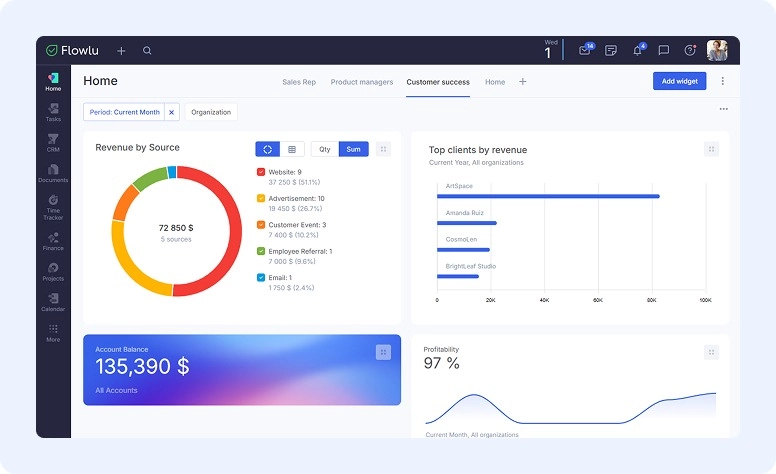
Product managers can use the Agile Project dashboard to follow sprint progress and tie key results — like feature releases or bug-fix rates — directly to their team's active tasks.
5 Critical OKR mistakes to avoid
#1: Defining too many OKRs
If you're new to this framework, you may have a tendency to define too many.
Fix: Treat them as priorities and stick to 3 to 5, not more.
#2: Treating key results as a to-do list
A key result isn't the same as a task. If it looks like a task, that's usually because it is one.
Fix: For each key result, ask what happens once the task is completed — the answer is your real, measurable result, not the task itself.
#3: The set-and-forget mentality
OKRs don't work if you set them once and forget about them.
Fix: Keep monitoring them — not just annually, but on a quarterly basis too.
#4: Punishing failure
Failure should be seen as something to learn from, not something to punish.
Fix: Even if an objective was only partially achieved, that's still a win. Celebrate it with the team.
#5: Treating OKRs as top-down orders
Sure, it's management's job to write the objectives. But the whole team should have a say.
Fix: Before setting OKRs, check in with the colleagues and ask how they plan to reach those goals.
Clear objectives — high results
Just like any other framework, when you decide to adopt OKRs in your company, you're making a cultural change — not just a quick shift in how you manage or run your business.
With this, you'll finally see the impact each employee has on your organization, since every key result will have an individual responsible for it.
Remember that OKRs isn't a system that you can set and forget. Maintain constant monitoring and prioritization each quarter and annually. To make sure that your goal setting, team alignment, and quarterly planning are easier, we recommend you to try special tools like Flowlu. With this cloud-based platform, you can easily link tasks to high-level objectives, and have every information you need in just one place, avoiding bureaucracy.
While the framework has a learning curve, it brings real benefits to your company. So just remember to start small and take it one step at a time. Before you know it, you'll be reaping the rewards of this powerful framework.

FAQ
The meaning is straightforward: Objectives and Key Results. See them as a framework just like Kanban or Scrum. The difference is that this one uses goals to drive focus, align teams, and measure performance.
You might set the company objective as delivering the best onboarding experience to customers. Based on that, you could define the following key results:
- Increase user retention to 30%.
- Decrease onboarding completion time to 20 minutes.
- Reach a customer effort score of at least 70.
KPIs are just a method to measure your business operations as usual, without any changes.
OKRs show you where your company is headed and what will be done to reach it.
As a rule of thumb, you should only set between 3 to 5.
They aren't a set-and-forget system. Check in briefly each week during your regular team meeting, review progress in more depth monthly — focusing on key results that are blocked or at risk — and do a full reset each quarter. High-level annual objectives are usually revisited once a year.