



Project Life Cycle Stages: From Initiation to Closure

Quick answer
No matter the undertaking you have in hand, or the one you're considering, the main idea is that all projects should begin with an idea and end with a tangible deliverable. To make your work successful, enthusiasm alone isn't enough. You need structure, the discipline to follow the plan, and direction. When any of these three components fail, you may end up with a failed project — whether it's because of delays, scope creep, or budget overruns. And this is more common than you might think: PMI’s 2025 research found that only half of projects meet its definition of success.
This is exactly what this framework covers, and why it matters so much. Simply put, it breaks project management into several formal phases, making it easier to comply with requirements, meet deadlines, manage risks, and spend resources wisely.
What is the project life cycle
Simply put, we can say this is a framework built from different stages or phases, through which a project moves from the very beginning until it's formally completed. It serves as a roadmap for managers.

One thing worth keeping in mind is that even though all projects are different, it stays structured, providing a level of control and predictability.
The purpose
As we said, this process breaks the work into different stages. This makes the work more manageable and lets it progress step by step through clearly defined project management phases.
Structure allows project managers to:
- Plan which activities should happen and when
- Bring clarity, since each specialist understands not just the initial goal, but the final outcome
- Ensure that everyone involved stays perfectly aligned
If you're looking for a digital space where everyone involved can collaborate easily and effectively, use dedicated project management tools like Flowlu.

Why stages help governance and delivery
One of the main reasons project management phases matter so much is the control they give you over resources, scope, and quality.
This becomes even more important as work gets more complex. PMI’s 2026 research found that 81% of professionals say projects have become more complex in recent years. It also found that teams that manage complexity effectively are five times more likely to report successful outcomes.
#1: Phase gates
You may also hear phase gates called milestones or checkpoints. At these points, the project is evaluated before it can move to the next stage.
#2: Proactive risk and change management
In the early stages of a project (initiation and planning), companies need to identify possible risks, resource constraints, and potential bottlenecks before they commit any capital. That way, even if a market shift happens, it's a lot easier to deal with its impact and adjust the plan as needed.
#3: Resource optimization & financial control
In almost every undertaking, the amount of financial and human resources allocated differs from one stage to the next. This makes it easier for the project manager to assign resources to each phase and keep them optimized.
#4: Quality assurance & scope guardrails
Before the work can move to the next stage, it needs some criteria that you should have previously defined. This ensures that quality standards are being met throughout time and not just leaving everything to fix before launch.
Main project life cycle stages
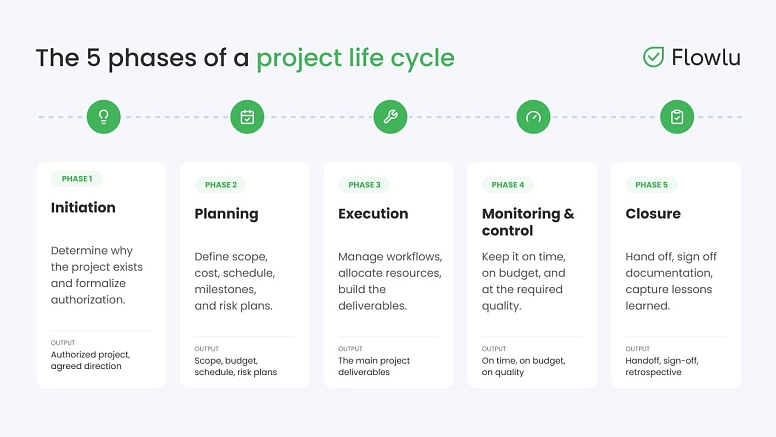
Phase #1: Initiation
This first phase serves to determine why the initiative is being taken in the first place. So, as you can easily understand, this is the stage when you formalize authorization and establish the initial direction.
Phase #2: Planning
This stage establishes the terms of completion. You'll need to determine the scope, cost, and schedule for the team to execute the tasks. Don't forget that risk response plans and milestones should also be defined during this phase.
Phase #3: Execution
Execution is the time of "doing" or "building." You'll need to manage team workflows, facilitate communication, allocate resources, and produce the main outputs.
Phase #4: Monitoring and control
Here, you want to make sure everything is on track for success. This means finishing on time, on budget, and with the required quality.
Phase #5: Closure
The last stage is, as you can easily understand, when you formally wrap things up — meaning it's time to deliver the work. The transfer to end users finally takes place, and this is also when you do some retrospective work: sign off on all project documentation, look at what worked well and what didn't, archive all files, and hold onto the lessons learned so you can apply them to future initiatives.
What happens at each stage
Here's what happens at each of the project lifecycle stages described above.
NOTE: The project manager is a stakeholder at every stage.
|
Stage |
Deliverables |
Key decisions |
Risks |
Stakeholders |
Documents |
|
Initiation |
- Initial business case, - Scope outline, - Feasibility studies. |
Whether the project is viable or not. |
- Misaligned business goals, - Vague objectives, - Missing stakeholder information. |
- Project owner, - Portfolio manager, - Finance leads, - Executive sponsor. |
- Project Charter (requires formal sign-off), - Stakeholder Register. |
|
Planning |
- Cost baseline, WBS (Work Breakdown Structure), - Project schedule, - Resource management plan, - Risk management matrix. |
- Vendor selection, - Make-or-buy decisions, - Resource allocation commitments, - Baseline approvals. |
- Inaccurate budget forecasting, - Unrealistic timeline estimates, - Scope creep during planning, - Unavailable resources. |
- Procurement team, - Technical leads. |
- Project Management Plan (requires approval), - Communications plan, - Procurement plan. |
|
Execution |
- Functional deliverables, - Completed product components, - Status updates, - Team performance reports. |
- Reallocation of resources, - Technical adjustments, - Conflict resolution, - Vendor contract management. |
- Team conflicts, - Burnout, - Unmanaged scope changes, - Poor communication. |
- Quality assurance leads, - Core delivery team. |
- Task logs, quality checklists, - Work performance records, - Issue logs. |
|
Monitoring and control |
- Quality audit reports, - Variance analysis reports, - Approved change requests, - Earned value calculations. |
- Implementation of preventive or corrective actions, - Approval or rejection of change requests. |
- Unnoticed cost overruns, - Uncontrolled scope creep, - Delayed defect detection. |
- Quality assurance team, - Change control board. |
- KPI dashboards, - Risk register, - Change log, - Variance analysis reports. |
|
Closure |
- Finalized documentation, - Handover package to end users, - Lessons-learned database. |
- Release of team resources, - Formal acceptance of deliverables, - Final vendor payment authorizations. |
- Premature team release, - Unassigned ongoing support responsibilities, - Incomplete knowledge transfer, - Unresolved vendor disputes. |
- End users, - Executive sponsor, - The team. |
- Final project report, - Closed procurement contracts, - Project acceptance sign-offs, - Lessons-learned documents. |
How to manage the life cycle in practice
Up until now, we've been fairly theoretical about all this, without showing you any real project lifecycle examples.
Essential workflows: templates, checklists, and handoffs
#1: Documentation & templates
These are great tools for cutting down time spent on repetitive tasks, and for keeping your documentation consistent from project to project. Some of the documents or templates you should have ready to use include a Work Breakdown Structure matrix, a project charter template, and a risk register.
#2: Checklists
The key objective of checklists is to make sure every point is checked off. Only then can a project move from one stage to the next.

For example, a project can't move to the next phase until certain prerequisites are met. These should include having the project management plan signed off by the sponsor, the schedule baseline set and the budget locked in, resource capacity and assignments determined, and risk response actions assigned to task owners.
#3: Clear handoff protocol
Handoff points represent moments where momentum or knowledge can be lost. It's important to keep in mind that these protocols require sign-off receipts, technical walkthroughs, and formal documentation reviews.
Common pitfalls across the life cycle
The reality is that even experienced teams run into some very common mistakes at every phase.
#1: Skipping initiation
Sometimes, you may be so eager to start a project that you're tempted to skip the initiation phase. You'll want to avoid this at all costs, though, since it usually means failing to deliver real business value.
#2: Release of resources ahead of time
Some project managers tend to start releasing team members during the execution stage so they can help with other projects or tasks. This should be avoided, though — your plan accounted for these resources being used until this phase is complete.
#3: Scope creep in execution
If you keep allowing minor changes or additions during the execution stage without documenting or approving them, you'll most likely end up with a delayed project and inflated costs.
#4: Overlooking lessons learned
One of the best things about working on a project is the chance to learn from it and make future projects run more smoothly. When you skip the retrospective, you're not just ignoring the mistakes you made — you're setting yourself up to repeat them.
Streamlining project life cycle management with Flowlu
You may be eager to start applying these stages, but there's still one thing missing — a centralized system like Flowlu to manage it all in one place. Here's what that looks like in practice:
1. Planning phase: Create and reuse your own project templates, design workflows and set them as predefined, build task dependencies, and add milestones to map out your plan.
2. Execution phase: Break your work down into tasks, and track progress visually with Gantt charts and Kanban boards.
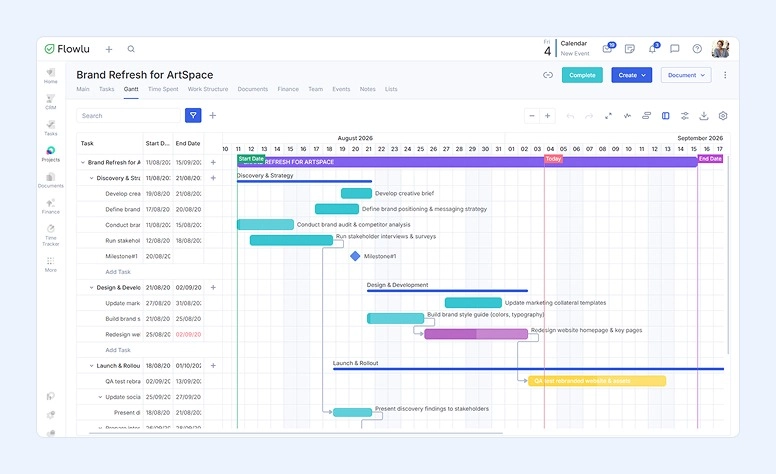
3. Closure phase: Use Flowlu's built-in knowledge base and document management system to keep all your documentation organized and your lessons learned visible and easy to consult anytime.
Make the life cycle work for you
As a project manager, you need a structured framework you can use and replicate — one that keeps both the team and everyone involved informed as the project moves from start to finish. But more than that, you want to master the 5 phases of the project life cycle.
When you combine these phases with a tool like Flowlu — which gives you custom templates, documents, workflows, and more — you have everything you need for effective project life cycle management.
FAQ
There are 5 stages: initiation, planning, execution, monitoring & control, and closure.
The project life cycle is the complete path a project takes from concept to completion, while its phases are the individual stages the project passes through within that life cycle.
The project life cycle is important because it serves as a structured roadmap for all your projects.
This is the stage where final transfers occur. Deliverables are accepted by the user, vendor contracts are closed, team members are released to other activities, the lessons-learned document is created, and all financial records and project files are archived.