




12 Principles of Agile Development: Meaning and Practical Examples


Quick answer
While classic frameworks may be a firm basis, in modern circumstances they're quite rigid. That is why many organizations are already adopting a more flexible methodology like Agile. The thing is, in its 12 principles, you'll discover how teams can deliver more value to their business through proper customer collaboration, working software, and constant improvement.
Today, we're going to show you how to start using Agile in your processes. Here's everything about the 12 principles — 12 steps to a successful business.
Where the 12 Agile principles come from
The Agile Manifesto was written back in 2001 by 17 software developers in the United States. This Manifesto offers a more flexible vision of how you should run your business.
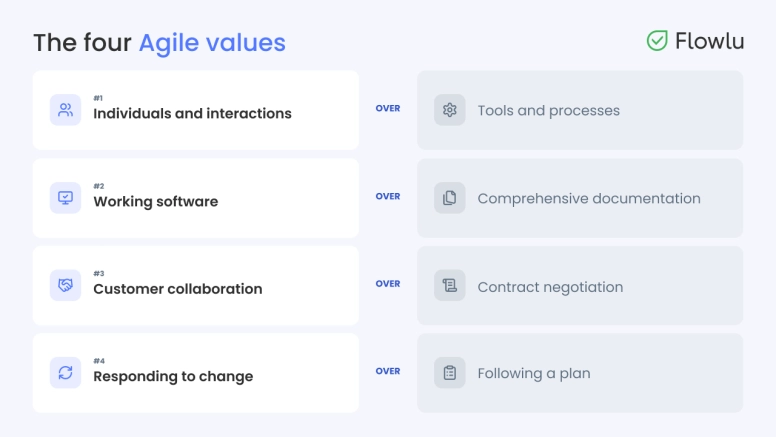
Here are its 4 main values:
- Individuals and interactions are more important than tools and processes
- Working software is more important than documentation
- Customer collaboration is more important than contract negotiation
- Responding to change is more important than simply following a plan
One of the main questions many business owners ask is how you can actually put this into practice, in your business's day-to-day. To answer this question, the authors of the Manifesto defined 12 core directives — the Agile manifesto principles that guide how Agile teams work today.
The 12 Agile principles explained
#1: Satisfy the customer through early and continuous delivery
This principle simply states that you shouldn't leave your customers waiting for your product for weeks, months, or years. Deliver them working pieces (with improvements) regularly.
Say you want to launch an e-commerce platform. Instead of taking a year to launch it with all the bells and whistles, you launch a basic version in a month. Buyers can start purchasing, join your loyalty plan, and give you feedback on which payment options to add next.
#2: Welcome changing requirements, even late in development
One thing you should always keep in mind is that change is inevitable. So don't look at new requirements as a burden — add them to the next sprint and see them as an opportunity to deliver a more competitive, better product.
You're building a CRM, and a client asks for custom invoice templates you hadn't planned for. You add them to next week's sprint instead of the next release six months out — a bit of rework now, but the client gets what they actually need.
#3: Deliver working software frequently
Don't leave stakeholders or clients waiting for the final delivery. Instead, send them regular, usable updates of the product — this lets you get feedback along the way.
You're building an inventory management tool with modules for stock tracking, supplier orders, and reporting. Instead of waiting six months to deliver the whole system at once, you ship the stock tracking module in week 4 and get it in front of the client for feedback right away.
#4: Business people and developers must work together
It's important to hold daily meetings between business people and developers so the main goal and vision remain intact. These recurring check-ins are great for getting approvals and clearing bottlenecks.
Say your dev team is heads-down building a new feature, but no one's confirmed with the business side whether it still matches the client's priorities. A quick daily sync catches that early — instead of finding out at launch.
Tools like Flowlu, with its Client Portal, make this easier by keeping tasks, comments, and approvals in one place both sides can see.

#5: Have motivated individuals
Always try to hire the most motivated, passionate people. Give them the right tools and a good environment, and they'll bring their best to the job.
A support agent who actually has the tools to solve tickets fast spends less time apologizing for delays and more time making customers happy.
#6: Enable face-to-face conversation
Email isn't the best tool for real communication. It just takes too long. Talk directly with others, face to face. When that's not possible, hop on a quick video call to discuss the issue and land on a solution together. It'll take 5 minutes, not 20 or more.
Instead of a five-email thread about a bug, you hop on a quick Zoom or Google Meet call — and it's solved before the emails would've even landed.
#7: Working software is the primary measure of progress
You may have beautiful software with slick to-do lists, fancy charts, and thorough documentation. But what matters is that it actually works in the hands of users — not just that it looks good.
If you're evaluating project trackers, prioritize ones that hold up under daily use, not just ones that look sharp in a demo — tools for Agile project management like Flowlu, Asana, or Trello are solid examples of software built with that in mind.
#8: Promote sustainable development
There will always be deadlines to meet, but if you maintain a sustainable pace, your team can keep going without burning out.
Your team just shipped a big feature after two weeks of 12-hour days. Instead of immediately piling on the next one, you build in a lighter sprint to recover — so burnout doesn't creep in by month three.
#9: Pay close attention to technical excellence and good design
The main focus in Agile should be to get things done right the first time. This means you won't have to keep going back to fix mistakes as you work toward the final product.
Instead of rushing out a signup form that lets users register with an already-taken email, you spend an extra day adding proper validation — so you're not fielding duplicate-account complaints three sprints later.
#10: Simplicity — maximizing the amount of work not done
Don't make things harder or more confusing than they need to be. Just do what was actually requested. Nothing more.
A client asks for a search bar. Instead of building filters, sorting, and autocomplete no one requested, you ship a simple search box that just works.
#11: Self-organizing teams
As the business owner, you shouldn't always make decisions for your team. Your job is to steer the business, but they're the ones solving problems in the real world — so they're better placed to decide which tools and features actually fit.
If your dev team says a certain testing tool will save them hours each sprint, let them choose it — even if it's not the one you'd have picked yourself.
#12: Regularly reflect and adjust
It's important to always dedicate some time to reflection. It doesn't need to take days or weeks — just take a moment to evaluate how things are going.
Look at what your business is doing well and what could be improved. What mistakes happened recently, and how were they solved? How can you prevent them next time?
How teams apply Agile principles in real work
1. Planning
Agile teams usually work with flexible, short-term plans that adapt as circumstances change. The planning usually includes:
- Backlog refinement: The development team and the product owner get together regularly to turn broad goals into smaller ones.
- Relative estimation: Teams estimate effort based on the complexity of tasks instead of simply tracking hours.
- Just-in-time detailing: Technical specifications are only discussed right before the work begins, not months in advance.
2. Feedback
Feedback should also be continuous, to make sure that ideas are validated earlier and risks are minimized.
3. Delivery
Just like feedback, delivery needs to be constant as well. You want to define small increments that can be released and analyzed by stakeholders.
4. Team autonomy
In Agile, authority isn't concentrated in management — it's often handed to cross-functional execution teams, since they have the skills needed to make decisions and handle practical questions like how something gets done.
Agile principles call for daily communication. For a concrete practice, you can borrow from Scrum, the most widely used Agile framework — it recommends a 15-minute daily stand-up.
5. Technical excellence
Agile development principles require a robust codebase. This is why developers and engineers play a key role in delivering only the best quality.
6. Retrospectives
In everything in life, not just in business, learning from mistakes is key. We're not machines, and there is always room to improve. So, looking back at what succeeded and what didn't, and questioning how you could have done things differently, is very important.
Common misunderstandings
The truth is that even though we gave you a quick explanation of each of the 12 Agile development principles, some teams still struggle to put them into action. And this isn't because they don't want to — it's because the concepts may feel a bit confusing. Let's take a look at some common misunderstandings about Agile values and principles.
#1. Agile is different from Scrum
Many people continue to say that Agile and Scrum are just the same thing, but they're not. Scrum is one of the different frameworks you can use to implement Agile, which is a complete philosophy that includes 4 core values and 12 principles.
#2. No documentation
While in Agile, working software is more important than comprehensive documentation, there's no excuse for not having technical guides or tests. When we say it isn't so important, we mean you still need some documentation — but it needs to be useful.
#3. Water-Scrum-fall
It's very common to see teams use Scrum ceremonies on the surface while still running long development stages where delivery only happens at the end — a leftover habit from Waterfall. This delays feedback and eventually hides technical risk until it's too late to adapt.
#4. Micro-managed standups
Regular, quick daily stand-ups can turn into little more than a status report to a manager. This is terrible for the entire team, since it destroys their autonomy and turns the meeting into an accountability check
#5. Scope creep in the middle of the sprint
Stop adding new tasks to the board during the sprint. Not only will the team get overwhelmed, but it also jeopardizes predictable delivery and prevents a sustainable pace.
Agile adoption checklist
Before you can say that you have Agile business processes, they need to meet specific criteria:
- The management trusts self-organizing teams, and success is measured by outcomes and not by the number of hours worked
- Deployments happen frequently, backed by solid testing
- Stakeholders and product owners meet regularly to improve backlogs
- Failure is seen as a way to improve
- What happened at the end of each cycle is evaluated, and adjustments are made for continuous improvement
Centralizing work visibility with Flowlu
To apply the Agile philosophy properly, there are things you need to watch closely, such as team capacity, the product backlog, and ongoing sprints. That's where a dedicated tool makes a real difference.
While there are some available on the market, Flowlu is one of the best, thanks to its simplicity and effectiveness.
It has a dedicated Agile module designed around flexible best practices:
- Start your sprint: Set a duration and enable deadline notifications in issues.
- Revise backlog: Monitor what was completed during the sprint and what should move to the next one.
- Set issue types: Is it a task or a bug?
- Borrow from Scrum: Use an easy, customizable drag-and-drop Kanban board to track sprint progress.
- Automate: Create rules to speed up workflow and free up your specialists' time from routine work.
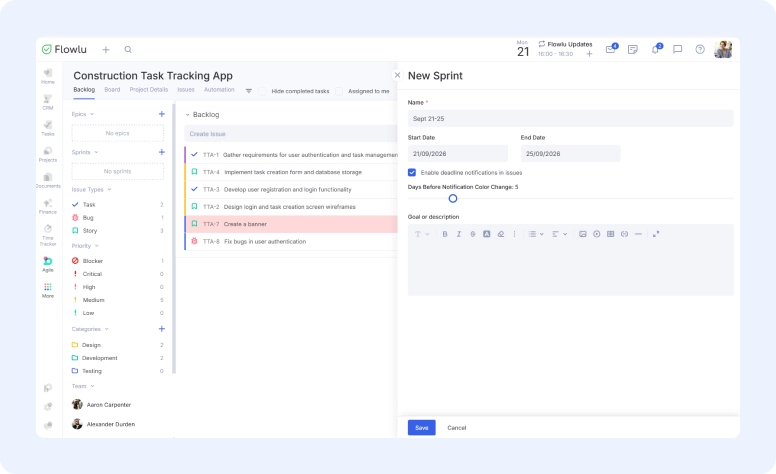
Because the interface is so intuitive, you can pick up the methodology even if you're new to it. It'll be fairly easy to identify bottlenecks and track progress with clear boards and reports.
Bring Agile into your business
This framework allows you to finally put Agile into practice in your own business. You should see it as the principles behind the Agile Manifesto, put into practice — and finally be ready to become a 21st-century company.
Agile is a complete philosophy that helps you build trust and quality, and, above all, adopt a culture of adaptation. The truth is that it's not easy to start implementing all these core values and principles overnight. Using Flowlu can really make a difference for your business. With all its features, it'll be easier to deliver quality products, keep customers happy, and keep your teams working at a steady pace.

FAQ
The Agile Principles are practical guidelines based on the Agile Manifesto:
- Customer satisfaction with continuous deliveries
- Welcome changing requirements
- Deliver working software regularly
- Developers and business people need to work together daily
- Face-to-face communication
- Build projects around motivated individuals
- Progress is measured by working software
- Sustainable development
- Technical excellence
- Simplicity
- Self-organizing teams
- Regularly reflect on and adjust processes
Agile principles are the practical, day-to-day behaviors — the Agile Manifesto principles — while Agile values are the broader beliefs the Manifesto describes.
Agile principles help you put this methodology into practice and make your business more adaptable. They do this by breaking projects into smaller iterations to reduce risk, preventing team burnout, eliminating wasted work, and ensuring technical quality.
To start applying these principles, teams first need to set their own routines. These include prioritizing the product backlog, working in short sprints, holding quick daily meetings, conducting regular retrospectives, and using Flowlu.
No — while Agile started in software development, its principles apply to any team that delivers value through iterative work, like marketing, HR, or product design. The core ideas — customer collaboration, sustainable pace, continuous improvement — work just as well outside a dev team.