How do you train more than 10,000 salespeople across Europe and lead over 1,500 workshops without losing sight of all the details that go into each one?
For Bićanić Consulting, this began with spreadsheets, which did the job for a long time until the volume and complexity of their work naturally outgrew what a manual system could support.
Bićanić Consulting specializes in consultative B2B sales education and helps companies improve how they sell complex, high-value products and solutions. Their programs are built on real field experience, including more than 5,000 B2B sales meetings, and are trusted by globally recognized brands such asDaikin, Siemens, Erste Bank, Telekom, Merck & Milipore, Roche Diagnostics, Allianz, Grawe and A1.
As their training programs expanded, the work behind the scenes expanded with them. Coordinating sessions, preparing materials, and tracking multiple client projects required far more structure than Excel could offer. More and more admin tasks were slipping into their day, and important details became easier to miss.
That is when the team decided they needed one clear, reliable place to manage it all.
The point when spreadsheets reached their limit
Excel had been part of their workflow for years. It helped track training sessions, client updates, and internal plans. But as more programs ran in parallel, the tool started getting in the way. Every new project meant another tab; every update had to be done by hand. Even finding the right file took longer than it should.
We used Excel for years, but as our operations grew, it became too time-consuming and limiting. We needed something more structured.
Danijel BićanicOwner of Bićanić Consulting
What they were missing was a clear picture of their day. They sought a single space to keep tasks, deadlines, and client conversations, and a simple way to understand the week ahead without digging through files. Just as important, the system had to mirror how their training work actually unfolds: planning sessions, running them, checking in with clients afterward.
A system that fit their daily work
The Bićanić Consulting team tried a handful of tools along the way, but most of them were either too bulky for everyday use or didn’t fit how their work actually happens. What they were searching for was something straightforward: one software solution for all their information, a clear visual layout they could grasp instantly, and a system they didn’t have to spend weeks learning.
Their sales team and external consultants helped shape these criteria.
After discovering Flowlu work management platform on LinkedIn and testing it with a few internal processes, the choice became clear. Flowlu brought everything they required into one place and fit the way they already liked to work.
The transition took about a month. There was no complicated setup, and once the calendar and workflows were arranged, Flowlu quickly became their shared daily workspace.
What changed after Flowlu
A calendar that brings everything into one view
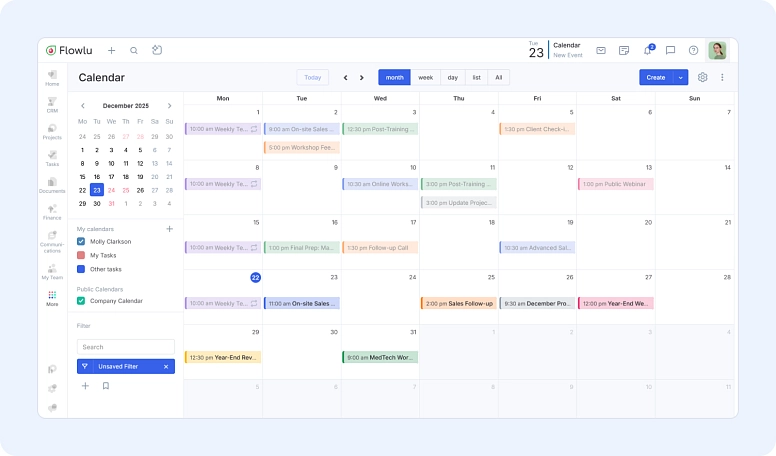
The color-coded calendar quickly became the feature the team turned to most. What used to be a manual process is now one simple overview of all training events, deadlines, and meetings.
From one screen, they can see what needs attention now, what is coming up, and how each project fits into the week. This single change removed a significant amount of repeated administrative work.
Project delivery with fewer moving parts
Project workflows added structure to multistep training programs. Once tasks were easier to track and the team could coordinate without extra steps, project timelines shortened. They now deliver programs about 10 to 15 percent faster.
Sales information stored in one place
Sales pipelines brought all leads, conversations, and follow-ups into one place. With contacts and notes organized, the team noticed fewer misunderstandings and a reduction of roughly 25 percent in repeated communication.
Less time spent on manual work
Centralized information and visual task overviews helped reduce manual work across the team. They now spend 20 to 30 percent less time on administrative tasks.
The CEO, sales team, project managers, and external partners all work in Flowlu every day. With everyone working from the same structure, alignment improved naturally, and the team no longer needs as many check-ins to stay coordinated.
Results at a glance
30% less time spent on administrative work
15% faster delivery of training projects
25% fewer internal follow-ups
All tasks and deadlines visible in one place
One shared workspace for the entire team
The tools they use most in Flowlu
The team uses several Flowlu modules every day.
The color-coded calendar is now where the team checks their day first, because it gives them a quick sense of the day ahead.
Sales pipelines keep all client conversations in one place and make follow-ups easier to handle.
Project workflows guide each stage of training delivery.
Dashboards and reports provide quick status updates without extra manual work.
Together, these tools give the team a complete view of both sales activity and training projects without switching between different systems.
Flowlu became our place to see events, deadlines, and tasks with a single look. The calendar is the feature we use every day. It helps us stay organized and manage our schedule much more efficiently.
Danijel BićanicOwner of Bićanić Consulting
The outcome
Flowlu now supports the structure behind Bićanić Consulting’s expanding training operations. Now that admin work takes less time and coordination is easier, the Bićanić Consulting team can concentrate on delivering strong training programs.
At Flowlu, we’re certain that any team still relying on spreadsheets can gain the same sense of order and visibility. Flowlu tools give teams a clearer, more organized way to manage scheduling, projects, and sales. You can also try every feature free for seven days and see for yourself how it works for your team.