




Team Building Games and Corporate Activities for Office, Remote, and Hybrid Teams


Quick answer
When employees hear that a manager is planning a game, they almost always react negatively. First, it gets associated with something awkward. Second, people feel obligated to join something they didn't ask for. A good leader knows how to put those doubts to rest and turn corporate team-building activities into something that actually works.
When done right, games close the gap between colleagues, establish psychological safety, and break down silos.
Other advantages that work well for both the company and the team include:
- Conflict resolution
- Increased productivity
- Employee engagement and retention
- Skills development
But while it's usually simpler for office staff, what do you do when working with remote or hybrid ones? We'll show you how to pull it off for anyone.

How to choose the right corporate team-building activities
The first thing you need to do is actually study the games you're considering. They should be fun but have a purpose behind them. Here are 7 things to consider:
1. The goal
Decide what you're aiming for and what the purpose of the activity is.
For example, you may be looking to improve active listening or communication.
2. The group size
Not every activity scales the same way. Most of them depend on the number of people involved.
Something that works great for 10 people may fall flat with a company of 50.
The right collaboration tool, like Flowlu, can help you manage and engage teams of any size, whether you're working with 2 employees or 50.
3. The time
Timing matters too.
Shorter activities usually run up to 30 minutes and are perfect as openers at the start of a session. The more effective ones typically take between 2 and 4 hours. It’s long enough to work on a specific goal properly.
4. The location
Team building activities for work don't have to take place at the office, even if you're reinforcing company culture. Managers often default to in-office simply because it's cheaper. But off-site works too. A new setting naturally levels the playing field and breaks down hierarchies.
For remote or hybrid teams, go with a digital platform. To make the experience feel more tangible, consider sending a physical kit to attendees or ask them to prepare one themselves.
5. Energy level
Different office team-building games require different levels of physical and emotional involvement. Depending on your goal, think about energy level:
- Low: tends to reduce social anxiety. Examples: food tours, painting sessions, board game cafes.
- Medium: more mental than physical effort. Examples: museum tours, escape rooms, trivia.
- High: great for competitive groups, but riskier. Examples: outdoor survival challenges, sports tournaments, and go-karting.
6. Inclusivity
People are different. Some are up for anything; others aren't—whether that's down to personality or any other factor that might prevent them from fully participating.
If you go with a high-energy activity and several employees aren't comfortable with it, you've already missed the point. Make sure whatever you choose genuinely works for everyone.
7. Budget
Not every idea is easy to pull off without a real budget.
Be honest about how much you can afford to spend per person.
Team building games for work
Quick icebreakers

When you need to shift energy, introduce new hires, or open a meeting, these are your go-to options.
Try: "Two Truths and a Lie"
Each person writes two true facts and one believable lie about themselves. They read all three aloud, and the group has to spot the lie.
Problem-solving games
These work well for improving critical thinking and pushing against creative constraints.
Try: The Marshmallow Challenge
Each group gets a marshmallow, some raw spaghetti, and a few other materials. The goal is to build the tallest freestanding structure with the marshmallow on top and keep it standing for 10 seconds.
Collaboration challenges
Great when you want to strengthen active listening, trust, and communication between teammates.
Try: The Blind Drawing Challenge
Pairs sit back-to-back. Person 1 has a hidden, complex drawing. Person 2 has a blank sheet and a marker. Person 1 describes the image without naming what it is; person 2 draws it from the description alone.
Remote and hybrid team building activities
With remote team building games, the screen is your main constraint. But modern tools make it easy to create a smooth, connected digital experience. And that concern largely disappears once you've run one well.
Fast virtual games

Great for virtual happy hours or meeting openers. Keep it under 45 minutes.
Try: Desert Island
How to: The host gives everyone a prompt: "You're stranded on a desert island with one chance to survive. You have 1 minute to grab 5 items within arm's reach and show them to the camera." Once everyone reveals their survival kit, the group votes on who'd last the longest.
Low-stress asynchronous activities
Perfect team bonding activities for remote teams spread across time zones. No live meeting required.
Try: Collaborative Playlist
How to: Create a shared playlist on Spotify or YouTube Music and drop a new theme in the chat each week. Name it something like "Energizing morning anthems." Everyone adds their picks throughout the week.
Immersive online workshops
A great way to mark milestones or celebrate team wins virtually.
Try: virtual activities like a live crafting session, mixology class, or similar.
How to: Hire a vendor (a cocktail maker, for example) who ships each team member a kit with ingredients ahead of time. On the day, the vendor guides everyone through it live on camera.
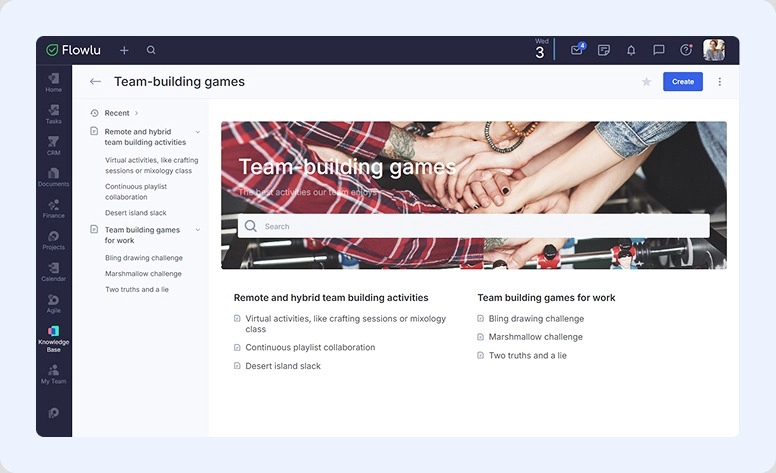
To keep track of all these activities and save the most successful ones, build your own library. Write them up in your Knowledge Base and let colleagues add reviews and new ideas. In Flowlu, you can set up exactly that kind of wiki.
How to run activities without making them awkward
#1. Facilitation
A lot of people feel uncertain and aren't sure how to behave. Before the event starts, make it clear that participation isn't mandatory and show colleagues it's actually going to be worth their time.
#2. Pitfalls to avoid
- Surprise scheduling: Never run something that wasn't announced in advance.
- Forced personal oversharing: Keep questions professional, not personal. Avoid prompts like "Share a life-altering childhood moment" or "What is your biggest fear?"
- Skipping the why: If participants don't understand the purpose of the event, it does nothing for morale and becomes a waste of everyone's time.
#3. Run a pre-event checklist
- The activity doesn't exclude anyone physically
- Food and drinks cover all dietary restrictions
- You've personally tested the tech setup
- The time box is defined and a visual timer is in place
- You have a 5–10 minute buffer for people to get connected
#4. Measure engagement
Whether you're running office games, remote activities, or hybrid ones, make sure you can actually measure how it landed.
Don't rely on surveys alone. Look for behaviors that signal engagement more directly: how people interact with colleagues from other departments afterward, whether the activity comes up in Slack, or similar signs.
Watch for low engagement signals:
- People give short answers just to pass the mic
- Everyone heads out the moment the clock hits
- In a virtual setting, one person turns off their camera, and others follow
Keep engagement going
More and more companies are investing in team building activities for work—and for good reason: they get results. It doesn't matter whether your employees are in the office or spread across time zones. That's never a reason to skip them; if anything, it's a reason to be more intentional about them.
The right activity strengthens teamwork, boosts employee engagement, and makes the day-to-day feel a little more human. It doesn't have to be expensive or on-site. It might take a couple of hours, or it might take a full day.
Your job as a leader is to show that while participation isn't mandatory, it's worth showing up for. These are the moments that make work feel human and keep the environment healthy.

FAQ
It depends on how much time you have and what you're trying to achieve. All good ones are simple to set up and low-stakes.
Good starting points:
- The icebreaker "Two Truths and a Lie"
- The problem-solving "Marshmallow Challenge"
- The team-focused "Blind Drawing Challenge."
It depends on the activity, the number of participants, and the goal. A solid icebreaker can work in 30 minutes. More involved activities typically run 2–4 hours.
Go fully digital. Even if some colleagues are on-site. Factor in different time zones and locations. The activity should work for everyone, not just those who can join live.
Yes, but only when they're planned carefully and have a clear purpose that participants actually understand.