



Agile and Scrum Definitions Every Project Team Should Know


Quick answer
While a lot of people tend to use Agile and Scrum as synonyms, the truth is that they are different concepts: the first can be seen more like a philosophical mindset, and the second one—like a tactical approach.
Today we will take a closer look at them and also touch on Scrumban, which is often seen as a hybrid.
Definitions
What Agile means in project work
This mindset becomes more popular every day. It helps you deal with changes and uncertainty besides being especially focused on continuous improvement. Some of the other principles it includes are flexibility, collaboration, and delivering value to the customer incrementally.
The goal of this methodology isn’t to predict every detail but to prioritize:
- Customer collaboration over contract negotiation
- Individuals and over processes
- Responding to change over following a rigid plan
- Working on deliverables over comprehensive documentation.
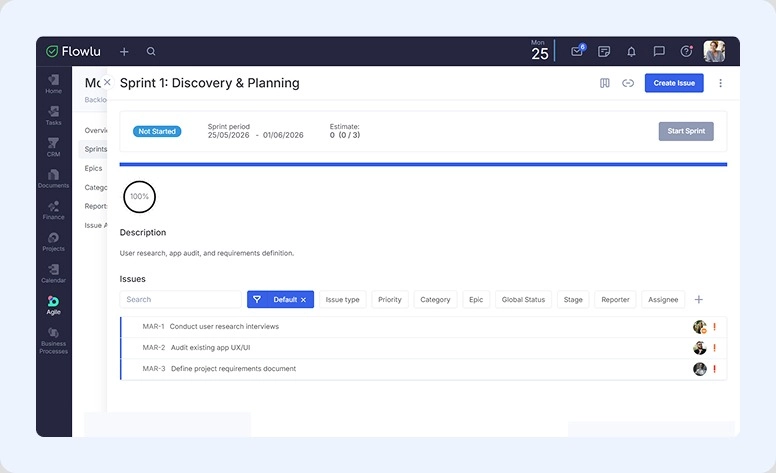
In Flowlu, you can create your first project for an Agile team. Enable the dedicated module, create a project, customize the workflow or use a standard one, and start your first sprint. Test if your team feels comfortable when working in a new, more flexible environment.

How to define Scrum in Agile methodology
If you look at the first as the philosophy, then you may define Scrum methodology as something that puts it into action.
It’s a lightweight system that is very structured and is convenient to put key principles into action by using:
Roles
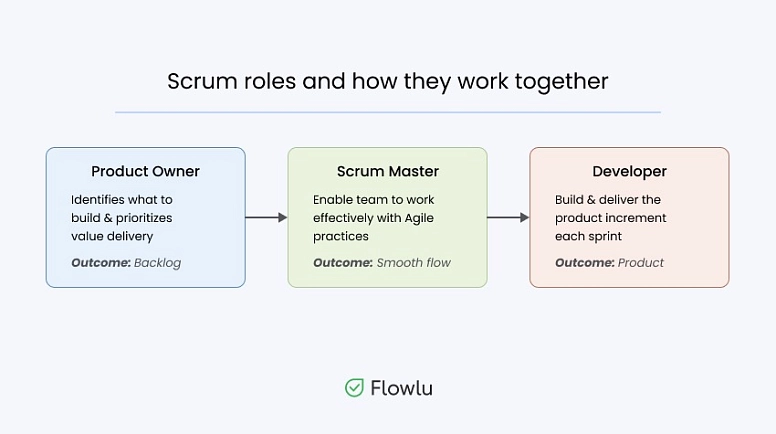
There are 3 of them:
- Product owner
- Scrum master
- Developers
Ceremonies
This method works in repeating cycles, or sprints. They usually last between 1 and 4 weeks.
Each work cycle includes four main ceremonies, also known as events:
- Planning
- Daily Scrum
- Sprint review
- Retrospective
Artifacts
- Product backlog
- Sprint backlog
- Increment
Why both concepts are not synonymous
The first is the methodology that is composed of principles. Then, the second puts these principles into practice. Therefore, both concepts should never be used interchangeably.
Core Scrum terms and roles
To make sure that you run a team successfully, you need to speak the same language. Use precise terminology and know all the defined roles.
Terminology
-
Sprint cycles: They are used by the team to build a usable product increment.
Cycles repeat one after the other, without gaps. -
User stories (value descriptions): There are no technical documents. Instead, specialists use the user story, which is the way these teams have to capture the end-user’s perspective. Instead of focusing on the tool that is being built, the company focuses on the value that is being delivered.
-
Product backlog: This is an ordered list of everything that the product needs, from the user story to bug fixes and even non-functional requirements. The product owner constantly prioritizes this list.
-
Sprint backlog: These are some of the tasks selected from the overall project task list that the team commits to completing within the current work period.
-
Capacity constraints: This is the total work that is performed by a team during one single work cycle.
-
Definition of done (DoD): You’ll need to use a formal checklist to make sure that the item passes the quality tests. Only then is it considered to be done.
Roles
#1. The product owner
Main goal: Maximize the value of the product.
Responsibilities:
- Taking care of the product task list and prioritizing assignments
- Ensuring the team works on the most valuable operation first
- Accepting or rejecting the final work.
#2. The scrum master
Main goal: The team needs to understand and act under the key principles.
Responsibilities:
- Eliminating any blockers or impediments that slow the team down
- Facilitate ceremonies
- Coach self-management and cross-functionality to the team
- Protecting the team from external distractions and scope creep.
This person plays a key role in the SDLC (systems development life cycle) by helping the team follow Agile practices, remove blockers, and keep development processes running smoothly.
#3. The developers
Main goal: Make sure that planned work turns into a usable product.
Responsibilities:
- Building the task list
- Holding themselves accountable for delivering the commitment
- Ensuring that all the work complies with the DoD
- Adapting their plan daily to meet the goal.
How Scrum works in practice
The complete cycle in action
Each one contains 4 specific ceremonies:
Ceremony #1. Planning
At the beginning of the iteration, the product owner shares the priority items of the product backlog with the team so that they can discuss these items’ scope and determine what they can really deliver.
The list that contains specific tasks. Employees should complete them within the following 1 to 4 weeks. The second part is the goal. It is represented as one sentence that explains the business value they promise to deliver.
Ceremony #2. The daily
This is a quick meeting that only takes 15 minutes each day. In this check-in, developers say what they did the day before, what they’ll do today, and if they have any constraints.
An updated board and a daily plan.
Ceremony #3. The review
This ceremony occurs when a phase ends, and it includes a live demonstration of the product. The main goal is to have stakeholders see the product working and deliver immediate feedback.
An updated task list based on stakeholder feedback and any market changes identified during the demonstration.
Ceremony #4. The retrospective
Between the cycles, the product owner, the master, and the developers have a quick meeting to discuss what went well or wrong, and also look for process bottlenecks in the work that just ended.
A continuous improvement action plan with changes that can be implemented in the very next stage.
Practical estimation: story points & planning poker
Project management estimates are never easy because we are terrible at judging time, and it can become subjective. For this reason, this methodology opted to use relative estimation using story points.
With this change, the main question also transforms. Instead of asking, “How long will this activity take?” the team asks, “How complex, big, or risky is this task compared with the standard or baseline task?”
And the answer is also different; it’s given in Fibonacci numbers ($1, 2, 3, 5, 8, 13, 21$) to reflect that the larger the scoop is, the more uncertainty it carries.
Measuring progress: velocity tracking
Velocity can be calculated when some iterations are completed, and it simply reflects the average number of story points that a team managed to turn into done work in each stage.
Estimates vs binding commitments
One of the things that makes the system different is the way it looks at estimates.
It doesn’t consider an estimate as a binding contract since this would lead teams to skipping quality assurance testing and cutting corners just to hit the estimate.
Instead, the team is always trying to achieve the goal, leaving the task estimate flexible. This also uses the help of both the product owner, who may remove a non-critical item from the current work, and the master, who may help employees adapt.
Agile vs Scrum vs Scrumban
How two first differ
While the first has a set of principles established that need to be followed, it doesn’t really tell you what to do exactly. This is what the Scrum framework does using a structured blueprint.
What Scrumban is
It stands somewhat in the middle of both methodologies. It’s a project management framework that combines structured planning with the continuous workflow approach of Kanban.
When teams use it
#1. In maintenance and support projects
When a company deals with planned feature development and unexpected production bugs at the same time, the chosen system won’t simply work. However, when you’re using Scrumban, you’ll be able to use this methodology to absorb any urgent tickets in a more dynamic way. This happens without affecting the commitment.
#2. When they are overwhelmed by ceremonies
When specialists become exhausted from constant reviews, estimations, and planning, this approach can help by giving teams a more visual way to organize their work.
When Scrum helps and when it does not
It delivers high value
- It allows you to build, test, and pivot incrementally → make sure you see what users prefer.
- Regular feedback is mandatory → prepare a prototype working in front of end-users.
- A complete team is involved → employees won’t be pulled to other projects.
Two cases when it fails (what to use instead)
#1. The work is unpredictable or interrupt
An example: Your IT team keeps getting new support tickets and needs to handle server maintenance. That makes it difficult to plan work in fixed iterations.
Solution: Opt for the Scrumban.
#2. The requirements are fixed and well-understood
An example: You have a project that doesn’t have any “unknown” element.
Solution: Go with the Waterfall framework. It’s the best one to handle products with no changes and where predictability and sequence are paramount.
Choose the right approach
In today’s world, there isn’t really a solution that you can apply to all your projects. As we’ve seen throughout this article, with two frameworks you can either deliver a more flexible mindset or a more structured one. However, it is this stickiness that allows you to put the key principles into action.
Notice that none of these methodologies can cure any friction, lack of communication, or unclear ownership. However, they all can bring these problems to light earlier, improving the work environment and the actual success of the company at the same time. Focused on continuous improvement, teams can finally build a culture of execution.
If you’ve still never used flexible methodology, you can find special digital platforms that guide you and help to create your first workflow. For example, Flowlu offers a robust module where you can clearly understand how to plan sprints, fill in a backlog with tasks, set priority, and monitor completion on the project board.
Try new dedicated tools and start managing your projects with high visibility and flexibility.

FAQ
The first is a unique mindset that brings flexibility. The second is a more rigid framework that puts principles of a previous methodology into practice.
If you’re looking for an agile scrum definition, it’s a framework that helps teams manage projects through short work cycles. The method is also defined by the roles and feedback loops.
It’s a fixed iteration (1 and 4 weeks) during which teams work on the selected operations. Throughout the project, one cycle is always in progress.