




Construction Cost and Risk Management: Practical Controls for Project Teams

Quick answer
When a project slips in terms of budget, you can't assume there was only one cause. It's usually a combination of things, including:
- labor gaps that weren't accounted for
- change orders that weren't tracked
- minor site delays that end up costing significantly more
To deal with cost control in construction, you need to be more than an expert—you need to be rigorous and proactive. Today, we're sharing practical controls for project teams on construction cost and risk management.
Why construction projects go over budget
Experience shows that construction projects are rarely finished on budget. These failures represent millions of dollars in losses.
Many people assume the problem is bad planning, but practice reveals three main underlying causes:
#1. Change orders & scope creep
Planning construction operations is relatively straightforward. But when execution begins, reality enters the picture.
It's normal to deal with many change orders—formal requests to modify the original scope. Some are necessary. But others aren't.
On top of that, you'll need to manage scope creep: doing more work than what was originally agreed, without adjusting the budget to match. While some scope creep is inevitable, it pays to stay vigilant.
Effective budget tracking makes both aspects easier to manage with the right system. In Flowlu, all project elements—tasks, documents, and finances—are connected. When you log an adjustment, it updates in real time and notifies assigned team members immediately.

#2. Material costs & labor shortages
One of the things that makes this work so difficult is that costs must be projected across years, not just months, based on assumptions that are hard to verify.
Prices are always changing, and you have no control over it.
Think of copper, concrete, or steel—all common materials in the industry. Their prices are influenced by many factors: inflation, geopolitical events, and supply chain disruptions.
Then there's labor. Unlike many other industries, construction doesn't have an abundance of candidates lining up for open positions. It's genuinely hard to find masons, plumbers, and electricians. That means you may need to pay a premium to get them on-site. And when you can't find them or can't meet their rates, work gets delayed.
Strong procurement practices are one of the most effective ways to manage this. Locking in subcontractors and materials early through formal agreements limits your exposure to price swings down the line.
#3. Weather delays & approval bottlenecks
Equipment rentals, financing interest, insurance, and supervisor salaries are all paid by the day—which means you need to maximize output every single day. But you can't control the weather. And its impact goes beyond lost work hours: storms can destroy completed work and make the site unsafe.
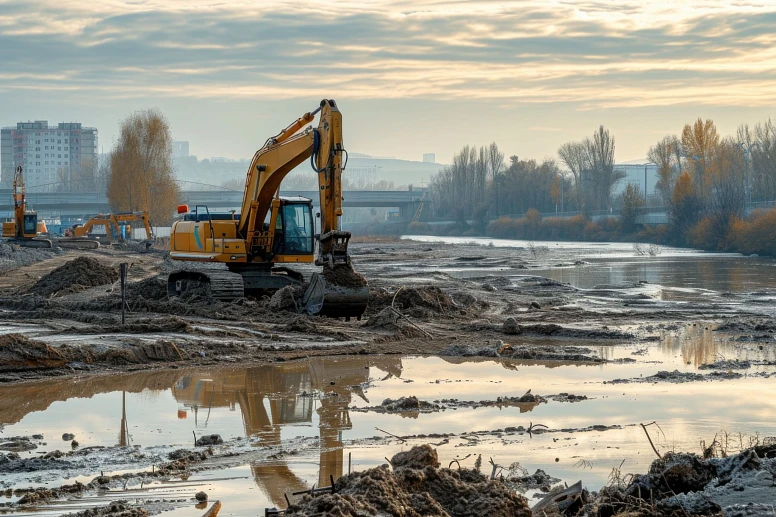
Then there's the bureaucracy. Approvals are often held up by local governments, leading to delays of weeks or even months. With thorough documentation and good planning, though, you can significantly reduce that exposure.
Construction cost management basics
The main goal here is to narrow the gap between expectations and reality.
As mentioned above, many costs are determined by assumptions. So you can't predict everything that will affect material and labor prices. But you do need solid construction cost management controls in place to track all spending.
1. Estimates
Produced during the planning stage, an estimate covers what you expect all equipment and materials to cost.
If you don't have a dedicated tool for writing estimates, try a free generator from Flowlu.
2. Budgets
Once the bid is accepted, your estimate is locked. This is the maximum you've agreed to spend on the job.
3. Cost codes
One of the best things you can do is adopt the CSI MasterFormat. This is the standard method for categorizing and tracking expenses.
4. Purchase orders
A purchase order is a contract you send to vendors that specifies the quantities, types, and prices of products and services. These are committed costs, so make sure your manager doesn't duplicate charges.
5. Actual costs
These are real-time expenditures: rented equipment receipts, paid invoices from lumberyards, processed payroll.
6. Forecasting
Go beyond just comparing estimates and expenses. Financial forecasting lets you see exactly how much you've spent so far, and what it will realistically cost to complete the work.
7. Contingency planning
Expect the unexpected in construction. That's why you need backup plans for different scenarios—a percentage of the budget set aside from the start, typically ranging from 5 to 15%. Consider two types:
- Contractor contingency: For labor inefficiencies, minor material waste, and execution errors.
- Owner contingency: For scope changes.
Construction risk management process
In construction risk management, you have to be proactive, not reactive. It's not about eliminating every risk — that's not realistic in this industry. It's about knowing what to do when something hits the fan.
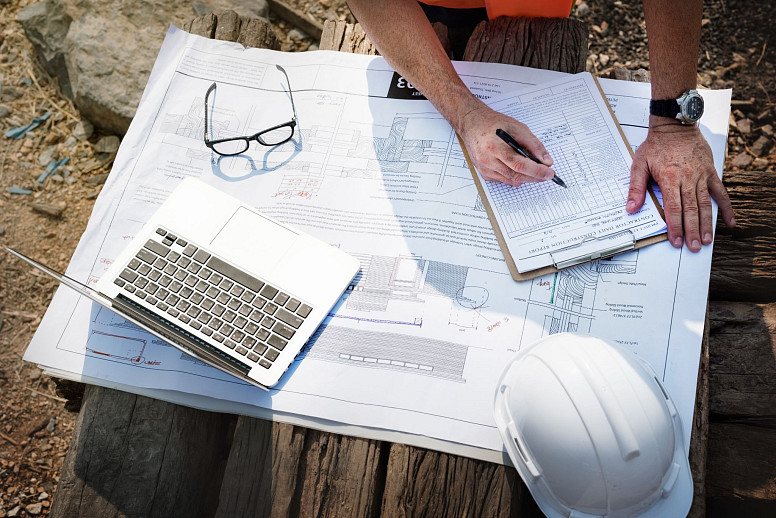
Whenever the construction site faces a crisis, the team follows a plan that looks like this:
Step #1: Risk identification and documentation
You can't mitigate a threat you haven't anticipated. Keep in mind that risks are already present in pre-construction and carry through to the end of the project.
Gather all stakeholders (managers, architects, engineers, and key subcontractors), identify the risks, and divide them into four categories: financial/legal, logistical, socio-environmental, and technical.
At this stage, it's standard practice to build a risk register. This is a living document that scores each threat by likelihood and severity, and serves as a foundation for all your risk documentation going forward.
Step #2: Risk owners & mitigation strategies
Every identified risk needs an owner. This is the person responsible for monitoring that threat and executing the response.
Once you've assigned ownership, the team agrees on one of four core mitigation strategies:
- Avoidance: Change the project detail entirely to eliminate the threat.
- Mitigation: Take proactive steps to reduce the likelihood of the threat.
- Transfer: Pass the financial impact of the threat to a third party.
- Acceptance: Acknowledge the exposure and set aside funds to cover it if it occurs.
Step #3: Monitoring & escalation procedures
A risk register is only useful if you keep it current.
Track it continuously so risk owners can watch for triggers—early warning signs of emerging problems. As soon as an issue crosses the threshold you've set, execute your escalation procedures.
Tools, checklists, and final recommendations
To keep everything in one place (spending data, budget tracking, cash flow projections, and risk documentation) you need reliable software.
When picking a platform, look for these features:
Interconnected architecture
A good tool lets you see tasks, financial data, and client records in the same place. This keeps your team informed and ensures nothing falls through the cracks.
Granular financial tracking
The system needs to support both estimated and actual costs so you can compare them directly. It should also support cost coding or offer custom tracking fields.
Invoicing & estimates
Check whether you can convert a won estimate into an invoice with a single click.
External client portals
The software should let stakeholders see work status to help prevent scope creep. Strong management solutions don't just share progress — they also secure approvals and log changes faster.
Cost control checklist
Run through this at major stages of your project to keep construction project cost control on track:
#1. Preconstruction
- Lock baselines: Convert the final accepted bid into a fixed budget (your construction capital management baseline) and hold it from start to finish.
- Tag cost codes: Assign a tracking code to every expected line item before the job starts. Include labor, concrete, and permits.
#2. Construction
- Purchase orders: Require these for all materials to lock in committed costs before invoices arrive.
- Weekly audits: Review actual expenditures against your construction budget management baseline on a weekly basis.
- Formal change orders: Make sure all requests are signed off in writing. Never just verbal.
#3. Closeout
Compare the final numbers against your initial estimates. This analysis is valuable documentation for future projects. It becomes your reference point for better forecasting next time.
Use Flowlu as a construction control center
Although Flowlu is known as flexible, general-purpose business management software, it works well for construction projects too. Its interconnected structure makes document management much easier. You can organize construction operations and keep a close eye on your finances all in one place.
With Flowlu, you have
Tasks & procedure workflows
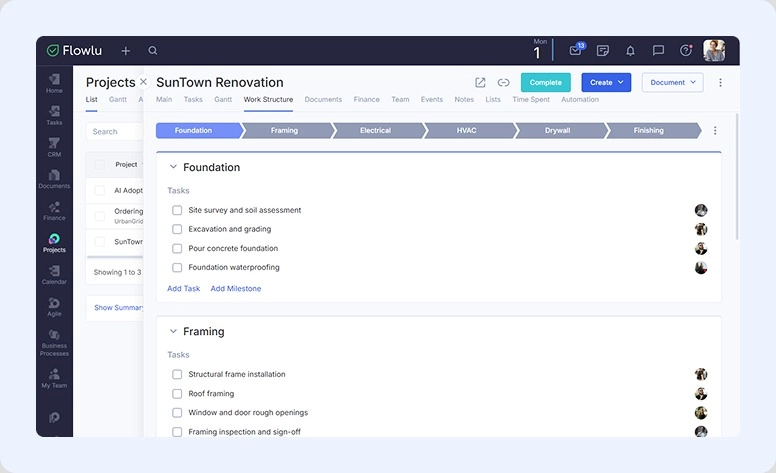
Build your own project workflows and use them as templates. Map out each phase, make sure milestones are hit in sequence, add custom fields, use time tracking, and set automatic dependencies between tasks.
For example, for a residential renovation, you might create a workflow template with phases: foundation → framing → electrical → plumbing → HVAC → drywall → finishing. Set it up so electrical can't start until framing is signed off, and plumbing can't begin until electrical is done.
Real-time financial visibility
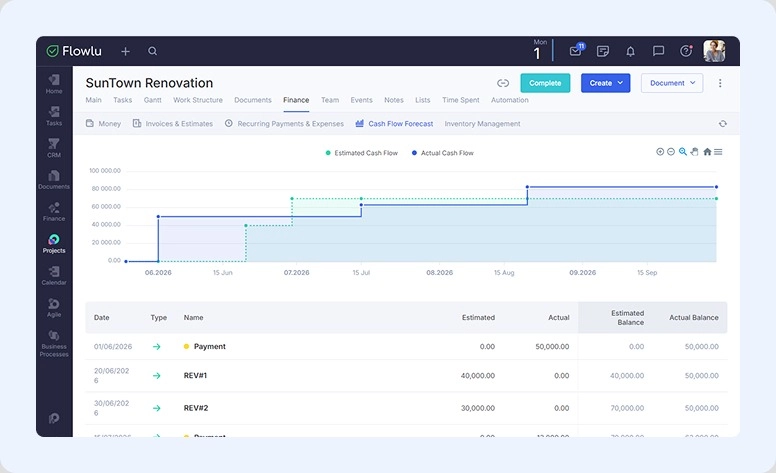
Flowlu's project cash flow forecast helps you plan expected revenue and spot gaps before they become problems. The tool generates dynamic charts based on your input, showing exactly where cash flow issues may occur.
Unified documents
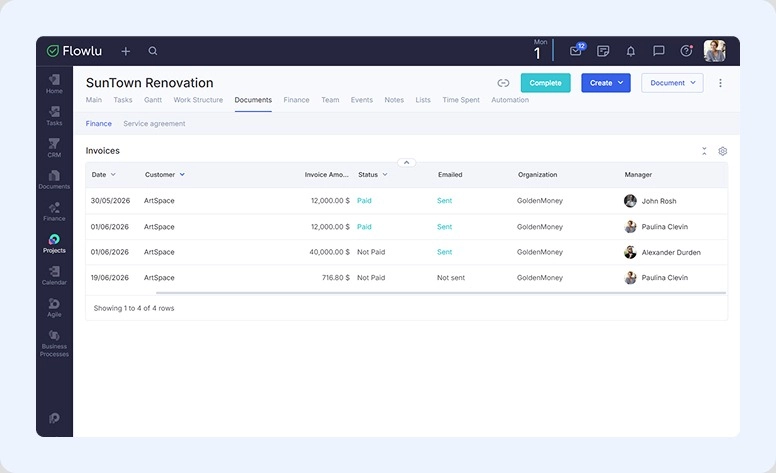
Keep all documents (estimates, specifications, and bills of quantities) in one place, tied directly to the project. Access them from a single tab without jumping between systems or digging through emails.
Build Smart, Not Just Fast
Construction cost management and construction project risk management aren't optional—they're your safety net.
Make sure your company survives every contract it wins. Move from guesswork to purchase orders, strict cost codes, and live financial forecasts. Turn your risk register from a static document into a living tool. And use a platform like Flowlu to keep all your data in one place.
You can't avoid every surprise. But you can certainly prevent financial ruin.

FAQ
Construction cost management is a process that begins before construction starts and ends when the job is done. It means monitoring all materials, equipment, labor, subcontractors, overhead costs, and reserve funds.
To practice sound construction capital management, teams establish a baseline, control procurement through strict purchase orders to lock in committed costs, enforce formal change order management, and set aside contingency funds for unforeseen expenses.
It should include a risk ID and category, description and root cause, likelihood and severity scores, risk owner, and mitigation strategy.
Absolutely. Software is invaluable for effective construction budget management and keeping scope creep under control.