



Scrum vs Kanban vs Agile: Key Differences and How to Choose

Quick answer
There's no question that Agile is one of the most used methodologies nowadays. The main reason is that it is fast to adapt to changes, making it a strong fit. After all, it continues to be the standard in terms of collaboration.
However, to put this into practice, you also need to understand the difference between Scrum and Kanban. And although both are included in Agile methodology, the first is based on sprints, while the second on flow.
Look closer, and it's clear why all three concepts aren't the same thing.
And how Flowlu helps teams implement these best practices effectively.

What Agile, Scrum, and Kanban mean
Understanding the definitions and why a lot of people continue to look at these as similar concepts is a very important step. From here, you'll determine the framework that suits your setup best.
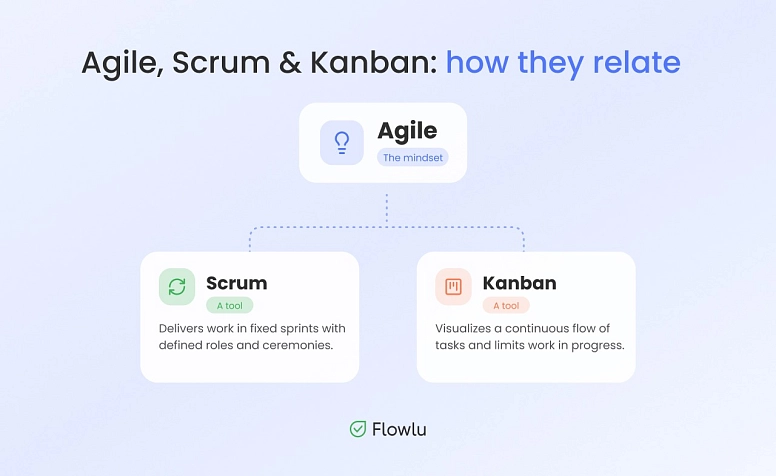
To make things easier, you can see the agile vs scrum vs kanban relationship as a diagram where Agile stays on top and is considered the mindset. It is then divided into two of the most popular frameworks that can be used to meet that mindset: Scrum and Kanban.
The definitions
#1: Agile
As we just mentioned, it refers to the mindset, to a methodology, to a set of values. It's not a tool or software you can use.
This appeared back in the beginning of this century as a strong opponent of the Waterfall methodology.
Its 4 main agile principles are:
- People and their relationships are more important than processes and tools.
- Working software is prioritized over comprehensive documentation.
- Customer collaboration comes first over contract negotiation.
- Responding to change over following a plan.
#2: Scrum
When people think of Agile they automatically recall Scrum. Not surprisingly, because it is the most popular framework to put this philosophy into action. It is a very structured one and it was specifically designed to be used with complex projects.
Scrum works in a simple way. Work is divided into fixed-length periods called iterations. These usually last between 2 and 4 weeks and as soon as one ends, a new one begins. At the end of that period, everyone gathers for a review or ceremony to deliver a working part of the build.
If you want well-organized work, stick to consistent sprint length.
This framework has 3 specific elements:
- Scrum roles
- Ceremonies or meetings
- Rule
As for the roles, there are 3 main ones:
- Product owner
- Scrum master
- Developers
There are 4 meetings or ceremonies:
- Sprint planning
- Daily standups
- Sprint review
- Sprint retrospective
And the rule is pretty simple: as soon as one sprint cycle starts, you cannot add new work or change its goal. To do so, you'll need to wait for the next iteration.
#3: Kanban
From the Japanese "card" or "visual sign", this is a more visual approach based on the Agile methodology. Instead of being structured like the previous one, it is more flexible, relying on continuous flow.
With this framework, the process supports continuous delivery. So, as soon as one task is completed, another one starts; there are no timed iterations.
Kanban also has 3 key elements:
- Board
- WIP limits
- Flexibility
As for the first one, it is where you can visualize the work divided into labeled lanes. These columns refer to the activities that haven't started yet, the items currently being worked on, and the operations that are already completed.
Work-in-progress caps are simple limitations to the number of tasks in each column. This prevents multitasking, as members need to finish older items first before taking on new ones.
Finally, there is a lot of flexibility. It is perfectly possible to add a top priority task to the top of the queue at any time.
It's very handy to manage work with the Kanban board. Use special digital tools for that. For example, the Flowlu Kanban board is a flexible project view option with quick editing features.
The relationship
As we already mentioned above, Agile is the main methodology. But two of the most popular ways to apply it are Scrum and Kanban. If you prefer a more structured workflow, you should pick Scrum. On the other hand, if you're a more visual manager, you should go with Kanban.
When looking at the kanban vs scrum differences, there are many — but you may certainly mix both frameworks and use a hybrid approach.
Scrum vs Kanban: main differences
|
Scrum |
Kanban |
|
| Cadence(how work is seen and done) |
The work is divided into fixed sprint cycles. Although these go one by one, the work isn't continuous. There is always a short break in which meetings or ceremonies occur. |
The work is continuous. |
| Roles |
Very well defined (the master, who coaches the process, the product owner, who manages the backlog, and the developers, or the team). |
There aren't any strict roles here because it is a lot more flexible. |
| Boards |
Always changing because in each sprint, there is a new list of things to be completed. |
Never erased. The tasks simply move from one column to the next according to the stage where the project currently is. |
| Planning |
There is always a planning session to map out the initiative in detail. Participants discuss the product backlog, the estimated time, and the resources needed. |
It never stops. People simply look at the priorities and pull the most important ones to be completed first. |
| Work in progress (WIP) limits |
Always determined by time, but indirectly. The team decides what they need to do during one iteration only. |
Only determined by column caps. Each lane will have a limit that cannot be passed until one moves to the next. |
| Change flexibility |
As it's a rigid framework, it has fixed periods to complete the tasks and there shouldn't be any change in priorities or new user stories added in the middle of a sprint. |
On the other hand, it is incredibly flexible. Imagine that a client has an urgent request. In this setting, the product manager will immediately put this request at the top of the list for the developers to handle. |
| Metrics |
One of the metrics used is velocity. This measures the number of tasks considered done in each iteration. |
Uses two different metrics: cycle time and lead time. It evaluates the time it took from a request to the deliverable, and the time it took from when the work began to when it was finished. |
Agile vs Scrum vs Kanban by use case
Understanding the difference between agile and scrum (as well as how both compare to Kanban) becomes clearest when you map each to a real-world scenario. This agile framework comparison covers the five most common use cases.
#1: Product developement
When you're dealing with a product development project such as UX design, hardware, or software, you should prefer Scrum.
These projects are usually complex and need a lot of collaboration, making this framework perfect.
Everyone will know exactly what to do and what their priorities are. They won't be interrupted or called to handle other work, ensuring delivery on time.
#2: Support
When you're looking to improve customer service or IT support, you should go with Kanban.
You never know when your services will be needed or what you'll need to do exactly; they're mainly reactive, meaning that a very structured framework like Scrum wouldn't work well in this case.
#3: Marketing
For marketing teams, a hybrid framework is what works best. If you think about it for a second, it makes perfect sense.
It is normal that when you're creating a marketing campaign, you'll have plenty of interruptions. Just think of a sudden event that requires you to issue a press release, for example.
So, Scrum is just too rigid for this. But why not use Kanban? Well, Kanban may be way too flexible when you need to come up with an entire product launch campaign, for example.
#4: Operations
For operations like legal, finance, human resources, and similar, you should pick Kanban.
They usually involve different requests that need to be handled continuously over time, plus unexpected internal ones.
#5: Mixed teams
Many mid-sized companies usually have mixed teams. But what exactly are they? Simply put, they are teams that take care of different work streams at the same time.
For example, they may need to continue doing maintenance and support while building a new product at the same time.
For these companies, the best approach is a combined method.
You need Scrum's structure to deliver the new product on time, but also Kanban's flexibility to keep support and maintenance running in parallel.
How to choose and combine methods
While you may be thinking that you need to decide between several approaches, on more occasions than you imagine, you'll opt for a hybrid framework. Looking at the scrum vs kanban trade-offs, both are great for many projects, but Scrumban is ideal for work that needs structure mixed with easy execution.
The difference between agile and scrum is also worth clarifying here: Agile is the overarching set of agile principles and values, while Scrum is one specific framework built on top of it. Knowing this distinction helps you pick the right approach from the start. And when comparing scrum vs kanban, the core question is always whether your group needs fixed cycles or continuous workflow.
Scrumban overview
It ends up being a mix of both. From the first it takes the structure, especially the roles, the optional cycles, and meetings to ensure that everything is done. From the second, you'll get the visual boards with column caps already in place.
Risks during adoption
The most common traps are:
#1: ScrumBut (“Fake Scrum”)
This happens when you start by only having the meetings or ceremonies but you completely neglect the rules.
For example, if people don't brainstorm over what happened during the previous cycle.
#2: No WIP limits (“Lazy Kanban”)
This trap occurs when you treat it as just a bunch of columns. This will certainly lead to multitasking and tasks piling up — exactly what you're trying to avoid.
#3: The overhead tax
This happens when ceremonies become too heavy or long.
For example, while there are 4 ceremonies included, they don't need to take a long time or else you'll be spending more time discussing than actually working.
Quick checklist: what’s best for you
- If you have clear goals broken into sprints of 2 to 4 weeks → Scrum.
- If you expect unpredictable requests that require immediate action → Kanban.
- If you need daily maintenance along with long-term project milestones → Scrumban.
- If you need to deal with half-completed projects and multitasking → Kanban with strict WIP.
- If your team has a complex structure or needs other departments → Scrum.
Structure your workplace In Flowlu
Flowlu is a great tool that you should be using no matter the framework you choose for your projects. With its simple but highly customizable interface, it will be incredibly easy to set up your process for either Scrum, Kanban, the hybrid approach:
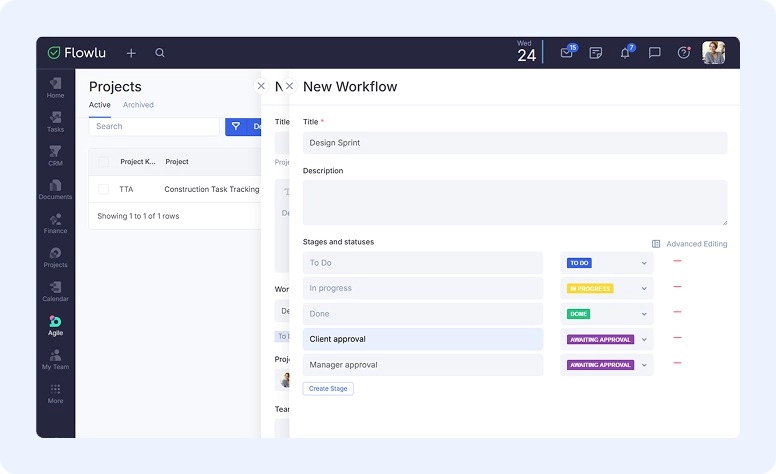
#1: Scrum: create a custom multi-stage sprint workflow
For example, apart from the standard 4 stages you can add your own, like "Client approval," and monitor how many issues are already ready to be tested by final users.
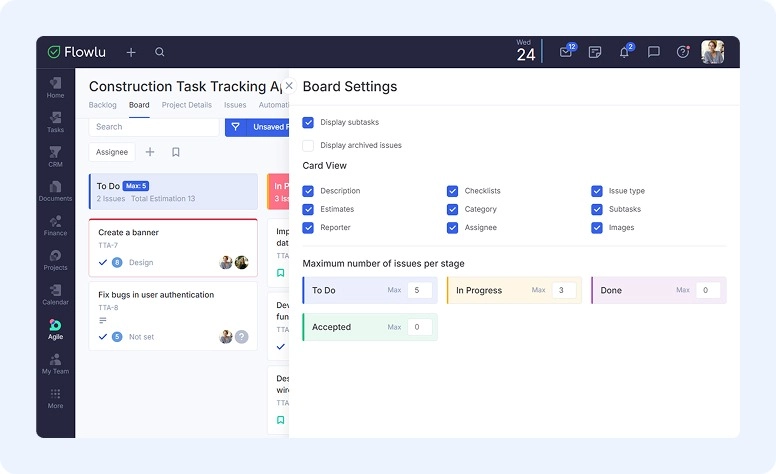
#2: Kanban: manage WIP limits
You can easily label the columns you need to use for your project and set the respective limits for each one.
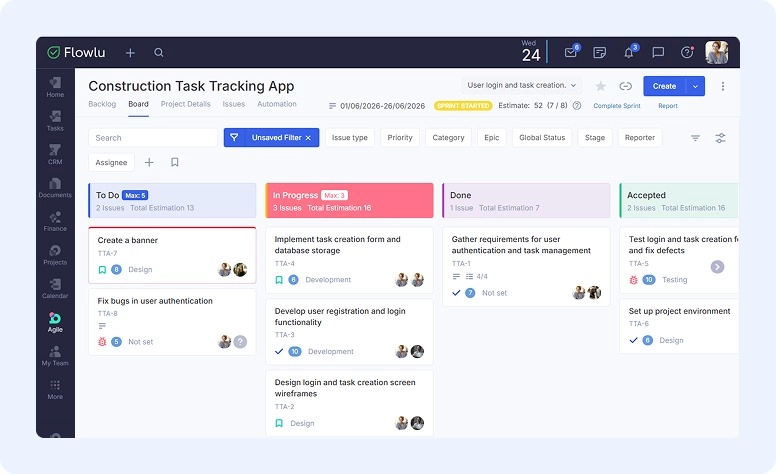
#3: Combined method: control all the steps on a visual board
After creating cycles, filling the queue, setting limits, estimations, and priorities, you can monitor how all issues are progressing on a flexible visual board while still respecting work-in-progress caps and cycle rules.
Final thoughts
The truth is that there is no right or wrong framework. There is no best one for all projects, or a worst one either. Your goal is to determine what your team needs, the project requirements, and decide based on each framework's characteristics.
Fortunately, you don't only have Kanban and Scrum to choose from. There are also other types like Scrumban that combine elements of both. And the right tool, like Flowlu, to manage it all.

FAQ
Yes, Kanban is one of the frameworks that is based on Agile.
The first works in fixed sprint cycles with defined roles and locked scope. The second is continuous — no sprints, no mandatory roles, new work can be added anytime. One gives structure, the other gives flexibility.
Choosing one or the other implies looking at the project itself and your team.
Yes, not only can these frameworks be combined, they usually are, resulting in hybrid frameworks like Scrumban.
Whenever you need to constantly reprioritize, you should avoid Scrum