



Lean vs Agile: Meaning, Principles, and Usage

Quick answer
Even though you may be used to listening or reading about Agile and Lean terms interchangeably, the truth is that they’re completely different terms and methodologies.
The main idea of Lean is to reduce waste and improve flow. The Agile framework delivers customer value iteratively through feedback and adaptation.
So today, we decided to give you a more in-depth overview of both and explain what they mean, their principles, and how they're used.
What Lean and Agile mean
The Lean methodology
Simply put, when talking about Lean, we are referring to a methodology whose goal is waste reduction so that the flow can be optimized. If an activity doesn’t bring value to the organization or to the customer, it needs to be eliminated since it is considered waste.
This approach began in Japan, at Toyota, to be more precise. It was later popularized in the mid-90s with the book Lean Thinking by James Womack and Daniel Jones.
The core goals the authors identified:
-
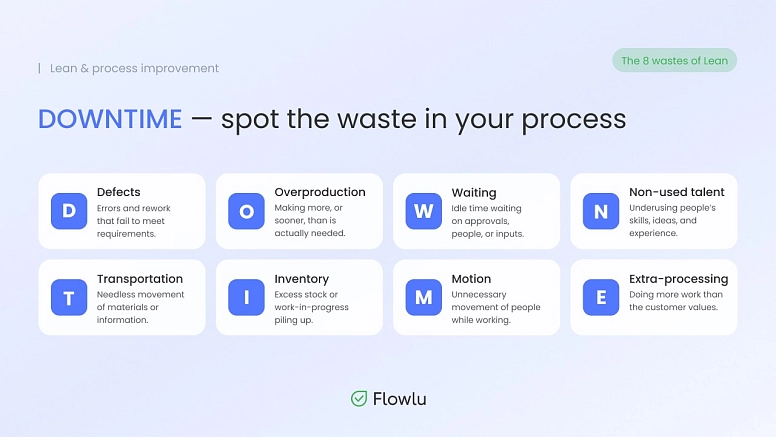
Waste elimination: According to this framework, you need to consistently look for and eliminate the 7 wastes.
The amount of 7 is correct for the traditional Toyota model (muda). Although, many modern Lean frameworks now cite 8 — they add "unused skills/talent," from the DOWNTIME acronym.
-
Whole optimization: Lean focuses on the whole system, not specific tasks. The whole thing needs to be constantly improved.
-
Build quality in: Any mistakes that are discovered should be fixed so defects don't appear later in the flow.
From this, you can say the ultimate goal of Lean project management is figuring out whether you're actually building the item more efficiently. This is done by eliminating both bottlenecks and waste to keep the overall flow running smoothly.
The Agile methodology
Talking about agile, we mean embracing change so that adaptability can happen quickly.
This framework focuses on both responsiveness and flexibility. It looks at how small teams can collaborate to build simple and complex things alike, in situations where changes may occur rapidly and unexpectedly.
Agile was only defined this century — in 2001, to be exact — through the Agile Manifesto, written by 17 software developers. This document includes 12 Agile core principles and 4 core values.
The main goals proclaimed:
- Regularly deliver working pieces: The customer should get small, working pieces every week or two, not wait months for them.
- Continuous feedback loop: You need to ask for feedback regularly, since this is what allows you to keep adapting the piece to get the desired outcome.
- People over processes: Teams are always more important than processes. This means you should trust your teams to make their own decisions.
In sum, the main goal of Agile is to figure out whether you're building the right item for the customer. This is done by handling change and uncertainty in small blocks.
If you haven't worked with Agile before, a tool built specifically for it makes the transition much easier. Flowlu, for example, comes with a prebuilt Agile module with elements for sprints, issues, WIP limits, estimations, and more — its intuitive interface helps you dive into Agile in practice without a steep learning curve.
Lean vs Agile: key differences
Even though both share a similar purpose — delivering customer value quickly — the reality is that they use different mechanisms to solve this problem.
Simply put, while Lean focuses on making sure the process is smooth, Agile is more oriented toward the destination — it tries to sort out problems as soon as they're discovered.
|
Criteria |
Lean |
Agile |
|
Core principles |
|
|
|
Planning approach |
Based on the concept Last Responsible Moment: irreversible decisions are only made once you have enough data to prevent rework. |
Occurs in fixed-length cycles: the team is responsible for planning the next cycle, but they know requirements can change at any time and stay ready to adapt. |
|
Delivery |
The flow is continuous. There are no batches or stops, and features are released as soon as they're ready. |
Small time increments (usually 2 weeks). The team decides which features to work on for the next cycle, works on them during the cycle, and delivers a working part of the product by the end. |
|
Metrics |
|
|
|
Team practices |
Teams tend to use Kanban boards or other visual tools since these let them see where bottlenecks are occurring and where waste needs to be eliminated. |
More structured approach. It includes ceremonies (essentially meetings) and specific roles within the team. |
|
Customer feedback |
Collected upfront |
Collected throughout the entire process, so the team can keep adapting the product until it's what the customer wants |
How Lean project management works
Under lean management, you'll need to change your focus. Start looking at the entire system, not just each task individually. More than working fast, it's important that your team works well — and to do that, they'll remove any friction that appears along the way.
To fully understand how this approach works, we'll need to look at the 4 core lean principles:
#1: Value stream
In the Lean, it is impossible to optimize what you can’t see. This means that the first thing you’ll need to do in this kind of project is to create a VSM (Value Stream Map) to visualize the journey.
To build this map, the team needs to add all touchpoints, handoffs, and approvals.
This journey includes 2 different things:
- The Value-Adding time, which is the time the team may need to design a layout or write a code.
- The Non-Value-Adding time, which refers to the time the design or the code is waiting to be reviewed.
In the Lean methodology, the need of eliminating the Non-Value-Adding time is always present.
#2: Waste reduction (Muda)
As soon as the VSM is determined, the team will immediately start looking for waste.
By this logic, anything that consumes effort, time, or budget without adding value to the product counts as waste.
There are 3 different types of waste:
- Muda: Includes defects, overproduction, transportation, waiting, motion, overprocessing, and inventory.
- Mura: This refers to spikes in the workload, where teams are working more than they can in one week and almost doing nothing in the next one.
- Muri: This refers to teams or systems being pushed beyond 100%, which then leads to delays and mistakes.
#3: Continuous improvement
Lean project management is never actually completed, because there’s always something that can be improved. Specialists don’t wait for a failure in the project; they keep making small adjustments on a weekly basis. This continuous improvement is based on Kaizen — a Japanese concept centered on making small, ongoing changes across the whole organization.
#4: Flow efficiency
While traditional project management tends to rely on resource efficiency, that's not how lean sees it. In fact, if everyone is always occupied with something, there won't be anyone available to detect mistakes or handle unexpected issues.
Flow efficiency refers to focusing on the progress of a single piece of work from beginning to end. To ensure this process optimization, lean applies 2 different mechanisms:
- Pull instead of push: No one pushes a task onto anyone. When an employee finishes an operation, he is perfectly capable of pulling the next high-priority task to do.
- Limiting work in progress (WIP): In this framework, there’s always a limit on the number of tasks that can be “in progress” at the same time. This keeps the whole team focused on "stop starting, start finishing."
When to use Lean, Agile, or both
Prefer Lean when:
The process is the main problem. Even though you may be perfectly aware of the end goal, the reality is that the problem is always in the pipeline (bottleneck or waste).
Examples:
- Continuous IT service delivery, hardware assembly, or manufacturing — in general, any project with highly structured or repetitive operations.
- When you need to improve delivery speed. Your team knows exactly what needs to be done, but they still need months instead of weeks to deliver, because of internal bottlenecks or simply because it takes too long to get the necessary approvals.
- Mature products that need their support ticket queue cleared and their costs reduced.
Prefer Agile when:
The product is the main problem. When you're dealing with an ambiguous, volatile, or complex environment, you should use Agile.
Examples:
- When you need creative marketing campaigns, custom software applications, or startups — basically, anything centered on launching a brand-new product.
- When requirements are constantly evolving or can't be defined upfront because the customer needs to see a prototype first.
- When your industry, consumer trends, or customer needs are changing fast, sometimes week to week.
Prefer both (hybrid model) when:
You need scale and adaptability at the same time. More and more companies are looking at this kind of hybrid model, using Agile to discover what they'll be building next and Lean metrics to make sure development goes as smoothly as possible.
The best example is companies scaling their software.
The risks of misapplication
Choosing the wrong methodology for your project can be a costly mistake:
#1: When you use Agile on high-volume, stable projects
Applying Agile principles built for constant iteration to repetitive, predictable work isn't a good idea. After all, if the process rarely changes, most of the ceremonies and check-ins just add overhead without adding much value.
#2: When you use Lean on new creative work
Lean is about cutting anything that doesn't add value, but in projects like this, time spent on creative R&D (research & development) can get mistaken for that. As you can imagine, that leaves little room for experimentation or creativity.
Lean vs Agile checklist
Whenever you're in doubt about choosing Agile or Lean as the best methodology for your project, just follow this checklist:
#1: The final product is already clearly defined and shouldn't require any radical changes.
"Yes" → go with Lean.
#2: The main delays are due to internal questions.
"Yes" → go with Lean.
#3: You need constant feedback from the customer.
"Yes" → go with Agile.
#4: The workflow depends directly on team collaboration.
"Yes" → go with Agile.
How to gain workflow visibility with the right tools
No matter which methodology you choose for your project, it's important to keep in mind that software like Flowlu can make a real difference in seeing what you're managing.
To give you a simple example: if your project requires Agile, Flowlu can help you start sprints, manage your backlogs, track progress milestones, and even organize collaboration in a centralized workspace.
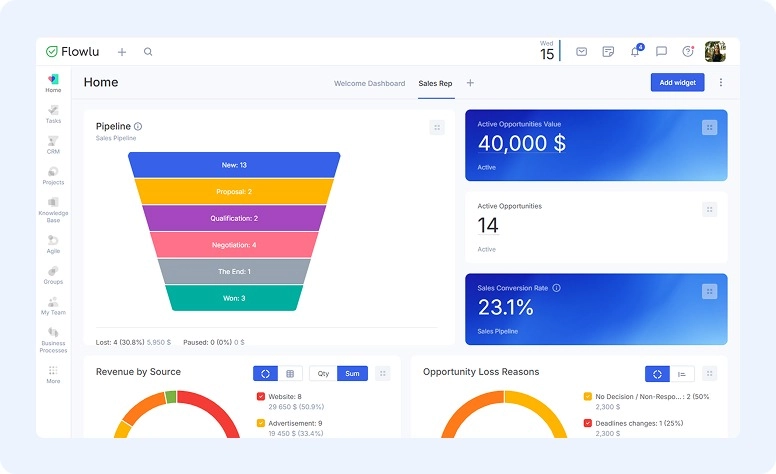
If your project requires Lean, you can create opportunities in the CRM module and visualize your pipeline through dashboards — great for spotting bottlenecks and hidden queues.
Wrap up
There's no question that choosing between Agile and Lean isn't easy, and neither methodology is better than the other. You need to take the time to look at the project in hand and determine the best approach for it.
When you opt for Lean, you'll be focused on eliminating the bottlenecks and inefficiencies that keep projects from being delivered on time. When you choose Agile, you'll be more focused on market and industry changes, and making sure your team has the ability to adapt to them.
FAQ
While many people continue to confuse Lean and Agile, the main difference between the two is their focus. Lean centers on the process itself and its efficiency, while Agile is more concerned with strong team collaboration and continuous feedback.
No, they're different methodologies.
It involves 4 main:
- Waste reduction
- Mapping the value stream
- Flow efficiency
- Continuous improvement
Yes, without any problem. This is why we mentioned a hybrid methodology above, where you can use Lean to make sure progress goes smoothly and Agile to figure out what the team will build next.